
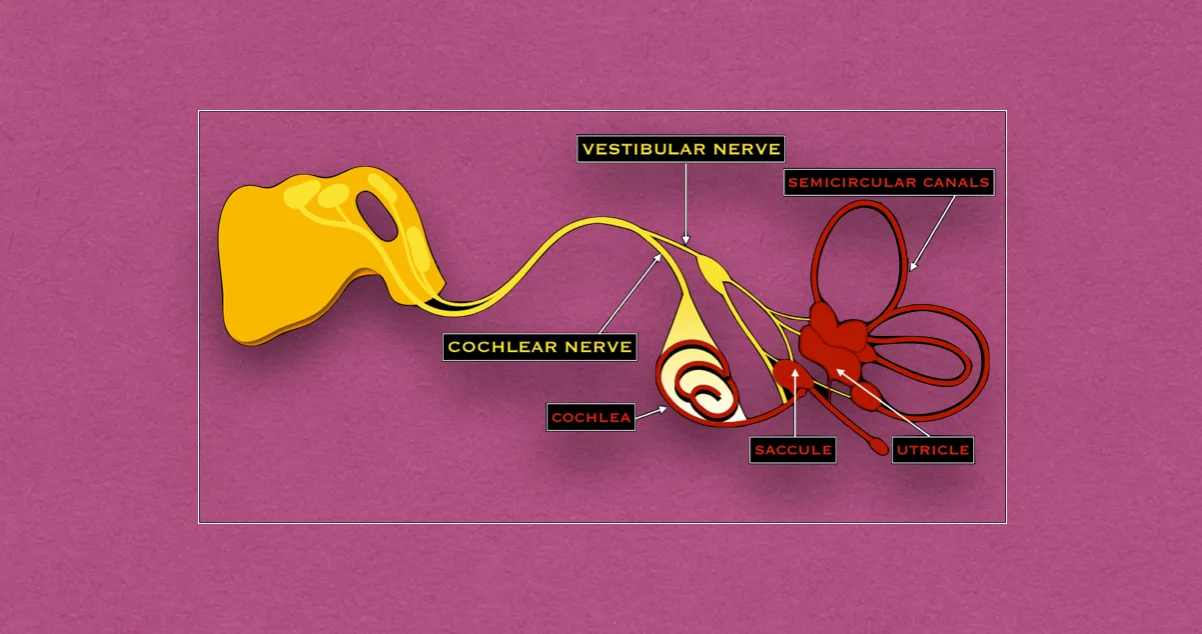
It is the 8th cranial nerve, that consists of two parts, a vestibular part and a cochlear part. The vestibular part/nerve is concerned with the maintenance of equilibrium, while the cochlear nerve is concerned with hearing.
Functional Components
It consist of special somatic afferent fibres, that carry sensory information necessary for the maintenance of equilibrium and hearing from the membranous labyrinth of the internal ear.
- Fibres carrying sensory information for equilibrium terminate in the vestibular nuclei within the brainstem.
- Fibres carrying sensory information for hearing terminate in the dorsal and ventral cochlear nuclei, located on the dorsal and ventral aspects of the inferior cerebellar peduncle respectively.
Anatomy & Pathway
Vestibular Nerve
- Arises from the lateral aspect of the pontomedullary junction and passes through the pontocerebellar angle.
- It enters the internal acoustic meatus along with the facial nerve and labyrinthine vessels.
- Vestibular ganglion (Scarpa's ganglion) is located on the vestibular nerve in the lateral part of the internal acoustic meatus. It consists of bipolar sensory neurons.
- In the lateral part of the internal acoustic meatus, the nerve divides into three distinct branches: superior and inferior divisions and singular nerve.
- These branches pass through the foramina in the fundus of the meatus and innervate the sensory receptors for equilibrium (cristae ampullaris and maculae) in the membranous labyrinth of the internal ear.
Cochlear Nerve
- Arises from the lateral aspect of the pontomedullary junction and takes a similar course to enter the internal acoustic meatus.
- At the medial end of the meatus, it enters into bony labyrinth of the middle ear through tractus spiralis foraminosus in the fundus of the meatus and reaches the modiolus of the internal ear.
- In the modiolus, the cochlear nerve consists of a sensory ganglion called the spiral ganglion made of bipolar neurons. The peripheral process of these neurons innervates the sensory receptor of hearing i.e., the Organ of Corti.
Clinical Significance
The lesions of vestibulocochlear nerve clinically present as:
- Tinnitus (ringing or buzzing in ears).
- Impairment or loss of hearing.
- Vertigo (loss of balance).
Acoustic Neuroma
- One of the common intracranial tumors that arises from the sheath cells of the vestibular nerve fibres in the cerebellopontine angle region.
- If large, it may involve the adjacent trigeminal, facial and glossopharyngeal nerves and may compress cerebellum and medulla.
References
| [](https://amzn.to/3Ixnict)
Textbook of Anatomy Head, Neck, and Brain (Volume III), Vishram Singh |
- The image used is licensed under the Creative Commons Attribution 4.0 International license. (Source: Romano, N., Federici, M. & Castaldi A. Imaging of cranial nerves: a pictorial overview. Insights Imaging 10, 33 (2019). https://doi.org/10.1186/s13244-019-0719-5.)
*This article is an excerpt from the above mentioned sources and Medical Sutras does not make any ownership or affiliation claims.