
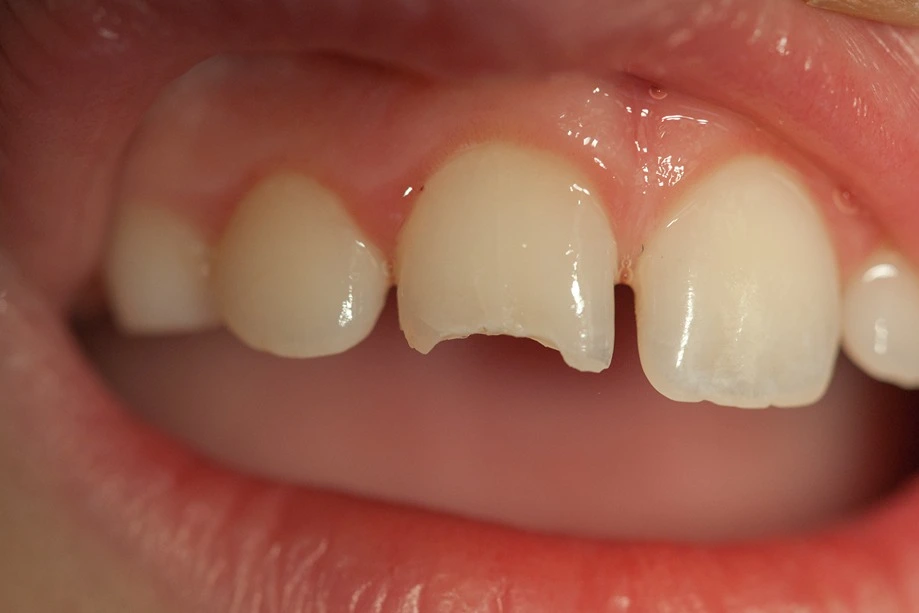
In Ellis Class I fracture, there is fracture of the enamel only, while, Ellis Class II fracture involves fracture of enamel and dentin (without pulp exposure).
The treatment modalities are almost same depending on the extent of fracture and recovery of the fractured tooth fragment.
Ellis Class I Fracture (Enamel Fracture)
Recontouring
- Recommended when the enamel fracture is minimal, without any substantial loss of tooth structure.
- It involves selective reduction or smoothening of the rough, jagged tooth surface, while maintaining aesthetics.
- Fluoride varnish can also be applied to prevent sensitivity.
- The patient should be re-examined at 2 weeks and after 1 month for any untoward changes.
Restoration
- Recommended when the shape or extent of the fracture precludes recontouring.
- It involves restoration of the missing tooth structure with composite restoration using an acid-etch technique.
- The tooth is kept under observation.
- Radiographs and vitality tests are to be repeated after 6-10 weeks.
Ellis Class II fracture (Enamel and Dentin Fracture)
Fracture involving enamel and dentin can lead to pulpal hyperemia and trauma to the pulp due to pressure and exposure to thermal, chemical or microbial irritants. Hence, the primary objective is to prevent any injury to the dental pulp by adequate coverage of the exposed dentin.
Reattachment of tooth fragment (Fragment restoration)
- It is recommended when the fractured tooth segment remains intact and is recovered after injury.
- The fragment can be reattached using resin and bonding techniques
Restoration
-
Traditional approach: Calcium hydroxide base, with acid-etch composite restoration. However, calcium hydroxide dissolves over time and have softening effect on composite restoration.
-
Recommended technique: Application of Glass Ionomer cement to the deepest aspect of exposed dentin. This is followed by a dentin bonding agent and composite restoration.
- Glass ionomer cement: Does not require acid-etching, forms chemical bond with the tooth, is hydrophilic and has good biocompatibility.
- Dentin bonding agent: Maximizes the bonding area and minimizes gap formation between the restoration and tooth surface, so that a hermetic seal can be formed.
Temporary Crowns
- Indicated when there is extensive fracture, fracture is close to the gingival margin (difficult to isolate for composite restoration) and in horizontal fracture requiring high strength of restoration.
Points to Note
- Enamel infraction in anterior teeth are usually limited to enamel and stop at the dentino-enamel junction. However, in posterior teeth, it is often implicated in the cracked tooth syndrome and involves enamel, dentin and cementum.
- As a rule, enamel infraction do not require any treatment. However, in case of multiple infarction lines, it is recommended to seal the enamel surface with unfilled resin and acid etch technique (as the lines may take up stain from different food items such as tea, coffee, etc.).
- Dentin thickness of 2 mm is needed for pulp protection.
- Fragment restoration or restoration with composite is normally preferred over temporary crown because they are aesthetically superior, less traumatic and provides better marginal seal (temporary crowns have potential risk of leakage).
- The hydrophilic nature of GIC helps it to adhere with the newly exposed dentin that have an outward flow of dentinal fluid.
References
- Andreasen J., Andreasen F., Andersson L. (Editors) - Textbook and Color Atlas of Traumatic Injuries to the Teeth (4th Editon) - Blackwell Munksgaard. https://amzn.to/49gYG2L
- McDonald and Avery's Dentistry for the Child and Adolescent (11th Edition) -Mosby (2021). https://amzn.to/3vZh9m7
- Arathi Rao - Principles and Practice of Pedodontics (3rd Edition) - Jaypee Brothers Medical Publishers (P) Ltd. https://amzn.to/498Y8fy
- The image used is made available under the Creative Commons CC0 1.0 Universal Public Domain Dedication.
*This article is an excerpt from the above mentioned books and Medical Sutras does not make any ownership or affiliation claims.