
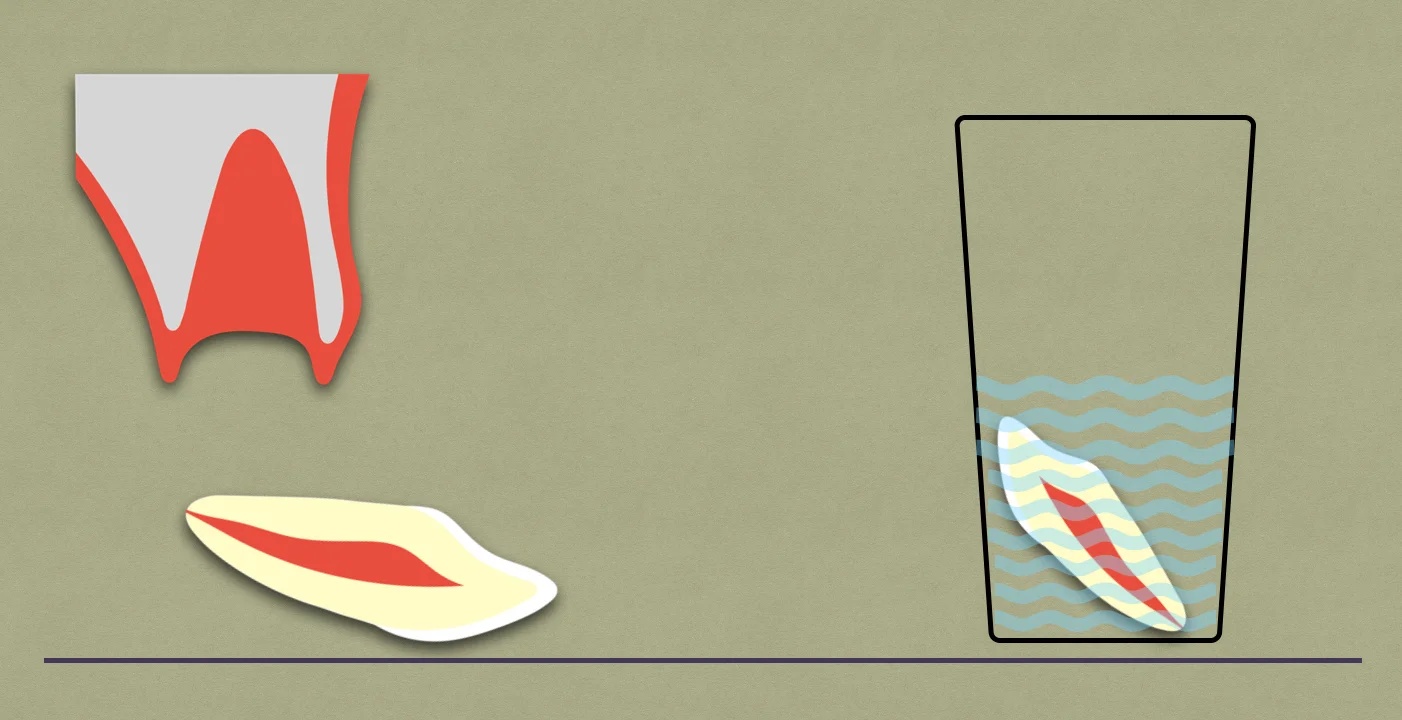
Transport media is basically a storage media to keep an avulsed tooth safe and preserve the vitality of remaining PDL cells, until the tooth is replanted.
Ideally, an avulsed tooth should be replanted immediately (within 5 minutes) as this allows the prompt return of PDL cells to normal function. With an increase in extraoral dry time the PDL fibres gets compromised (desiccated) and can become non-viable.
- After 15 minutes of dry storage, the precursor, progenitor or stem cells are not able to differentiate into fibroblasts.
- After 30 minutes of dry storage, virtually all of the remaining PDL cells are likely to become necrotic.
However, it is not always possible to replant an avulsed tooth immediately due to lack of awareness and unavailability of dental facility in close proximity to the site of injury.
Ideal Requirements
An ideal transport/storage media should:
- Be easily available, economical and have a good shelf life.
- Have physiological pH and osmolality, similar to body fluids i.e. pH 7.2-7.4 and osmolality 290-300 mOsm/kg.
- Have antimicrobial action.
- Be able to maintain the viability of periodontal fibers for an acceptable period of time and help in restoring depleted PDL cells.
- Have anti-inflammatory properties and be capable of reducing post-replantation root resorption or ankylosis.
- Minimise adherence of osteoclasts to the PDL fibres.
- Have antioxidant property to prevent cell damage due to oxidative stress (free radicals).
- Be capable to wash off extraneous material and toxic waste products.
- Be effective in different climatic and other conditions.
- Not react with body fluids or produce any antigen-antibody reaction.
Types
The transport media can be grouped as natural and synthetic media.
Natural Transport Media
- Tap water, Saliva, Milk, Egg white, Propolis, Coconut Water, Green tea extract, etc.
Synthetic Transport Media
- Saline, Hank's balanced salt solution, ViaSpan, Eagle's minimum essential medium, Gatorade, Ricetral, Contact lens solution, etc.
Hank's Balanced Salt Solution (HBBS)
HBSS is a sterile, physiologically balanced isotonic standard salt solution, widely used in biomedical research to support the growth of many cell types.
Composition
| **Content** | **Quantity** |
|---|---|
| Sodium chloride | 8 g/L |
| D-glucose | 0.4 g/L |
| Potassium chloride | 0.4 g/L |
| Sodium bicarbonate | 0.35 g/L |
| Sodium phosphate | 0.09 g/L |
| Potassium phosphate | 0.14 g/L |
| Calcium chloride | 0.14 g/L |
| Magnesium chloride | 0.1 g/L |
| Magnesium sulphate | 0.1 g/L |
Advantages
- Nontoxic.
- pH 7.2 and osmolality 320 mOsm/kg, making it biocompatible with PDL cells.
- Contain nutrients that can sustain and reconstitute the depleted cellular components of the PDL cells.
- Excellent efficacy.
- Long shelf life, no refrigeration required.
- Suitable to store avulsed tooth, even when the extra-alveolar period is extensive (72-96 hours).
Disadvantages
- Not easily available and expensive.
Recommendation
The American Association of Endodontists recommends the use of HBSS as the storage medium of choice for treatment of avulsed teeth because of its ability to provide long-term preservation of PDL cell viability.
Milk
Milk is considered 2nd or 3rd best transport media for avulsed teeth after ViaSpan and/or HBSS, according to the International Association of Dental Traumatology and the American Academy of Pediatric Dentistry.
Advantages
- Isotonic.
- Approximately neutral pH (6.5-7.2) and physiological osmolality (270 mOsm/kg) compatible to those of PDL cells.
- Contains growth factors and essential nutrients such as amino acids, carbohydrates, and vitamins.
- The epithelial growth factor (EGF) present in milk stimulates proliferation and regeneration of epithelial cell rests of Malassez and activates alveolar bone resorption. This ultimately contributes to isolation of bone tissue from the tooth and decreases the chance of ankylosis.
- Excellent efficacy.
- Easily available.
- Lekic et al demonstrated that milk was as effective as HBSS for storing avulsed teeth for up to 1 hour and superior to saline, saliva or water.
Disadvantages
- Presence of bacterial contents, however, pasteurisation reduces bacteria.
- Loses its effectiveness after 2 hours (due to climatic conditions).
- Antigens in milk can interfere with PDL reattachment. It need to be fresh and refrigerated. Sour milk is harmful to the PDL cells and revival of damaged cells is not possible.
Recommendation
Milk is widely recommended for storing avulsed teeth to be replanted, for upto 2-3 hours, due to its beneficial effects and characteristics and its ease of access at the moment of trauma.
Also, it is important that milk is used in the first 20 minutes after avulsion.
Saline
Normal saline consists of 0.90% w/v of sodium chloride (NaCl).
Advantages
- Physiological pH (7) and osmolality (280 mOsm/kg).
- Compatible to the PDL cells.
- Available at every medical store.
Disadvantages
- Lacks essential nutrients, such as magnesium, calcium and glucose (fundamental to the normal metabolic needs of PDL cells).
- Poor efficacy.
Recommendation
Saline is not an adequate medium, as it is potentially damaging to the PDL cells, if the tooth is stored for longer period of time. It can be used for storage of avulsed tooth for short-period (about 2 hours) when:
- Other media are not immediately available.
- Required for a short period of time.
Saliva
Saliva (buccal vestibule) can be used as an interim storage media and some authors considered it as the best immediate transport media for an avulsed tooth.
Advantages
- Immediately available.
- Produces 1/3rd less cell damage than dry storage or storage in tap water.
Disadvantages
- Microbial contamination.
- Very poor efficacy, can cause approximately twice as much damage as HBSS or milk.
- Hypotonic with non-physiological pH (6.3).
- Osmolality (60-70 mOsm/kg) is much lower than physiologic, which can cause swelling and damage to the membrane of PDL cells.
Recommendation
Saliva can be used for a short period of time, less than 30 minutes, in cases where:
- Extra-alveolar time is less.
- Other superior storage media are not available.
Water
Tap water is readily available; however, it has very poor efficacy due to bacterial contamination, hypotonicity, and non-physiological pH, and osmolality.
Advantages
- Easily available.
- Prevents tooth dehydration.
Disadvantages
- Microbial contamination.
- Hypotonic, osmolality 30 mOsm/kg. It leads to cellular swelling and lysis of remaining PDL cells.
- Non-physiological pH 7.4 - 7.9.
- Very poor efficacy.
Recommendations
Water is the least desirable media and is recommended only to avoid tooth dehydration. It should be used for very brief periods, only in situations where no alternative media is available.
Points to Note
- The prognosis of replanted tooth depends on the viability of the PDL cells remaining on the root surface, integrity of root cementum, and minimal bacterial contamination, which are directly related to the extra-alveolar time, type of storage after avulsion, and root surface alterations.
- Osmolality refers to the concentration of osmotically active particles (such as ions, glucose, and urea) in a solution.
- Physiological osmolality specifically refers to the osmolality of body fluids (e.g., blood, urine, and interstitial fluid) under normal physiological conditions.
- Isotonic solution has the same osmotic pressure as another solution or a reference solution (such as blood plasma). Isotonic fluids generally have an osmolality in the range of 270 to 310 mOsm/L.
- In the context of cell biology, an isotonic solution has the same solute concentration as the cells. When a cell is placed in an isotonic solution, there is no net movement of water across the cell membrane.
References
-
Recent Advances in Transport Medium for Avulsed Tooth: A Review Venugopal, Malini https://journals.lww.com/amjm/fulltext/2022/18020/recent_advances_in_transport_medium_for_avulsed.1.aspx
-
Clinical and Practical Implications of Storage Media used for Tooth Avulsion
Vineet IS Khinda, Gurpreet Kaur, Gurlal S Brar, Shiminder Kallar, and Heena Khurana https://www.ncbi.nlm.nih.gov/pmc/articles/PMC5571385/
*This article is an excerpt from the above mentioned sources and Medical Sutras does not make any ownership or affiliation claims.