
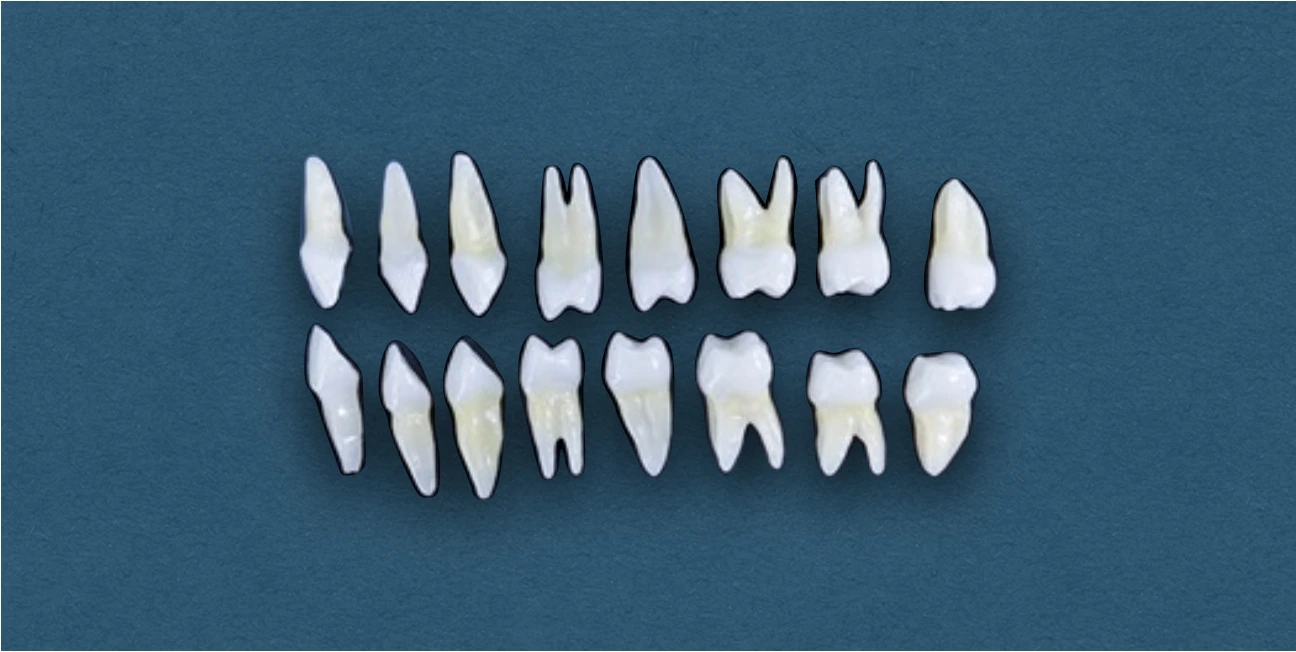
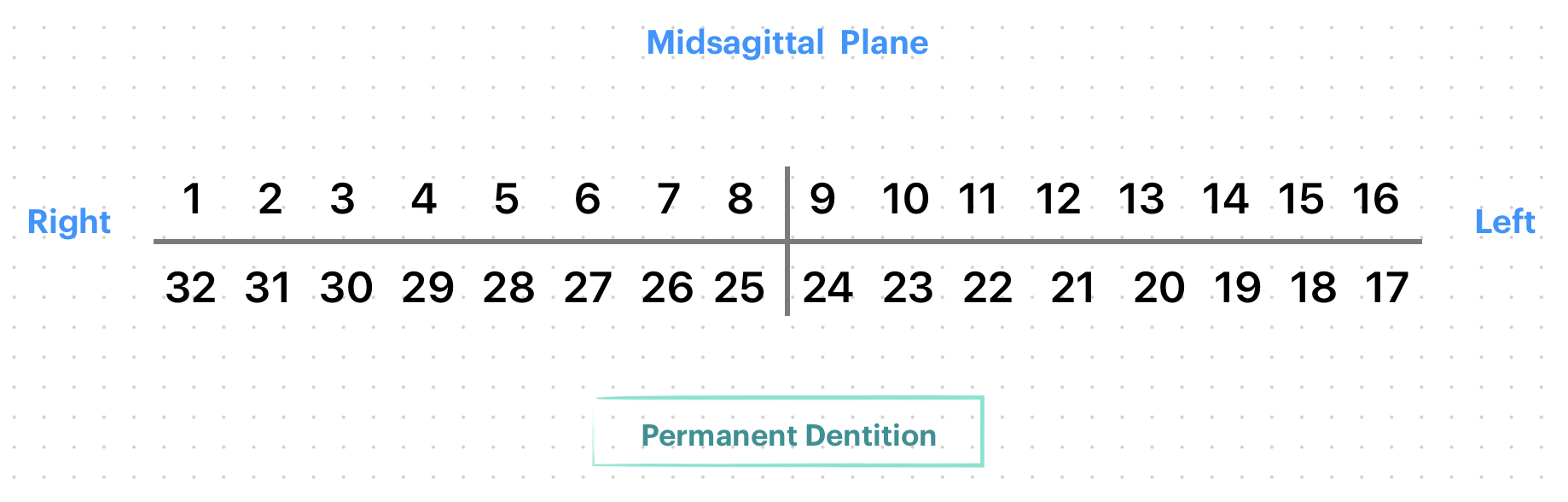
The American Dental Association (ADA), in 1947, recommended the Symbolic system (Zsigmondy/Palmer) as the numbering system of choice. However, in 1968, ADA officially recommended the Universal numbering system, due to difficulties with keyboard notation of the symbolic notation system.
The World Health Organisation has adopted a two-digit system proposed by the Federation Dentaire Internationale (FDI) and is widely accepted by other organisations also.
FDI System of Notation
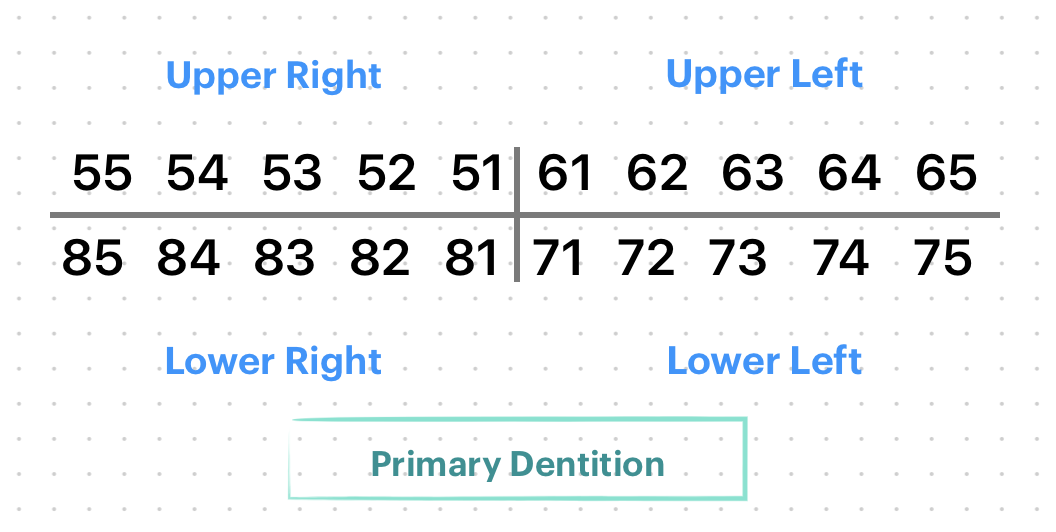
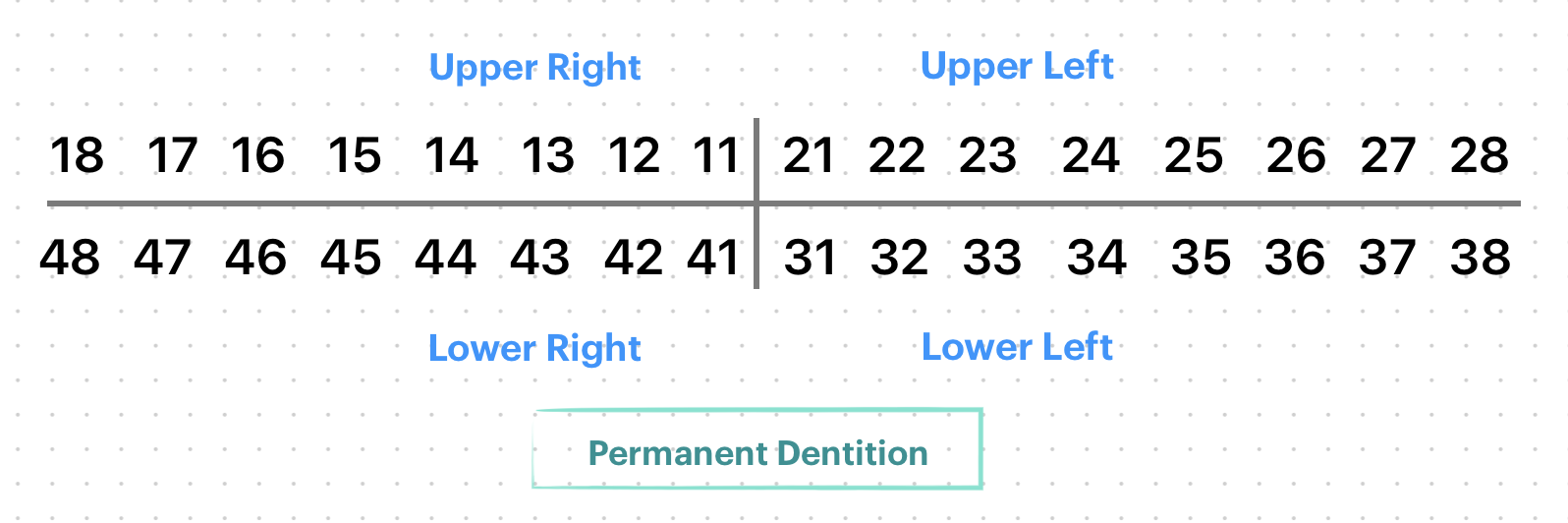
- Denotes each tooth with two-digits: The fist number indicate the sides of the maxillary and mandibular arches, and the second number represents the tooth number for each side.
- Primary dentition: 5, 6, 7, 8 are used to denote the sides (quadrants) i.e, upper right, upper left, lower left and lower right respectively. The tooth are numbered 1 through 5 in each quadrant, starting with the central incisor.
- Permanent dentition: 1, 2, 3, 4 are used to denote the sides (quadrants) i.e, upper right, upper left, lower left and lower right respectively. The tooth are numbered 1 through 8 in each quadrant, starting with the central incisor in each arch.
Universal System of Notation
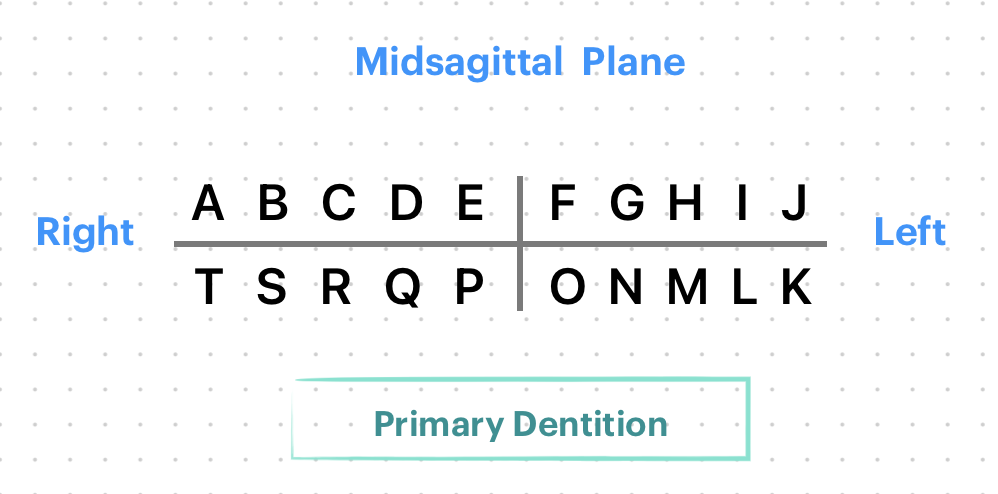
- Primary dentition: A through J for the maxillary teeth, beginning with the right upper second molar and K through T for the mandibular teeth, beginning with the left lower second molar.
- Permanent dentition: 1 through 16 for the maxillary teeth, beginning with the right upper third molar and 17 through 32 for the mandibular teeth, beginning with the left lower third molar.
Symbolic System (Zsigmondy/Palmer Notation System)
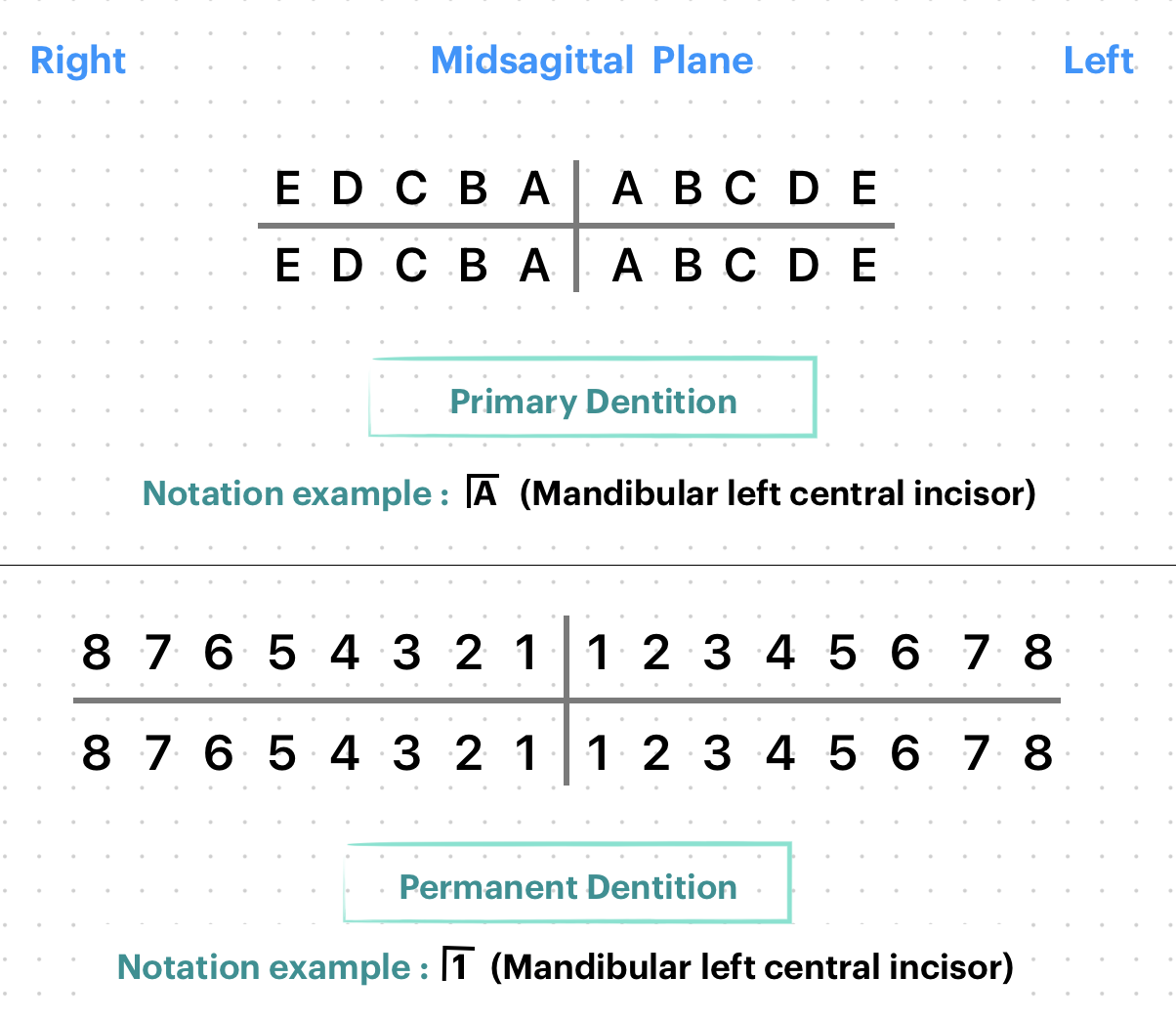
Most often referred as Palmer notation system in USA, it was introduced independently by Adolph Zsigmondy (Vienna) in 1861 and Palmer in 1870.
- The arches are divided into four quadrants, with the primary dentition notated using alphabets A to E and permanent dentition are numbered 1 to 8, beginning with the central incisor in each arch.
Basic Terminology
- Mandibular: Refers to the lower jaw, or mandible.
- Maxillary: Refers to the upper jaw, or maxilla.
- Primary: Constituting or belonging to the first stage in any process (first dentition).
- Deciduous: Means not permanent (transitory).
- Deciduous tooth, baby tooth or milk tooth : Defined as one of the temporary teeth of a mammal that are replaced by permanent teeth.
- Succedaneous: Suggests a successor dentition, does not suggest permanence.
- Permanent: Suggests permanence (but the tooth may get lost due to dental caries, periodontal diseases and trauma).
References
- Wheeler's Dental Anatomy, Physiology and Occlusion(2019), Stanley J. Nelson DDS MS, Elsevier.
- The image used as the cover photo is taken from the free Adobe stock library.
*This article is excerpt from the above mentioned book and Medical Sutras does not make any ownership and affiliation claims.