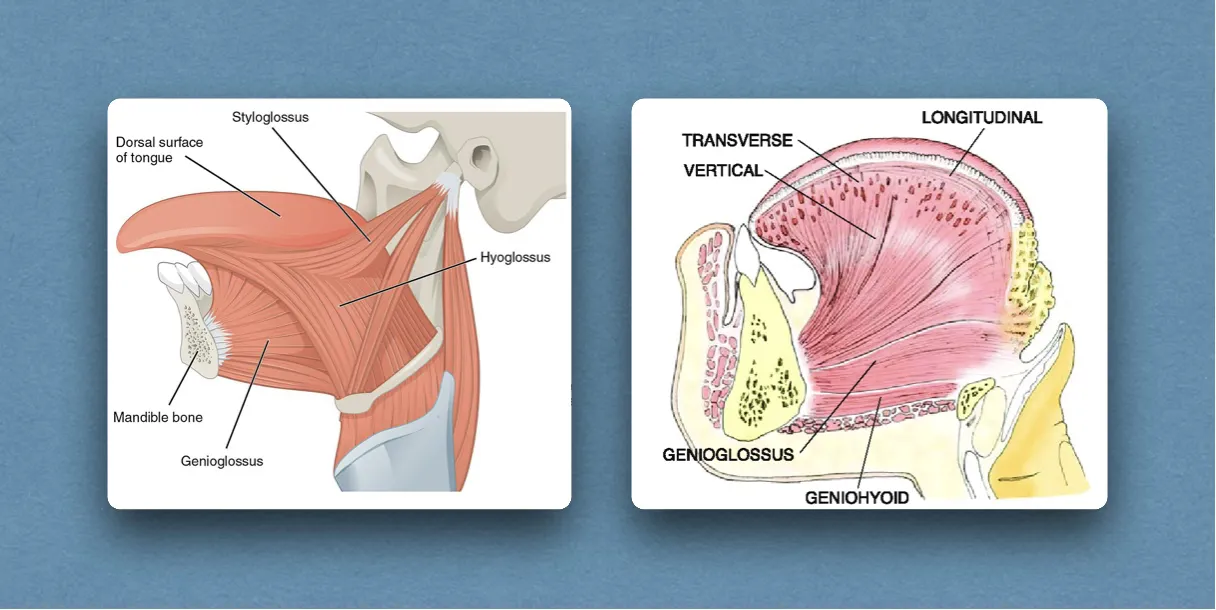
The muscles of tongue are grouped as intrinsic and extrinsic muscles.
The tongue is divided into right and left halves by a middle fibrous septum, and each half contains four intrinsic and four extrinsic muscles.
Intrinsic Muscles
The intrinsic muscles occupy the upper part of the tongue, and are attached to the submucous fibrous layer and median fibrous septum.
They alter the shape of the tongue.
(1) Superior Longitudinal
- Origin: Fibrous tissue deep to the mucous membrane on the dorsum of the tongue and middle lingual septum.
- Course: Pass longitudinally back from the top of the tongue to its root posteriorly.
- Insertion: Overlying mucous membrane.
- Actions: Elevates the tip and sides of the tongue superiorly. This makes the tongue dorsum concave and shortens the tongue.
(2) Inferior Longitudinal
- Origin: Fibrous tissue beneath the mucous membrane.
- Course: Lies between the genioglossus and hyoglossus, and stretch from tip of tongue longitudinally back to the root of the tongue and hyoid bone.
- Insertion: Mucous membrane of the tongue dorsum.
- Actions: Curls the tip of the tongue inferiorly, which makes the dorsum convex and shortens the tongue.
(3) Transverse
- Origin: Fibrous lingual septum.
- Course: Runs transversely from origin to insertion, and lies as a sheet on either side of the midline in a plane deep to the superior longitudinal muscles and superficial to genioglossus.
- Insertion: Submucous fibrous tissue at the lateral margins of the tongue.
- Actions: Makes the tongue narrow and elongated.
(4) Vertical
- Origin: Found at the borders of the anterior part of tongue.
- Course:
- Insertion:
- Actions: Makes the tongue broad and flattened.
Extrinsic Muscles
These muscles connect the tongue to external structures such as mandible, hyoid bone, styloid process and the palate.
(a) Genioglossus
-
Origin: Upper genial tubercle of mandible.
-
Insertion: Upper fibres into the tip of tongue, middle fibres into the dorsum, and lower fibres into the hyoid bone.
-
Actions:
- Upper fibres: Retracts the tongue.
- Middle fibres: Depresses the tongue.
- Lower fibres: Pulls the posterior part of tongue forwards and protrudes the tongue. (Life-saving muscle)
(b) Hyoglossus
- Origin: Whole length of greater cornua and lateral part of hyoid bone.
- Insertion: Side of tongue between styloglossus and inferior longitudinal muscle of tongue.
- Actions: Depresses the tongue, makes the dorsum convex and retracts the protruded tongue.
(c) Styloglossus
- Origin: Tip and part of anterior surface of styloid process.
- Insertion: Into the side of tongue.
- Actions: Retracts the tongue i.e., pulls the tongue upwards and backwards.
(d) Palatoglossus
- Origin: Oral surface of palatine aponeurosis.
- Insertion: Descends in the palatoglossal arch to the side of tongue at the junction of oral and pharyngeal parts.
- Actions: Pulls up the root of tongue, approximates the palatoglossal arches and thus closes the oropharyngeal isthmus.
References
- BD Chaurasia's Human Anatomy Volume 3 (Head & Neck), Eighth edition, CBS Publishers and Distributors Pvt Ltd
- Image Source 1: https://cnx.org/contents/FPtK1zmh@8.108:_xq2eUyd@5/Axial-Muscles-of-the-Head-Neck
- Image Source 2: https://www.researchgate.net/figure/ntrinsic-muscles-of-the-tongue_fig5_330101384/actions#reference
*This article is an excerpt from the above mentioned sources and Medical Sutras does not make any ownership or affiliation claims.