
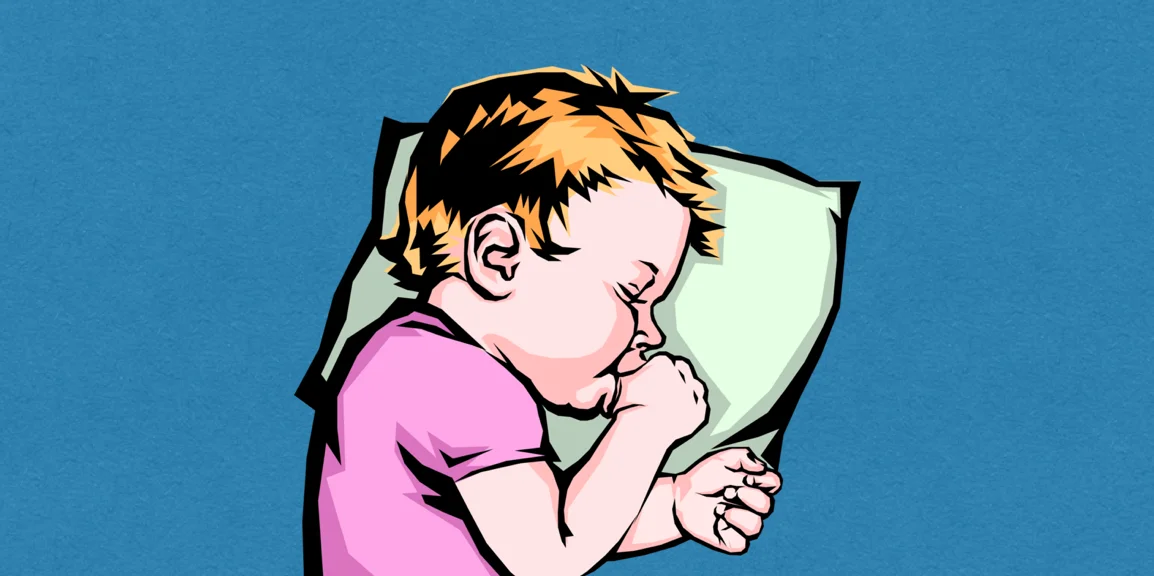
Moyers defined digit sucking as repeated and forceful sucking of thumb or digit with associated strong buccal and lip contraction.
The Sucking Reflex
It is the first coordinated muscular activity that occurs during the oral stage of development (seen at 29 weeks of i.u. life) and disappears between 1-31/2 years of age.
Types of Sucking
-
Nutritive form: Breast feeding, Bottle feeding (lacks warmth of association with mother's body).
-
Non-nutritive form: Adopted by infants in response to frustration, to satisfy their urge and need for contact.
It is usually found in children who receive restricted breastfeeding and don't have access to a pacifier to satisfy their need (urge).
Importance
- Nutritional satisfaction: Essential for fulfilling both psychological and nutritive needs during feeding.
- Learning & association: A child experiences pleasurable stimuli from lips, tongue and oral mucosa, and, learns to associate these with enjoyable sensations such as fonding and closeness of a parent.
*Babies who are restricted from sucking due to disease or other factors, become restless and irritable, and, the deprivation may motivate the infant to suck thumb or finger for additional gratification.
Predisposing Factors
- Parents' occupation.
- Socio-economic status of the family.
- Number of siblings.
- Order of birth of the child.
- Social adjustment and stress.
Classification
Thumb sucking habit can be classified as normal or abnormal. The abnormal thumb sucking can further be grouped as psychological and habitual.
Normal Thumb Sucking
- When present during initial 1-2 years of life.
- Usually disappears as the child matures and does not cause any malocclusion.
Abnormal Thumb Sucking
When the habit persists beyond the preschool period (~4 years). It may lead to malocclusion and other dentofacial changes, if not treated or managed during this stage.
- Psychological: It involves a deep-rooted emotional factor and may be associated with insecurities, neglect or loneliness experienced by the child.
- Habitual: It involves no psychological association and the child performs the act out of habit.
Clinical Features
Maxilla
- Proclination of the maxillary incisors (Labial flaring and protrusive spacing due to pressure generated by the thumb).
- Increased arch length.
- Increased anterior placement of apical base of the maxilla.
- Increase in SNA angle.
- Increase in clinical crown length of maxillary incisors.
- Increased counter-clockwise rotation of occlusal plane.
- Decreased width of palate (Constriction of maxillary arch).
- Atypical root resorption of primary central incisors.
- Increased trauma to maxillary central incisors.
Mandible
- Retroclination of mandibular incisors (Mandibular incisors experience a lingual and apical force).
- Increased mandibular inter-molar width.
- Mandible gets more distally placed relative to maxilla (More distal position of point B).
Inter-arch Relationship
- Decreased inter-incisal angle.
- Increased overjet.
- Decreased overbite and sometimes, anterior open bite (Due to remodelling of maxillary alveolar process and vertical displacement of the maxillary anterior teeth).
- Posterior crossbite (functional): Thumb sucking lowers the tongue and decreases the pressure exerted by it against the palatal aspect of upper molars, while cheek pressure is increased as the buccinator (circumoral musculature) contracts during thumb sucking. As a result, the maxillary arch becomes narrower.
- Increased unilateral and bilateral Class II situation.
Lips
- Lip incompetence.
- Hypotonic upper lip.
- Hyperactive lower lip with marked mentalis muscle activity. (Lower lip must be elevated by contraction of orbicularis oris and mentalis to a position between malposed incisors during swallowing.)
Tongue
- Tongue thrust (As an adaptation to anterior spacing).
- Increased lip to tongue resting position.
- Lower tongue position.
Diagnosis
History Taking
- Frequency, duration and intensity of the habit.
- Feeding pattern and parental care of the child.
- Psychological component involved.
- Presence of any other habit.
Extraoral Examination
-
Thumb or any other finger involved in sucking:
- Reddened.
- Clean, chapped and with a short finger nail.
- Fibrous or roughened callus on superior aspect of the finger (Dishpan thumb).
- Deformation of the finger.
-
Lips: Short, hypotonic and passive or incompetent upper lip during swallowing, and, hyperactive lower lip.
-
Facial form analysis:
- Maxillary protrusion and mandibular retrusion.
- High mandibular plane angle.
- Presence of facial grimace or excessive mentalis muscle contraction.
-
Other findings:
- Habitual mouth breathing and tongue thrust swallow (esp. in children with anterior open bite).
- Middle ear infection.
- Enlarged tonsils.
Intraoral Examination
- Tongue: Examine for correct size and position at rest and during function.
- Dentoalveolar structures: Assess for various changes mentioned above.
- Gingiva: Check for evidence of mouth breathing and gum line etching.
Management
The interceptive treatment to stop thumb sucking habit depends on:
- Patient's age.
- Emotional and psychological state.
- Cooperative motivation of the parents and child.
- Nature of occlusal changes.
- Associated functional adaptation.
An age-based approach forms the foundation for treatment and the treatment can be grouped for three age groups:
- Below 4 years.
- 4-6 years age group.
- Above 6 years.
Below 4 years
Periodic observation of the nature and intensity of the habit is generally recommended in children below 4 years age, since,
- The habit is considered normal during the first 2 years of life.
- Effects of the habit on occlusion are not permanent (if stopped by 4 years).
- Difficulty to cooperate with any of the interceptive treatments.
If the habit gradually diminishes, it is possible that the habit will cease without intervention. However, if it persists beyond 4 years of age or increases in intensity with adverse dental and skeletal changes, corrective measures needs to be taken.
4-6 years
Psychological counselling and reward therapy may help some children to cease thumb sucking in this age group.
Counselling of the patient and parents
- Discuss the problem and its adverse effects.
- Child is asked to keep a daily record of each episode of thumb sucking and report on their progress in stopping the habit.
- Parents should be advised not to nag or punish the child, as it may create greater tension and further intensify the habit.
- Parents should consent to disregard the habit and not mention it to the child for a more successful outcome.
Reward therapy
- For each day the child refrains from the habit, the child must be rewarded with a prize, such as "a star" on the calendar.
- The rewards should be progressively enhanced as to value for the child.
- If the child ceases the habit for 3 months, there are good chances for stopping the habit and enhancing occlusal development in the long-term.
Reminder therapy
It involves negative reinforcers such as mittens, bandages and bitter tasting medicaments applied directly to the offending finger.
- Distasteful agents: Cayenne pepper, Quinine, Asafetida, FEMITE (Denatonium benzoate).
- Ace bandage approach: It involves nightly use of elastic bandage wrapped across the elbow, that exerts pressure and removes the thumb from the mouth as the child falls asleep.
- Long sleeve nightgown: Long sleeves of gown interferes with the contact of the thumb and mouth, thus reminding the child constantly, esp. at night.
Above 6 years (School age years)
The reward and reminder therapy may be useful in some children above 6 years of age.
However, mostly the habit is so much ingrained that it often requires direct appliance therapy to stop the habit. This also helps in proper eruption and alignment by influencing any acquired muscular patterns.
The appliances include:
-
Habit breaking appliances (Fixed and Removable)
- Palatal crib appliance (Recommended appliance of choice).
- Bluegrass appliance.
-
Myofunctional appliances.
References
- McDonald and Avery's Dentistry for the Child and Adolescent (11th Edition) -Mosby (2021).
- Textbook of Orthodontics (2nd Edition), Gurkeerat Singh - Jaypee Brothers Medical Publishers.
- Image Credit: Designed by Wannapik, Source: https://www.wannapik.com/vectors/11424#!.
*This article is an excerpt from the above mentioned books and Medical Sutras does not make any ownership or affiliation claims.