
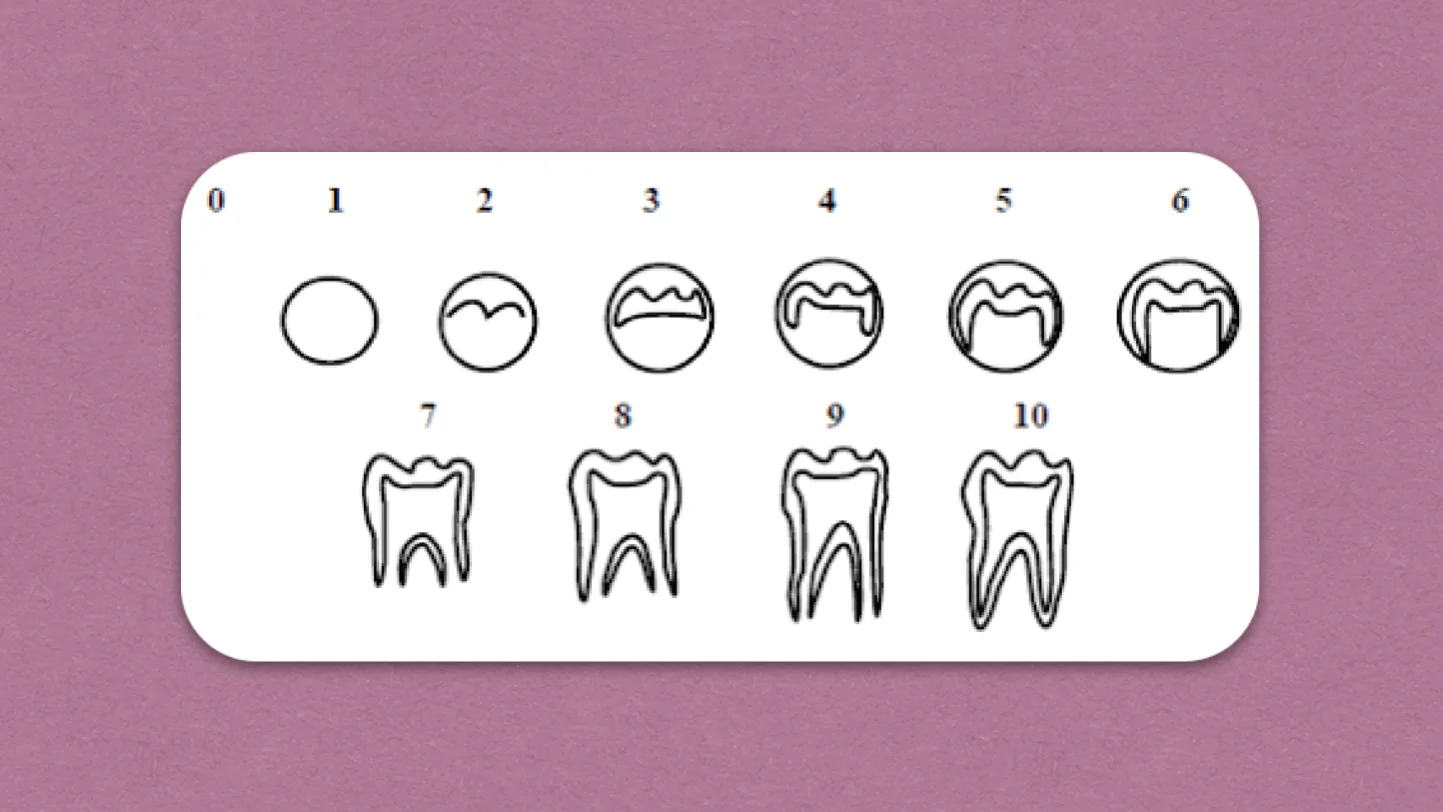
Radiographic studies of tooth formation have used at least three stages:
- Beginning of calcification.
- Crown calcification.
- Root completion.
Nolla expanded the number of stages to 11 and Gleiser and Hunt to 13, which served as the basis for several studies, including that of Moorrees et al., who defined 14 stages of permanent tooth formation.
Nolla's Stages of Tooth Development
- Absence of crypt
- Presence of crypt.
- Initial calcification.
- 1/3 of crown completed.
- 2/3 of crown completed.
- Crown almost completed.
- Crown completed.
- 1/3 of root completed.
- 2/3 of root completed.
- Root almost completed.
- Apical end of root completed.
Stages of Permanent Tooth Formation (Moorrees)
Moorrees et al., defined 14 stages of permanent tooth formation. The 14 stages are not numbered but are designated by abbreviations and subscripts.
Crown : Ci, Cco, Coc, Cr1/2, Cr3/4, Crc
Root : Ri, Cli, R1/4, R1/2, R3/4, Rc
Apex : A1/2, Ac.
Abbreviations
- C = cusp
- Cr = Crown
- R = root
- Cl = cleft
- A = apex.
Subscripts
- i = initiated
- co = coalescence
- oc = outline complete
- c = complete.
Chronologies of Human Dentition
Precise information regarding chronological events of developing teeth is required during surgery on young children, especially related to the repair of cleft palate.
Chronologies of dental development reflect the use of different statistical methods to produce three different types of tooth formation data.
Age-of-attainment chronologies:
- Based on tooth emergence.
- Not easily determined, since, during the study the attainment of the stage has not occured in some cases, while in other the stage is over.
- Can be produced by cumulative distributive functions (best method) or probit analysis and by the average age at first appearance less one half interval between examinations.
- Useful clinically when it is necessary to avoid damage to developing teeth during treatment.
Age prediction chronologies:
- Based on the average age of individuals in a stage of development.
- Used for assessing unknown ages of patients and for forensic and archaeological applications.
Maturity assessment scales:
- Based on mean stage for age, where stages rather than participant ages, are averaged.
- To avoid problems with calculation of mean age or mean stage, maturity scales are designed by several investigators, including Wolanski, Demirjian et al., Healy and Goldstein, and Nystrom et al.
- Used to assess whether an individual of known age is in front or behind compared with a reference population.
- Not designed for anthropologic or forensic applications.
References
- Wheeler's Dental Anatomy, Physiology and Occlusion(2019), Stanley J. Nelson DDS MS, Elsevier.
- Textbook of Orthodontics (2nd Edition), Gurkeerat Singh, Jaypee Brothers Medical Publishers (P) Ltd.
*This article is excerpt from the above mentioned book and Medical Sutras does not make any ownership and affiliation claims.