
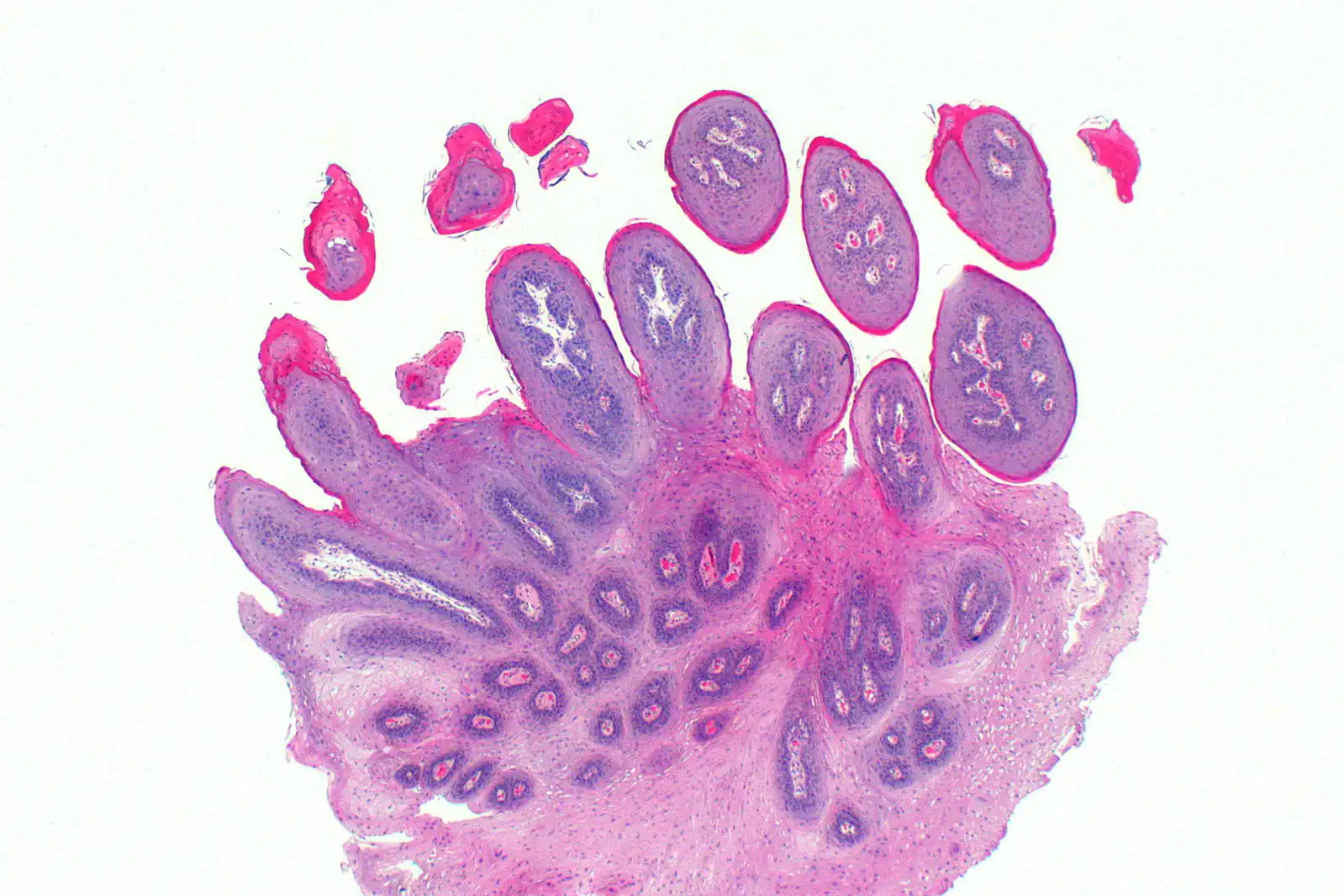
The oral squamous papilla is the fourth most common oral mucosal mass, found in 4 of every 1,000 and accounts for 3-4% of all biopsied oral soft tissue lesions.
It seems to be associated with human papilloma virus (HPV), also causes skin warts.
The HPV 6 and 11 that are commonly associated with squamous papilloma does not seem to be contagious and have an extremely low virulence and infectivity rate. These are not demonstrated in premalignant and malignant oral lesions.
Clinical Features
- Location : Most commonly found on the tongue, lips, buccal mucosa, gingiva and palate, particularly in the area adjacent to the uvula.
- Size : Majority are few millimeters in diameter, but lesions several centimeters in size may also be found.
- Age : Can be seen at any age, including young children.
- Presentation : Presents as a painless, exophytic growth made up of numerous, small finger like projections that result in a roughened, verrucous or cauliflower-like surface.
- Nearly always well circumscribed and pedunculated, occasionally sessile.
- Color : White, sometimes pink.
Histologic Features
- Consists of many long, thin, finger-like projections extending above the surface of the mucosa, each made up of a continuous layer of stratified squamous epithelium and containing a thin, central connective tissue core which supports the nutrient blood vessels.
- There is proliferation of the spinous cells in a papillary pattern.
- The connective tissue present is supportive stroma and is not considered a part of the neoplastic element.
- Hyperkeratosis may be seen in some cases, probably secondary to trauma or frictional irritation as per the location of the lesion.
- Occasionally, they show pronounced basilar hyperplasia and mild mitotic activity, which should not be mistaken for mild epithelial dysplasia.
- Koilocytes (HPV altered epithelial cells with perinuclear clear spaces and nuclear pyknosis) may or may not be found in the superficial layers of the epithelium.
- Chronic inflammatory cells may be present variably in the connective tissue.
Treatment and Prognosis
- Treatment consists of excision, including the the bse of the mucosa into which the pedicle or stalk inserts.
- Removal should never be accomplished by an incision through the pedicle.
- If the tumor is properly excised, recurrence is rare.
- The possibility of malignant degeneration in the oral papilloma is quite unlikely, although fixation of the base or induration of the deeper tissues should always be viewed with some suspicion.
Common wart/ Verruca vulgaris
- Frequent tumor of the skin, analogous to the oral papilloma.
- Associated viruses : Subtypes of HPV-2, HPV-4 and HPV-40.
- Clinically, it presents as multiple or clustered individual lesions, that shows pointed or verruciform surface projections, a very narrow stalk and white appearance due to considerable surface keratin.
- It enlarges rapidly to its maximum size, seldom achieving more than 5 mm in greatest diameter.
- It is contagious and capable of spreading to other parts of an affected person's skin or membranes by way of autoinoculation.
Cowden's Syndrome
- Multiple hamartoma and neoplasia syndrome, characterised by facial trichilemmomas associated with the gastrointestinal tract, the thyroid, CNS and musculoskeletal abnormalities as well as lesions.
- Autosomal dominant in nature.
- Presents papilloma like or papillomatous lesions as well as pebbly lesions and fibromas of various sites in the oral cavity.
- It is also considered a cutaneous marker of breast cancer.
References
- Shafer, Hine, Levy Shafer's Textbook of Oral Pathology (7th Edition), Editors - R Rajendran, B Sivapathasundharam, Elsevier.
- The image used is licensed under the Creative Commons Attribution-Share Alike 3.0 Unported license (Author: Nephron, Source : Wikimedia Commons).
*This article is an excerpt from the above mentioned books and Medical Sutras does not make any ownership or affiliation claims.