
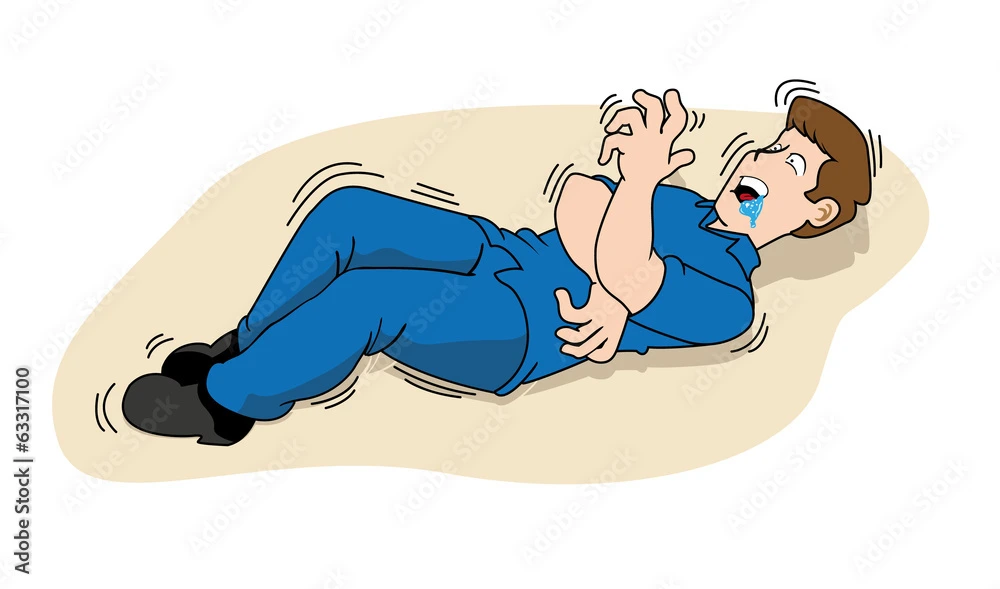
Seizure or epilepsy is not a disease, rather a symptom that represents a primary form of brain dysfunction, characterised by paroxysmal excessive neuronal brain activity and an abrupt onset of motor, sensory or psychic symptoms.
Types
- Partial seizure.
- Generalised tonic clonic seizure.
- Absence seizure.
- Status epilepticus.
Clinical Manifestations
Partial Seizure
It begin in a localised area of the brain (ictal focus), clinical signs and symptoms correlate to the affected area of the brain.
- Simple partial seizure (Jacksonian epilepsy): Involves a small portion or a focal area of the brain, without impairing awareness.
- Complex partial seizure (Psychomotor seizure): Involves extensive cortical regions and involves an associated impairment of consciousness, with complex behaviour patterns called automatisms.
Tonic Clonic Seizure (Grand mal epilepsy)
There is rapid involvement of bilateral cortical, subcortical, and brainstem networks of the brain.
It can be divided into four phases:
Prodromal Phase
- There are subtle to obvious changes in emotional reactivity, including increase in anxiety or depression.
- Characterised by aura (not a warning sign but an actual part of the seizure) : Last only a few seconds and clinical manifestations relate to the specific region of the brain in which the seizure originates, i.e, may be olfactory, visual, gustatory or auditory.
Preictal Phase
- There is loss of consciousness (if standing, patient falls to the floor).
- Simultaneously, a series of generalised bilateral, major myoclonic jerks occur, usually in flexion and last for several seconds.
- Epileptic cry: Produced as air is expelled through a partially closed glottis while the diaphragmatic muscles go into spasm.
- Autonomic changes: Increase in heart rate and blood pressure, increased bladder pressure, cutaneous vascular congestion and piloerection, glandular hypersecretion, superior ocular deviation with mydriasis and apnea.
Ictal Phase
- Tonic component (10-20 seconds): Series of sustained generalised skeletal muscle contractions occur, first in flexion, which then progress to a tonic extensor rigidity of the extremities and trunk.
- Clonic component (2-5 minutes): Generalised clonic movements of the body accompanied by heavy, stertorous breathing. Alternating muscular relaxation and violent flexor contractions.
- Patient may froth at the mouth because air and saliva are mixed.
- Blood may appear in the mouth as the patient may bite the lateral border of the tongue and cheek during the clonic portion of the seizure.
- Ends as respiratory movements return to normal and tonic-clonic movements cease.
Postictal Phase
- Consciousness gradually returns, clinical manifestations largely depend on the severity of the ictal phase.
- Patient exhibit a momentary period of muscular flaccidity during which urinary or fecal incontinence may occur.
- The patient relaxes and sleeps deeply.
- Almost total amnesia of the ictal and postictal phase
- Full recovery of pre-seizure cerebral functioning takes approximately 2 hours.
Absence Seizure (Petit mal epilepsy)
- Manifested by sudden immobility (no movements) and a blank stare.
- Lasts 5-30 seconds.
- Individual may exhibit simple automatisms and minor facial clonic movements, such as a cyclic blinking of the eyelids.
Status epilepticus
- True medical emergency.
- Can be defined as a seizure that continues for more than 5 minutes or a repeated seizures of any type without recovery between attacks.
- Usually categorised as generalised or partial (focal) and convulsive or non-convulsive.
Management
Absence Seizure and Partial Seizure
Management is protective in nature, the rescuer acts to protect the victim from injury.
- Terminate all dental procedures.
- Reassure the patient : Speak with the patient to determine the level of alertness and whether the episode was related to the dental treatment.
- If the seizure was related to dental phobia, appropriate stress reduction protocols should be followed in all future appointments.
- Consult the patient's primary care physician or refer the patient for medical advice.
- Do not allow the patient to operate any motor vehicle and do not discharge the patient without attendant.
*If the seizure persists for long (more than 5 minutes), start basic life support and call for medical emergency services.
Tonic Clonic Seizure
Objective: Prevention of injury and maintenance of adequate ventilation.
-
Terminate all dental procedures.
-
Positioning: If the patient is not seated in the dental chair, place the patient gently on the floor and turn onto one side. Otherwise, leave the patient in dental chair and position the dental chair supine.
-
Protection from injury: Patient’s head must be protected from traumatic injury by placing something soft and flat under the head.
- The headrests on most dental chairs are normally well padded so that no additional protection is needed.
- One member of the office emergency team should move as much nearby objects as possible away from the patient, while other two members should stand by the patient to minimise any risk of injury.
- Remove eyeglasses and loosen ties on anything around the neck that may make it hard to breathe.
- In addition, one member should be positioned at the victim's chest to protect the head and arms; the second member should stand astride the patient's feet.
- Placement of any object in the oral cavity and restriction of movement is usually not recommended.
-
The patient's head should be extended (head tilt) to ensure airway patency and if possible, the oral cavity suctioned carefully to remove excessive secretions.
After seizure, if the patient is conscious,
- The patient should remain in the supine position with legs slightly elevated.
- Suction airway, if necessary.
- Administer oxygen via a face mask or nasal cannula.
- Monitor vital signs at regular intervals, at least every 5 minutes.
- Reassure the patient and observe the patient in the dental office for 1 hour.
- The patient should be escorted to home and not allowed to leave unattended.
After seizure, if the patient is unconscious,
- Call medical emergency services.
- Place the patient onto one side and suction airway.
- Administer oxygen and monitor vital signs.
- Initiate basic life support, as needed.
- Shift the patient to nearby emergency care facility.
Status epilepticus
- Terminate all dental procedures.
- Activate medical emergency services.
- Position the patient gently onto one side.
- Monitor vital signs, every 5 minutes.
- Administer supplemental oxygen and obtain vascular access.
- Check random blood glucose level and administer 50% dextrose if hypoglycemia is present.
- If thiamine deficiency is a possibility, thiamine should be given before dextrose.
- Anticonvulsant drugs may be necessary to terminate the seizure.
Anticonvulsant Drugs
- Lorazepam is preferred because of its rapid onset of action. Dosage: 0.1 mg/kg IV (Max. 2 mg/minute).
- If Lorazepam is not available, Diazepam can be used at 0.15 mg/kg IV up to a maximum of 5 mg/minute.
- A repeat dose can be administered after 3-5 minutes if seizures do not resolve following the first dose.
- Pediatric patient: Intranasal Midazolam (0.2mg/kg) using 1 ml needleless syringe with an aerosolising head has been effective.
- If the second dose of Benzodiazepines (Lorazepam/Diazepam) does not abort seizure: It should be treated as refractory status epilepticus, with continuous infusion of anti-epileptic drugs such as Midazolam, Phenytoin and others.
*IV fluids (25-50 ml of 50% dextrose): Also helps the patient maintain blood sugar levels, as the brain uses large quantities of glucose during the ictal phase.
Post-recovery
- Place the patient onto one side and suction airway.
- Monitor vital signs.
- Shift the patient to nearby emergency care facility for further evaluation.
References
- Medical Emergencies in the Dental Practice (7th edition), Stanley F. Malamed, Daniel L Orr II, Mosby Elsevier. https://amzn.to/4bsbBkf
- Wylie T, Sandhu DS, Murr N. Status Epilepticus. [Updated 2023 May 8]. In: StatPearls [Internet]. Treasure Island (FL): StatPearls Publishing; 2024 Jan-. Available from: https://www.ncbi.nlm.nih.gov/books/NBK430686/
- Contemporary Oral and Maxillofacial Surgery (6th edition), James R Hupp, Edward Ellis III, Myron R Tucker, Mosby Elsevier. https://amzn.to/3HJehMO
*This article is an excerpt from the above mentioned books and Medical Sutras does not make any ownership or affiliation claims.