
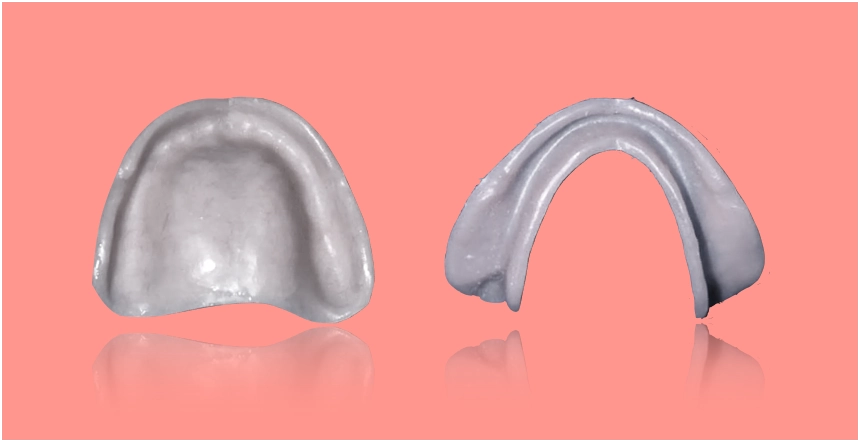
Record Base is an interim denture base used to support the record rim material for recording maxillomandibular records. (GPT-9)
Baseplate (syn, Record Base) can be defined as a rigid, relatively thin layer of wax, shellac or thermoplastic (heat-, chemically-, or light-activated) polymer adapted over edentulous surfaces of a definitive cast to form a base which, together with an attached occlusion rim made of wax or similar material, serves as the record base. (GPT-9)
Criteria for Ideal Record Base
- Well adapted and precisely fitting to the final cast.
- Rigid and stable, both on the cast and in the mouth (to ensure securing & transfer of accurate jaw relation records).
- Borders should be smooth, rounded and adequately polished to provide maximum patient comfort.
- Free of voids or projections on the surface that contacts the oral mucosa.
- Approximately 1 mm thickness over the crest and the facial slope of the ridge, to prevent the base from interfering with the placement of the artificial teeth.
- Approximately 2 mm in the hard palate area of the maxillary base and the lingual flange of the mandibular base for rigidity.
- Free of undercuts and easily removable from the cast.
- Smooth, rounded and must reproduce both the contours and the dimensions of the reflections of the final cast.
Roles/Functions
Record base plays both diagnostic and therapeutic roles.
Diagnostic roles
The following information can be obtained through the use of record base:
- Overextension or underextension of borders of the final impression.
- Presence of areas of compression in the residual ridge, hard palate or soft palate, approximating the borders of the base.
- Patient's acceptance of the final denture (can be inferred by his/her response to the denture base).
- Existence of gag reflex that could inhibit adaptation to or acceptance of the final denture.
- Reduced or inadequate flow of saliva, which may adversely affect denture retention.
- Observation of tongue positions or habits, which would be unfavorable to the stability of the final prosthesis.
- Any unfavorable ridge relationship, which would increase the difficulty of providing a satisfactory prosthesis.
Therapeutic roles
- Establishment of vertical dimensions at rest (VDR) and of occlusion (VDO).
- Establishment of an adequate interocclusal distance.
- Determination and recording of centric relation.
- Transfer of accurate jaw relationships to an articulator.
- Setting of artificial teeth for the trial denture.
Materials
The material used should meet the following criteria as much as possible:
- Be readily adapted to the required shape and contours with a minimum of time, expense and technical skill.
- Be rigid and strong in relatively thin sections.
- Not exhibit flow at mouth temperature.
- Not warp or distort appreciably during the procedures required for denture fabrication.
- Exhibit a color that will not distract from viewing the arrangement of the teeth of the trial denture as they will appear in the completed denture.
The various types of materials used for record base include,
- Temporary bases: Shellac, Could-cure (auto-polymerising) acrylic resin, Vacuum formed vinyl or polystyrene, Baseplate wax.
- Permanent bases: Processed acrylic resin, Glod, Chromium-cobalt alloy, Chromium-nickel alloy.
References
- Essentials of Complete Denture Prosthodontics, 2nd edition, Sheldon Winkler, AITBS Publishers India.
- The Glossary of Prosthodontic Terms, 9th edition, The Journal of Prosthetic Dentistry.
*This article is an excerpt from the above mentioned sources and Medical Sutras does not make any ownership and affiliation claims.