
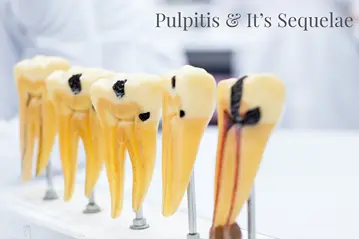
Pulpitis refers to inflammation of the dental pulp, that can be described clinically as reversible or irreversible and histologically as acute, chronic, or hyperplastic.
Reversible Pulpitis
- Reversible pulpitis is a clinical diagnosis where the subjective and objective findings indicate there is mild or transient pulpal inflammation and the inflammation should resolve and pulp should return to normal.
- There is sharp pain lasting for up to 5–10 seconds, which does not linger*.
- Removal of the causal factor such as cold or hot liquids, as well as air, usually result in alleviation of pulpal inflammation and immediate relief.
- Patient that complain of pain related to sweets is a typical case of reversible pulpitis.
- Confusion can occur in cases of exposed dentin, without evidence of pulp pathosis. Such cases can sometime present with sharp, quickly reversible pain when subjected to thermal, evaporative, tactile, mechanical, osmotic, or chemical stimuli. This is known as dentinal hypersensitivity.
* Lingering is when one tooth (or more) stands out above the rest of the teeth in terms of duration of the pain. If the patient's response is equal in duration on all teeth, it is said to be non-lingering.
Irreversible Pulpitis
- Defined as the condition where an inflamed pulp is no longer capable of healing and returning to normal.
- Symptoms of irreversible pulpitis may range from a sharp, throbbing pain, initiated by hot or cold stimuli and lasting minutes to hours, to spontaneous intermittent bouts of dull aching pain lasting for hours.
- The pain may be localized, or diffuse.
- Referred pain is common.
- With the application of thermal stimulus there is usually an initial sharp shooting pain due to Aδ fibre, that lasts for a few seconds. Then, after a few seconds, a dull throbbing C-fibre ache develops which may take minutes to hours to subside even after the stimulus has been removed.
- Application of cold in patients with painful irreversible pulpitis may cause vasoconstriction, leading to a drop in pulpal pressure, and subsequent relief in pain.
- Pain may be exacerbated when the patient lies down or bends over. This is due to increased intra-pulpal pressure.
- Aerodontalgia or barodontalgia is referred to as an irreversible pulpitis.
- Typically, there are minimal or no changes in the radiographic appearance of the peri-radicular bone. However, with advanced irreversible pulpitis, a thickening of the periodontal ligament may become apparent on the radiograph.
Pulp Necrosis
- Refers to the partial or complete necrosis of the pulp caused by a loss of, or inadequate blood supply.
- Pulpal necrosis is usually asymptomatic but may be associated with episodes of spontaneous pain.
- Until the periodontium is involved, the tooth is usually symptom-free. There may be discomfort or pain (from the peri-radicular tissues) on pressure.
- The periapical tissues appear normal radiologically.
- Cold, heat, or electrical stimuli usually produce no response.
- Single-rooted teeth usually do not respond to sensitivity testing. However, in multi-rooted teeth, the pulp may still be partially vital, hence, as a result, sensitivity testing may produce positive response.
Acute Apical Periodontitis (Symptomatic Apical Periodontitis)
- Involves inflammation of the apical periodontium, with a painful response to biting or percussion or palpation.
- X-ray may reveal a slight widening of the periodontal ligament space.
- A negative response to sensitivity testing indicates an endodontic cause.
Acute Apical (Periapical) Abscess
- Characterized by spontaneous pain, tenderness to pressure, pus formation, and swelling of associated tissues.
- There may be discernible mobility as the tooth is elevated from its bony socket.
- The tooth does not responds to sensitivity tests.
- X-ray can show anything from a widened periodontal ligament space to an apical radiolucency.
- The patient is frequently febrile, and the cervical and submandibular lymph nodes may exhibit tenderness to palpation.
Chronic Apical Periodontitis (Asymptomatic apical periodontitis)
- Defined as inflammation and destruction of apical periodontium that is of pulpal origin.
- It appears as an apical radiolucent area, and does not produce any clinical symptoms.
- The tooth does not usually respond to pulp vitality tests.
- The tooth is generally not sensitive to biting pressure but may “feel different” to the patient on percussion.
Chronic Apical/Periapical Abscess(Suppurative periapical abscess)
- Characterized by little or no discomfort, and intermittent discharge of pus through an associated sinus tract.
- In general, a tooth with a chronic apical abscess will not present with clinical symptoms.
- Usually the tooth is not sensitive to biting pressure but can “feel different” to the patient on percussion.
- The tooth will not respond to pulp vitality tests.
- Radiographically, a large periapical lesion may be present.
- It can be distinguished from chronic apical periodontitis by the presence of intermittent pus discharge through an associated sinus tract.
Additional Periradicular Terminology
Apical Scar
- Refers to dense collagenous connective tissue, that appears as a dark radiolucency, at or near the apex of a tooth that has been surgically treated.
- It is a form of repair but is commonly associated with lesions that have been involved with the destruction of both the facial and lingual osseous cortical plates.
Condensing Osteitis (Focal sclerosing osteomyelitis, Peri-radicular osteosclerosis, Sclerosing osteitis, Sclerotic bone)
- A diffuse radiopaque lesion usually seen at the apex of a tooth (or its extraction site).
- It is believed to represent a localized bony reaction to a low-grade inflammatory stimulus, commonly found in cases of long-standing pulp pathosis.
References
- John I. Ingle, Leif K. Bakland, J. Craig Baumgartner-Ingle's Endodontics-PMPH USA (2007).
- Mahmoud Torabinejad, Richard E. Walton Endodontics Principles and Practice.
- Kenneth M. Hargreaves, Louis H. Berman-Cohen's Pathways of the Pulp-Mosby (2016).
- Harty's Endodontics in Clinical Practice (6th Edition)
*This article is an excerpt from the above mentioned books and Medical Sutras does not make any ownership or affiliation claims.