
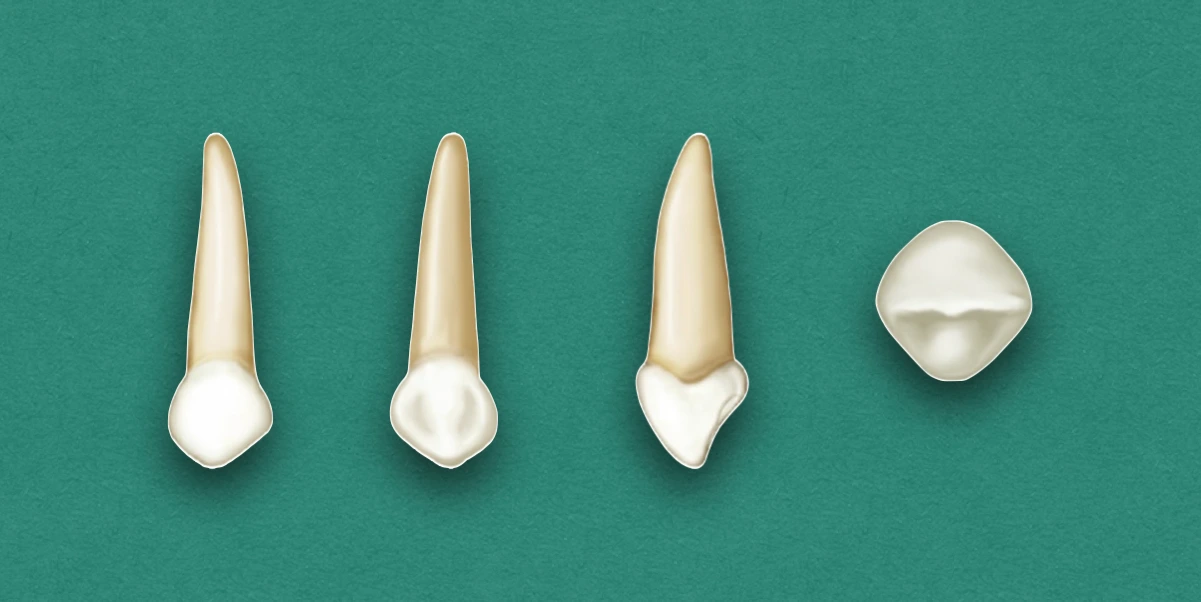
The primary maxillary canines are located lateral to incisors and presents a long, well developed, sharp cusp instead of incisal edge. Their function is to punch, tear, and apprehend food material.
Chronology
- First evidence of calcification: 17 weeks in utero.
- Crown completion: 6 months.
- Eruption: 16 months.
- Root completion: 2 and half years.
Dimensions
- Overall length: 19.0 mm
- Crown length: 6.5 mm
- Root length: 13.5 mm
- Mesiodistal diameter of crown: 7.0 mm
- Mesiodistal diameter of crown at cervix: 5.1 mm
- Labiolingual diameter of crown: 7.0 mm
- Labiolingual diameter of crown at cervix: 5.5 mm
Crown Morphology
Labial Aspect
- Crown is more constricted at the cervix in relation to its mesiodistal width.
- Mesial and distal surfaces are more convex.
- Presents a long, well-developed, sharp cusp (instead of incisal edge).
- The cusp is much longer and sharper, and the crest of contour mesially is not as far down toward the incisal portion, in comparison to permanent maxillary canine.
- Line drawn through the contact areas will bisect the line drawn from the cervix to the tip of the cusp. In permanent canine, the contact areas are not at the same level.
- The mesial slope of the cusp is longer than the distal slope.
Lingual Aspect
- Shows pronounced enamel ridges that merge with each other. The ridges include cingulum, mesial and distal margin ridges, and the incisal cusp ridges.
- The lingual ridge connects cingulum and cusp tip, and divides the lingual surface into shallow mesiolingual and distolingual fossae.
Mesial Aspect
- The outline is similar to the primary maxillary incisors, however, there is difference in proportions.
- The labiolingual measurement at the cervical third is much greater, which increases the crown dimensions. This along with root width and length provides resistance against masticatory forces.
Distal Aspect
- Distal outline is reverse of the mesial aspect.
- No significant differences can be noted, except that the curvature of the cervical line toward the cusp ridge is less than on the mesial surface.
Incisal Aspect
- The crown appears diamond-shaped, with angles formed by the contact areas (mesially and distally), cingulum (lingually), and the cervical third or enamel ridge (labially).
- The enamel ridge on the labial surface is more pronounced and less rounded than those found on the permanent canines.
- The cusp tip is distal to the center of the crown, and the mesial cusp slope is longer than the distal cusp slope. This allows for intercuspation with lower canine (have longest slope distally).
Root Morphology
- The root is long, slender and tapering.
- It is more than twice the crown length.
- The root tapers lingually and is usually inclined distally above the middle third.
References
- Wheeler's Dental Anatomy, Physiology and Occlusion(2019), Stanley J. Nelson DDS MS, Elsevier.
*This article is excerpt from the above mentioned book and Medical Sutras does not make any ownership and affiliation claims.