
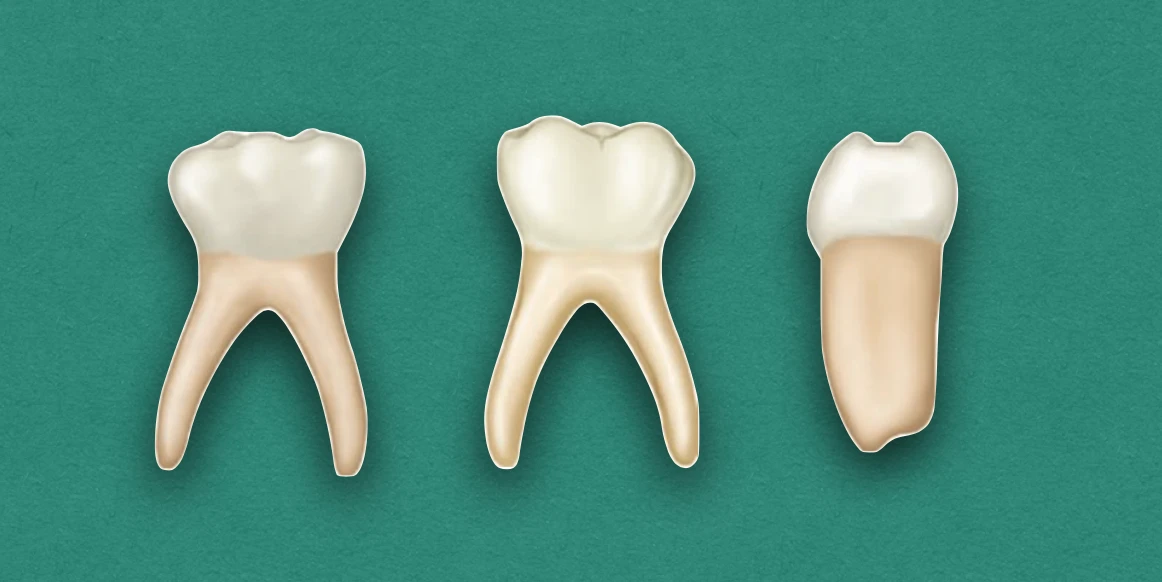
The primary mandibular second molar resembles permanent mandibular first molar in characteristics, but differs in dimensions.
Chronology
- First evidence of calcification: 18 weeks in utero.
- Crown completion: 10 months.
- Eruption: 27 months.
- Root completion: 3 years.
Dimensions
- Overall length: 18.8 mm.
- Crown length: 5.5 mm.
- Root length: 11.3 mm.
- Mesiodistal diameter of crown: 9.9 mm.
- Mesiodistal diameter of crown at cervix: 7.2 mm.
- Labiolingual diameter of crown: 8.7 mm.
- Labiolingual diameter of crown at cervix: 6.4 mm.
Crown Morphology
Buccal Aspect
- Has narrow mesiodistal width at the cervical portion when compared to the width at the contact level (lower permanent first molar is wider at the cervical portion).
- MB and DB developmental grooves divide the crown occlusally into three portions of equal size, resulting in a straight buccal surface with mesiobuccal, buccal, and distobuccal cusp. (Lower permanent first molar presents an uneven distribution, with two buccal cusps and one distal cup.)
Lingual Aspect
- Presents two cusps of almost equal dimensions, with a short lingual groove between them.
- Lingual cusps are not as wide as the buccal cusps, resulting in narrowing of the crown lingually.
- Cervical line is relatively straight, and the crown extends out over the root more distally than mesially.
- Mesial portion seems to be little higher than distal portion, making the crown appear tipped distally.
- Some part of buccal cusps can be seen from the lingual aspect.
Mesial Aspect
- Outline resembles that of permanent mandibular first molar. However, the crest of contour on the buccal side is more prominent on the primary molar, and the tooth appears more constricted occlusally (due to flattened buccal surface above the cervical ridge).
- Buccal cusp is over the root, and lingual outline extends out beyond the root line.
- Marginal ridge is high, making the MB and ML cusp appear short.
- Lingual cusp is longer, or higher, than the buccal cusp.
- Cervical line is regular, and extends upward buccolingually, making up for the difference in length between the buccal and lingual cusps.
Distal Aspect
- MB and DB cusps are visible from the distal aspect, as the crown is not as wide distally as it is mesially.
- Distolingual cusp appears well developed.
- Triangular ridge is seen over the distal marginal ridge, extending from the tip of DL cusp down into the occlusal surface.
- Distal marginal ridge is shorter buccolingually than mesial marginal ridge.
- Cervical line is regular, and has the same upward incline as on the mesial side.
Occlusal Aspect
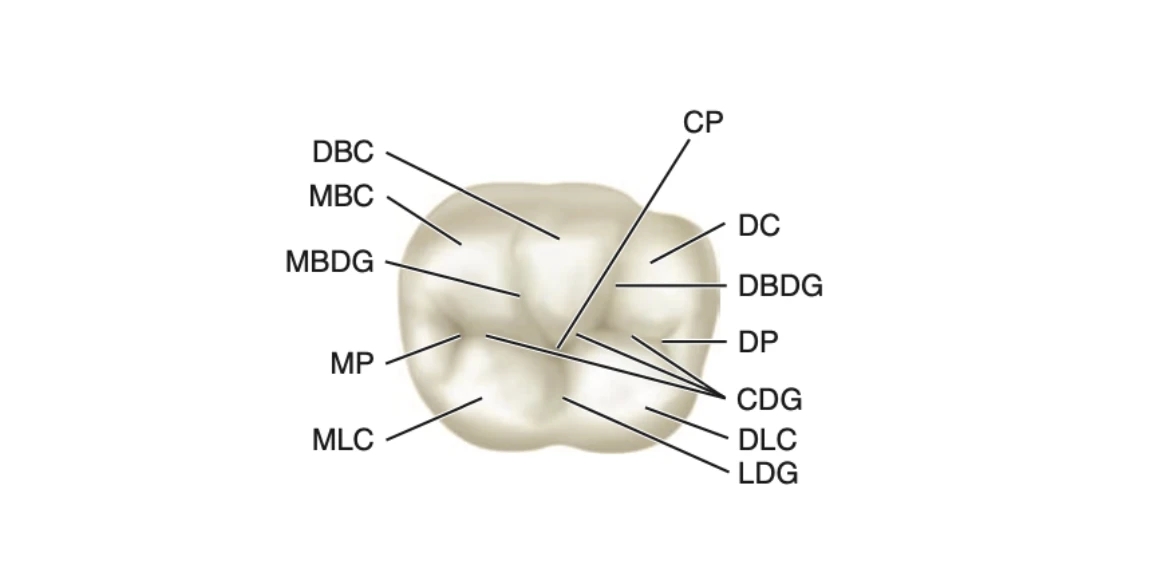
- Occlusal surface appear somewhat rectangular. The total MD width of lingual cusps is less than the total MD width of buccal cusps.
- The buccal cusps are similar in size, and the lingual cups are also equal.
- Triangular ridges are well-defined, extending from the tip of each cusp, and ends in the centre of the crown buccolingually in a central developmental groove.
- Central developmental groove follows a staggered course from the mesial triangular fossa (just inside the MMR) to the distal triangular fossa (just mesial to distal marginal ridge).
- Developmental grooves branch off from the central groove both buccally and lingually.
- Supplemental grooves are scattered over the occlusal surface on the slopes of triangular ridges and in the mesial and distal triangular fossae.
- Mesial marginal ridge (MMR) is better developed and more pronounced than the distal marginal ridge (DMR).
- Differences between deciduous lower second molar and permanent lower first molar:
| **Deciduous Lower 2nd Molar** | **Permanent Lower 1st Molar** |
|---|---|
| MB, DB and distal cusps are almost equal in size and development. | Distal cusp is smaller than the other two. |
| Crown is narrower buccolingually as compared to MD width, as the buccal cusps are smaller. | Crown is wider. |
Root Morphology
Buccal Aspect
- Roots appear slender and long, and can be twice as long as the crown.
- Have a characteristic flare mesiodistally at the middle and apical thirds.
- The point of bifurcation is immediately below the CEJ of crown and root.
Lingual Aspect
- Roots appear somewhat similar in appearance as from the buccal aspect.
Mesial Aspect
- Mesial root is unusually broad and flat with a blunt apex (sometimes serrated).
Distal Aspect
- Distal root is almost as broad as mesial root, and is flattened on the distal surface.
- It tapers more at the apical end, than the mesial root.
References
- Wheeler's Dental Anatomy, Physiology and Occlusion(2019), Stanley J. Nelson DDS MS, Elsevier.
*This article is excerpt from the above mentioned book and Medical Sutras does not make any ownership and affiliation claims.