
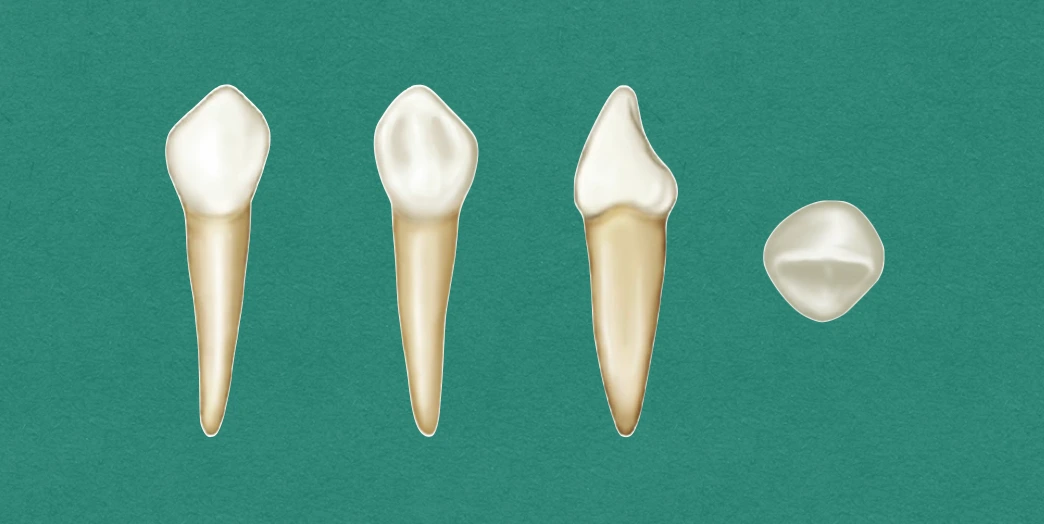
Primary mandibular canine is similar to the primary maxillary canine in functional form. The difference is mainly in the dimensions.
- Crown is 0.5 mm shorter, and the root is at least 2 mm shorter.
- Mesiodistal measurement at root trunk is greater compared to the measurement at contact areas, in contrast to the maxillary canine.
- Lower canine is thicker at the neck of the tooth.
- Primary maxillary canine is larger labiolingually.
- The labial and lingual cervical ridges are less pronounced compared to maxillary canine.
- The distal cusp slope is longer than the mesial slope in lower canine, while the opposite is found in upper canine. This aids in proper intercuspation during mastication.
Chronology
- First evidence of calcification: 17 weeks in utero.
- Crown completion: 9 months.
- Eruption: 20 months.
- Root completion: 31/4 years.
Dimensions
- Overall length: 17.5 mm.
- Crown length: 6.0 mm.
- Root length: 11.5 mm.
- Mesiodistal diameter of crown: 5.0 mm.
- Mesiodistal diameter of crown at cervix: 3.7 mm.
- Labiolingual diameter of crown: 4.8 mm.
- Labiolingual diameter of crown at cervix: 4.0 mm.
References
- Wheeler's Dental Anatomy, Physiology and Occlusion(2019), Stanley J. Nelson DDS MS, Elsevier.
*This article is excerpt from the above mentioned book and Medical Sutras does not make any ownership and affiliation claims.