
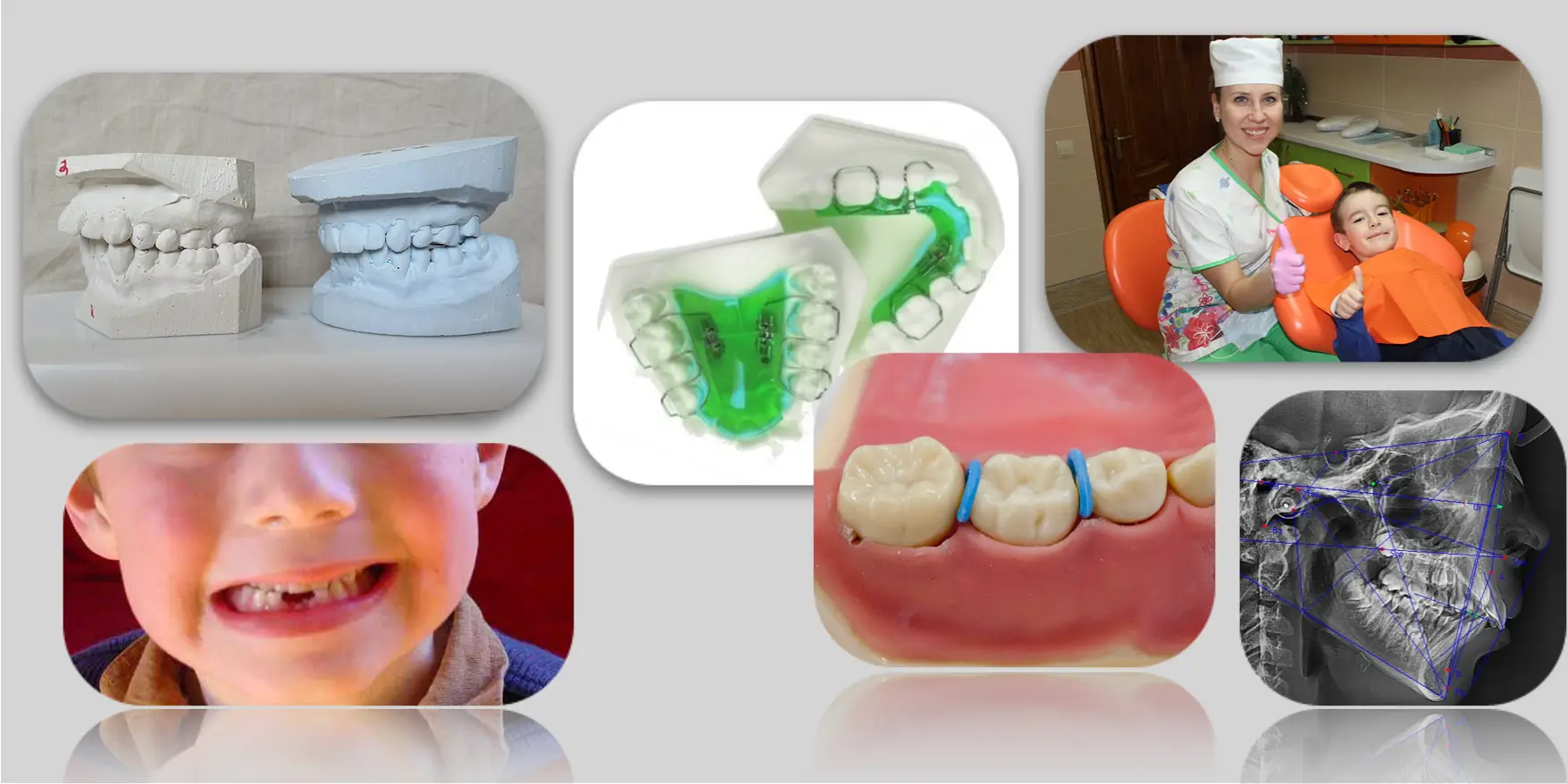
Preventive orthodontics involves the steps or actions undertaken to preserve or maintain the integrity of developing dentition and occlusion, so as to prevent development of any abnormalities or malocclusion.
American Association of Orthodontics defined interceptive orthodontics as that phase of science and art of orthodontics employed to recognise and eliminate the potential irregularities and malpositions in the developing dentofacial complex.
Preventive Orthodontics
Goal
To preserve the health and integrity of primary dentition and occlusion, upto exfoliation, so as to achieve normal growth of jaws, preserve arch length, and, allow normal eruption of the permanent teeth to their normal position.
Procedures
- Parent education and counselling.
- Caries control.
- Space maintenance: Recommended in case of premature loss of teeth, in order to preserve space for succedaneous tooth eruption.
- Management of oral habits and abnormal oral musculature.
- Management of abnormal frenal attachments: May cause diastema or excessive spacing between the teeth, and disallow the eruption of succedaneous teeth. High frenal attachments should be corrected surgically.
- Maintenance of tooth shedding time table or exfoliation of deciduous teeth: Generally, the deciduous tooth should exfoliate in about 3 months of exfoliation of the contralateral tooth.
- Treatment of locked permanent first molars (may get locked distal to the deciduous second molars): Slight distal stripping of the deciduous second molar allows the permanent first molar to erupt in its proper position.
Interceptive orthodontics
Goal
To eliminate the development of malocclusion, or, make it less severe by:
- Interception of any potentially developing malocclusion.
- Interception of adverse environmental factors, such as, oral habits, abnormal muscle function and occlusal prematurities.
- Reduction of any abnormalities or deformities that might contribute to malocclusion.
- Guidance of developing dentition.
- Prevention of premature loss of primary dentition.
Procedures
-
Space regaining: Indicated when space maintenance is not carried out on the premature loss of deciduous second molar and the permanent first molar moves mesially, resulting in the loss of arch length.
-
Correction of developing cross-bite (anterior and posterior).
-
Elimination of oral habits.
-
Removal of soft or hard tissue impediments in the pathway of eruption.
-
Interception of developing skeletal malocclusions.
-
Management/resolution of crowding: Involves the following steps,
- Observation.
- Disking of primary teeth.
- Serial extraction.
- Corrective orthodontic referral.
-
Muscle exercises: Allow the clinician to bring aberrant muscular functions into normal functioning, to create normal health and function that aids in the development of normal occlusion.
Parent Education & Counselling
This is the most effective way to practice preventive orthodontics, and can be divided into prenatal and postnatal counselling.
Prenatal Counselling
- Concerned about the importance of oral hygiene maintenance by the mother.
- The mother should be advised to have natural foods containing calcium and phosphorus e.g. milk, milk products, egg, etc. especially during the third trimester, as this would allow adequate formation of deciduous teeth crowns.
Postnatal Counselling
Associated with the clinical examination of the child.
6 months - 1 year
- Awareness about teething, associated irritation, and slight loose motions (possible in mildly elevated febrile condition).
- Prefer mother's milk as it is best for TMJ development and non-development of tongue thrusting habits.
- No sugar addition to bottle milk.
- Introduce brushing with the help of a finger brush during bathing.
- Cleaning of the deciduous dentition with a clean, soft cotton cloth dipped in warm saline is also recommended, to prevent the initiation of nursing or rampant caries.
- Child should initiate to drink from a glass by one year of age.
2 years of age
- Bottle-feeding, if previously initiated should never be given during the passage to sleep.
- Bottle-feeding to be withdrawn completely by 18-24 months of age, as this would decrease the chances of nursing caries.
- Brushing to be initiated post-breakfast and post dinner.
- Clinical examination to assess any incipient decay and eruption status of teeth.
3 years of age
- Parents to be informed about oral habits and their effects on the development of occlusion.
- Child to be encouraged to begin brushing on his own at least once a day, preferably post breakfast.
- Clinical examination to assess the eruption of full complement of deciduous dentition, occlusion, molar and canine relationships and presence of any discrepancies away from the normal. Also, check for incomplete eruption of deciduous second molars or peri-coronal flaps, that may lead to decay on the same.
5-6 years of age
- Parents to be informed about the initiation of exfoliation of deciduous teeth and that it would go up to 12-13 years of age
- In case of extraction of deciduous teeth, the importance of space maintainers should be explained.
- Advice to get reviewed at regular intervals.
Caries Control
The proximal caries in deciduous dentition may result in the tilting of adjacent tooth into the proximally decayed area, resulting in loss of arch length and lesser space for the eruption of succedaneous tooth.
The treatment options include,
- Restoration, in mild to moderate caries without pulp involvement.
- Pulpotomy or pulpectomy, followed by SS crown, in case of pulp exposure.
References
- Orthodontics Diagnosis and Management of Malocclusion and Dentofacial Deformities (3rd edition), Om Prakash Kharbanda, Elsevier India (2020).
- Textbook of Orthodontics (2nd Edition), Gurkeerat Singh, Jaypee Brothers Medical Publishers (P) Ltd.
- Images Source: Wikimedia Commons.
*This article is an excerpt from the above mentioned books and Medical Sutras does not make any ownership or affiliation claims.