
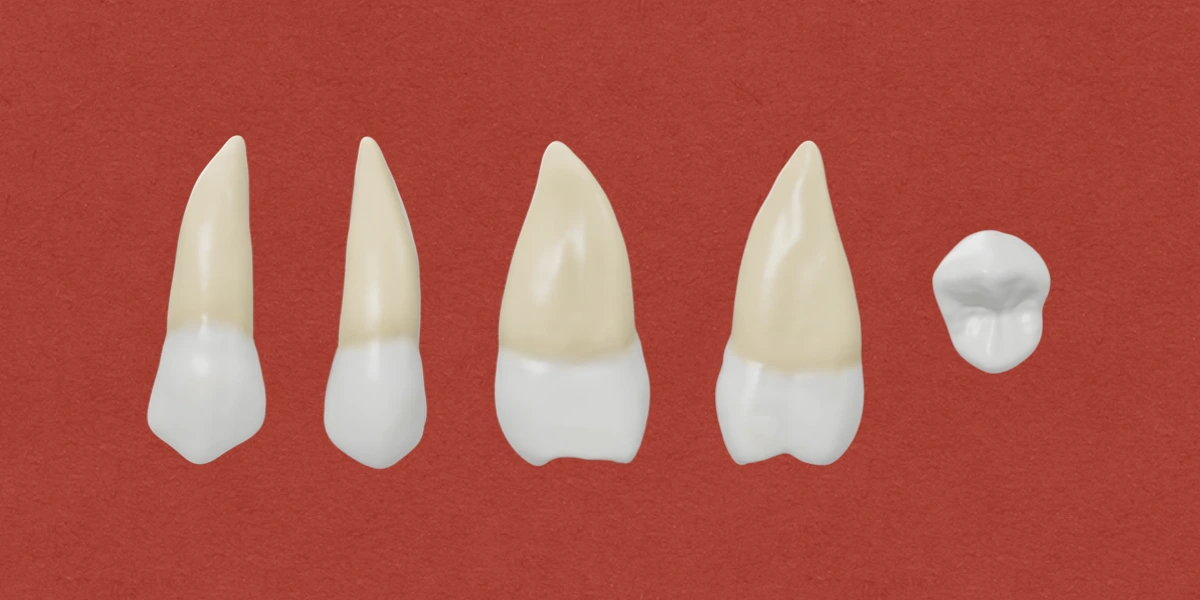
There are two permanent maxillary second premolars, one on each side of the maxillary arch. They are positioned 5th from the midline, posterior/distal to maxillary first premolar and anterior/mesial to the maxillary first molar.
- They are named premolars as they are present before the molars in sequence, when we count from anterior to posterior (from the midline).
- The premolars are also referred as bicuspids, as they usually have 2 cusps (Exception: Mandibular 1st premolars - Often have only one functional cusp, and Mandibular 2nd premolars - Often present 3 cusps).
Functions
The second premolars supplement first premolars in function and helps in:
- Crushing or grinding the food
- Providing support to the cheeks
- Maintaining vertical dimension of the face.
Chronology
| **Developmental Stage** | **Timeline** |
|---|---|
| First evidence of calcification | 24-27 months |
| Crown formation | 6-7 years |
| Eruption into oral cavity | 10-12 years |
| Root completion | 12-14 years |
Dimensions
- Overall length: 22.5 mm
- Crown length: 8.5 mm
- Root length: 14.0 mm
- Mesiodistal diameter of crown: 7.0 mm
- Mesiodistal diameter of crown at cervix: 5.0 mm
- Buccolingual diameter of crown: 9.0 mm
- Buccolingual diameter of crown at cervix: 8.0 mm
- Curvature of cervical line: 1.0 mm (Mesial), 0.0 mm (Distal)
Surfaces, Line Angles, Point Angles
- Surfaces (5): Buccal, Lingual, Mesial, Distal, Occlusal
- Line Angles (8): Mesiobuccal, Distobuccal, Mesiolingual, Distolingual, Buccoocclusal, Distoocclusal, Linguoocclusal, Mesioocclusal
- Point Angles (4): Mesiobuccoocclusal, Distobuccoocclusal, Mesiolinguoocclusal, Distolinguoocclusal
Buccal Aspect
Crown
- Shape: Trapezoidal with the shorter side toward the cervical line.
- Surface: Buccal surface generally convex, with less pronounced developmental depressions. The buccal ridge is not as prominent as seen in maxillary first premolar.
- Crown outlines: The mesial outline is slightly convex from cervical line to the mesial cusp slope, with the crest of curvature near the junction of middle and occlusal thirds (occlusal to the centre of the crown). The distal outline is more convex than mesial outline and the crest of curvature is in the middle third of the crown. The occlusal outline is formed by the buccal cusp tip and its mesial and distal slopes. The cervical outline is curved, with the curvature in the apical direction.
- Buccal cusp: The buccal cusp tip is less pointed than that of maxillary first premolar. The mesial slope of the buccal cusp is shorter than the distal slope (in contrast to maxillary first premolar where the mesial slope is longer than the distal slope.
- The crown is thicker at the cervical portion, compared to maxillary first premolar.
Root
- Usually single and conical; may occasionally be bifurcated at apex, but this is rare.
- Root is narrow mesiodistally, broad buccolingually.
- Apex is blunt and may show distal curvature.
Lingual Aspect
Crown
- Shape: Trapezoidal; both mesial and distal outlines similar to buccal aspect.
- Lingual cusp: Nearly as long as buccal cusp, making the crown appear more symmetrical and less inclined than maxillary first premolar.
- Surface: Broader and longer than maxillary first premolar; generally smooth and convex.
Root
- Narrow mesiodistally, broader buccolingually; tapers evenly from cervix to apex.
- Apex blunt, may curve slightly distally.
Mesial Aspect
Crown
- Shape: Trapezoidal with longer of uneven sides toward the cervical portion.
- Surface: Smooth and convex, with no developmental depression on the surface, or developmental groove crossing the marginal ridge.
- Outlines: Buccal outline is convex near the cervix and becomes straight or less convex as it reaches the buccal cusp tip. Lingual outline is convex from the cervix to the lingual cusp tip. The crest of curvature on the buccal side is located at the junction of cervical and middle third, while it is at the near the centre of middle third on the lingual side. The occlusal outline is formed by the mesial marginal ridge and is often straight with concavity in cervical direction. The cervical outline is slightly curved (1mm) in the occlusal direction.
- Cusps: Buccal and lingual cusps are almost equal in length, in contrast to maxillary first premolar where lingual cusp is around 1mm smaller. Also, the intercuspal distance is greater in second premolar, widening the occlusal surface buccolingually.
- Contact area: Located occlusal to the centre of the crown cervico-occlusally, and is broader than maxillary first premolar.
Root
- Appears broad buccolingually, narrow mesiodistally.
- Mesial depression is shallow compared to the distal.
- Apex is blunt.
Distal Aspect
Crown
- Similar to mesial aspect, but cervical line is straighter (Curvature of cervical line: 0mm on distal side, 1mm on mesial side).
- Distal contact area is at same level as mesial.
- No developmental groove on the distal surface, or depression crossing the marginal ridge.
Root
- Distal developmental depression is deeper than mesial - important for clinical procedures especially during scaling and root planing. A correct knowledge of the root depressions facilitates appropriate periodontal instrumentation. (In maxillary first premolar, the root depression is on the mesial side.)
- Apex is blunt, with possible distal curvature.
Occlusal Aspect
- Shape: Oval or rounded outline rather than hexagonal shape seen in maxillary first premolar. The crown is less angular, with less prominent buccal line angles. Also, the lingual taper is less, since both buccal and lingual cusps are of similar size.
- Dimensions: Greater buccolingual than mesiodistal dimension.
- Cusps: Buccal and lingual cusps are well-formed and almost equal in size, with blunt cusp tips and positioned in the same plane.
Elevations
- Mesiobuccal cusp ridge and distobuccal cusp ridge extends from the buccal cusp tip to mesiobuccal and distobuccal line angles respectively.
- Mesial and distal marginal ridges are strong and well developed. Compared to maxillary first premolar, no mesial marginal developmental groove is seen crossing the MMR.
- Buccal and lingual triangular ridges are not prominent as seen in maxillary first premolar.
Depressions
- Central developmental groove is shorter and more irregular compared to that seen in maxillary first premolar.
- Multiple supplementary grooves are seen radiating from the central groove, giving a "wrinkled" appearance to the occlusal surface.
- Pits: Mesial and distal pits are closer together due to the short central groove.
- Fossae: Mesial and distal triangular fossae are shallow, often with supplementary grooves.
Key Identification Features
- Buccal and lingual cusps nearly equal in size.
- Mesial slope of buccal cusp shorter than the distal slope.
- No developmental depression on the mesial surface.
- No developmental groove crossing mesial marginal ridge.
- Crown less angular and more rounded than maxillary first premolar.
- Central groove short, occlusal surface appears "wrinkled" due to many supplementary grooves.
Root Morphology
| **Feature** | **Description** |
|---|---|
| Number | Single root, generally not bifurcated |
| Length | Similar or a little longer than first premolar root |
| Form | Narrow mesiodistally, broad buccolingually |
| Depression | Deeper on distal surface of root |
| Apex | Blunt, may show slight distal curvature |
References
- Wheeler's Dental Anatomy, Physiology and Occlusion(2019), Stanley J. Nelson DDS MS, Elsevier.
- Rashmi GS Phulari, Textbook of Dental Anatomy Physiology and Occlusion, Jaypee Brothers Medical Publishers
*This article is excerpt from the above mentioned book and MedicalSutras does not make any ownership and affiliation claims.