
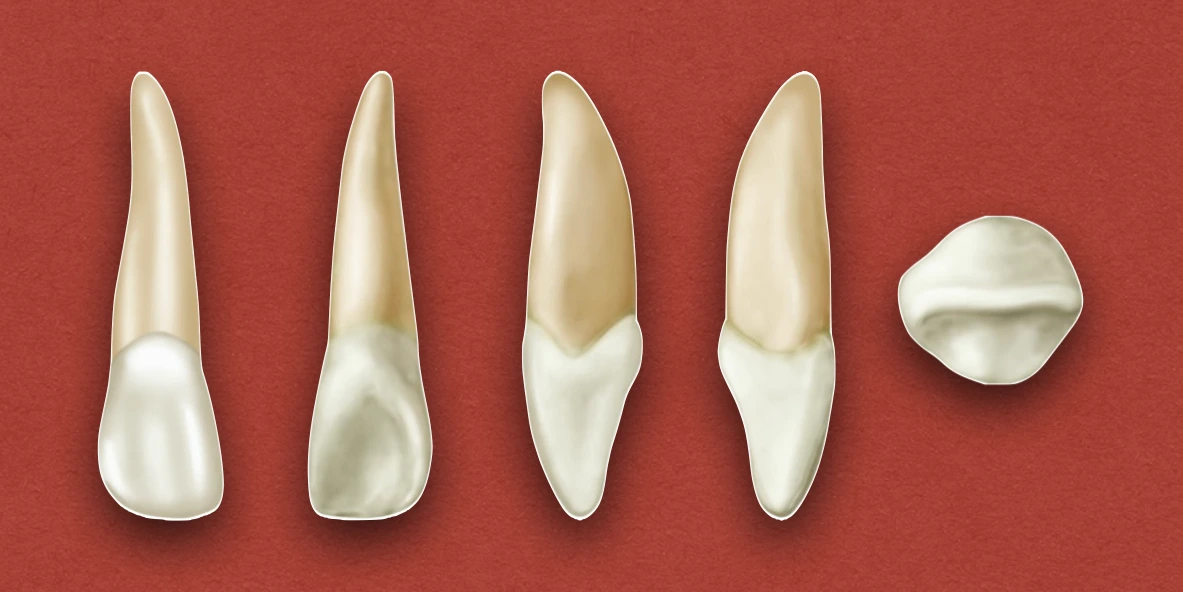
The permanent maxillary lateral incisors bear a close resemblance to central incisors, as they supplement central incisors in function. However, they are smaller in all dimensions, except root length.
Lateral incisors show most variation in form than any other tooth in the mouth, except the third molar. Some of the variations seen include:
- Peg-shaped laterals, most common variation presenting a nondescript, pointed form.
- Large, pointed tubercle as part of cingulum.
- Deep developmental grooves extending down on the root lingually, with a deep fold in the cingulum.
- Twisted roots, distorted crowns, etc.
- In some cases, the lateral incisors may be completely missing. In such cases, the central incisor may be in contact with the canine.
Chronology
- First evidence of calcification: 10-12 months.
- Crown completion: 4-5 years.
- Eruption: 8-9 years.
- Root completion: 11 years.
Dimensions
- Overall length: 22.0 mm.
- Crown length: 9.0 mm.
- Root length: 13.0 mm.
- Mesiodistal diameter of crown: 6.5 mm.
- Mesiodistal diameter of crown at cervix: 5.0 mm.
- Labiolingual diameter of crown: 6.0 mm.
- Labiolingual diameter of crown at cervix: 5.0 mm.
- Curvature of cervical line (Mesial): 3.0 mm.
- Curvature of cervical line (Distal): 2.0 mm.
Crown Morphology
Labial Aspect
- The labial surface is more convex as compared to central incisor, except in some square and flat-faced forms. It presents a rounded incisal ridge and incisal angles mesially and distally.
- Mesial outline resembles that of central incisor, with a more rounded mesioincisal angle. The crest of contour is usually at the point junction of middle and incisal thirds.
- Distal outline is more rounded and crest of contour is more cervical, usually in the center of the middle third. In some cases, a semicircular outline is seen from the cervix to the center of the incisal ridge.
- Mesiodistal width is approximately 2 mm narrower, and the cervico-incisal length is 2-3 mm shorter than the central incisor.
Lingual Aspect
- Presents marked mesial and distal marginal ridges and prominent cingulum, with a tendency towards deep developmental grooves within the lingual fossa, where it joins the cingulum.
- Linguoincisal angle is well developed, and lingual fossa is more concave and circumscribed than that found on the central incisor.
- The tooth tapers towards the lingual, similar to the central incisor.
- Deep developmental groove can be found on the side of the cingulum, extending into part or full length of the root. In the deep portion of these developmental grooves, faults in enamel are often found.
*The presence of palatogingival/palatoradicular groove in maxillary incisors may be a predisposing factor in localised periodontal disease.
Mesial Aspect
- From the mesial aspect, the tooth morphology is similar to that of a small central incisor. The crown is shorter, and the root is relatively longer.
- Labiolingual measurement of crown is 1 mm or so less than that of central incisor.
- Cervical line curvature is marked in the direction of incisal ridge, the extent being less than that of central incisor.
- Incisal ridge is heavily developed and appears thicker than that of the central incisor.
Distal Aspect
- Labiolingual width of the crown appears thicker distally than it does on the mesial aspect.
- Depth of the cervical line curvature is about 1 mm less than that on the mesial side.
- Development groove is commonly found, extending on the entire root or part of its length.
Incisal Aspect
- It may resemble with the incisal aspect of the central incisor except in size.
- They exhibit more convexity (labially and lingually) as compared to the central incisors.
- However, in some cases, it may resemble a small canine, with large cingulum and incisal ridge, and labiolingual dimension greater than the mesiodistal dimension.
Root Morphology
Labial Aspect
- The root is approximately 1.5 times the length of the crown. It is usually as long, or somewhat longer than that of the central incisor.
- Root tapers evenly from the cervical line to a point approximately two-thirds of its length apically, after which it often curves sharply in a distal direction, and ends in a pointed apex.
- Typically, distal curvature is seen, however, some roots are straight.
Lingual Aspect
- Developmental groove from the side of the cingulum, can extend on to the root for part or all of its length.
Mesial Aspect
- The root appears as a tapered cone, with a bluntly rounded apical end. It is relatively longer than that of central incisor.
- The apex may show variation and may be quite blunt in some cases, or pointed in others.
- The labial outline is straight, and the labiolingual measurement of root is 1 mm or so less than that of central incisor.
- A line drawn through the center of the root tends to bisect the incisal ridge of the crown, similar to the central incisor.
References
- Wheeler's Dental Anatomy, Physiology and Occlusion(2019), Stanley J. Nelson DDS MS, Elsevier.
*This article is excerpt from the above mentioned book and Medical Sutras does not make any ownership and affiliation claims.