
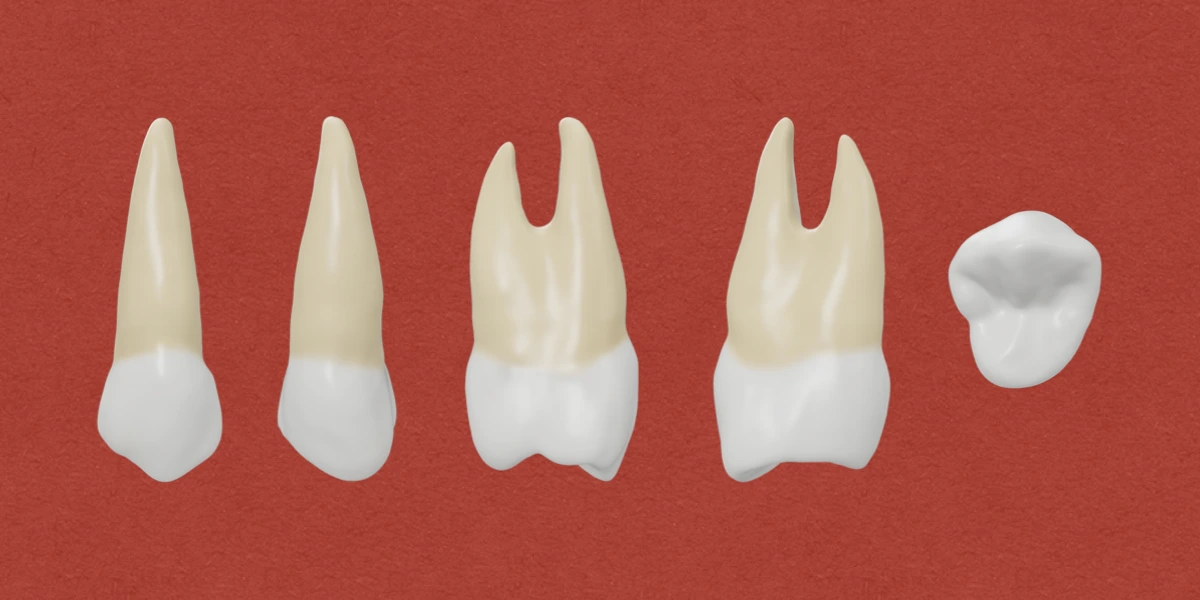
The permanent maxillary first premolar is the 4th tooth from the midline and the first posterior tooth in the maxillary arch.
There are four permanent maxillary premolars, two on each side of the maxillary arch. They are positioned posterior to the canines and lies anterior to molars. Hence, the name premolars as they are present before molars.
They are also referred as bicuspids, as they usually have 2 cusps (buccal and lingual). However, the term is somewhat misleading, since lower 1st premolar have only one functional cusp and lower 2nd premolar often presents three cusps.
Function
- Crush and grind food in conjunction with the molars.
- Assist canines in tearing of food.
- Provide support to cheek near corners of mouth.
- Helps in maintaining aesthetics during smile.
Tooth Notation
- FDI system: 14 (Maxillary right 1st premolar) and 24 (Maxillary left 1st premolar)
- Universal system: 5 (Maxillary right 1st premolar) and 12 (Maxillary left 1st premolar)
- Zsigmondy-Palmer system: 4| (Maxillary right 1st premolar) and |4 (Maxillary left 1st premolar)
Chronology
Similar to the anterior teeth, the maxillary first premolar also develops from 4 lobes:
- 3 Buccal lobes (Mesiobuccal, Middle buccal, Distobuccal): The middle buccal lobe forms the buccal cusp.
- 1 Lingual lobe: Forms the lingual cusp.
| **Event** | Timeline |
|---|---|
| First evidence of calcification | 18-21 months |
| Crown completion | 5-6 years |
| Tooth eruption | 10-11 years |
| Root completion | 12-13 years |
Dimensions
- Overall length: 22.5 mm
- Crown length: 8.5 mm
- Root length: 14.0 mm
- Mesiodistal diameter of crown: 7.0 mm
- Mesiodistal diameter of crown at cervix: 5.0 mm
- Buccolingual diameter of crown: 9.0 mm
- Buccolingual diameter of crown at cervix: 8.0 mm
- Curvature of cervical line: 1.0 mm (Mesial), 0.0 mm (Distal)
The buccolingual dimension exceeds the mesiodistal dimension, giving the crown an angular and prominent appearance.
Surfaces, Line Angles, Point Angles
- Surfaces (5): Buccal, Lingual, Mesial, Distal, Occlusal
- Line Angles (8): Mesiobuccal, Distobuccal, Mesiolingual, Distolingual, Buccoocclusal, Distoocclusal, Linguoocclusal, Mesioocclusal
- Point Angles (4): Mesiobuccoocclusal, Distobuccoocclusal, Mesiolinguoocclusal, Distolinguoocclusal
Buccal Aspect
Crown
- Outline: Trapezoidal with shorter of uneven sides toward the cervix.
- Buccal surface: It is convex and shows prominent buccal ridge (developed from middle buccal lobe). The buccal ridge extends from cusp tip to cervical margin. On either side of the ridge, developmental depressions are seen at or occlusal to the middle third. These depressions serve as demarcations between the middle buccal lobe, and mesiobuccal and distobuccal lobes.
- Buccal cusp: It is long and pointed, resembling the cusp of maxillary canine (but comparatively shorter and less pointed). The cusp tip lies distal to the line bisecting buccal surface of the crown.
- Mesial outline: It is slightly concave near the cervix, followed by a broad curvature/convexity of the mesial contact area upto the mesial cusp slope. The crest of curvature lies immediately occlusal to the middle of the crown. The mesial slope of buccal cusp is generally straight, however sometimes presents a notch or concavity.
- Distal outline: It is straighter than the mesial outline between the cervical line and contact area. The curvature of distal contact area is broader than the mesial contact area and the crest of curvature tends to be little more occlusal. The distal slope of buccal cusp is usually shorter than the mesial slope.
- Cervical line: It shows convexity towards the apex, with crest of curvature near the centre of the root.
*The contact areas in posterior teeth are more nearly at level with each other than anterior teeth.
Root
- Often two in number (buccal and lingual), occasionally single with two canals.
- Buccal root is longer, slender and often curves distally at the apical third.
- Bears a close resemblance to the maxillary canine, although it is 3-4 mm shorter.
- The buccal root apex is sharp, while the lingual is blunter.
Lingual Aspect
Crown
- Outline: Trapezoidal. It is similar to the buccal side, but narrower as the crown tapers lingually. Due to lingual taper of the crown and smaller lingual cusp, the buccal cusp tip (with mesial and distal slopes) is visible from the lingual aspect.
- Lingual surface: It is smooth and spheroidal from the cervical portion to the area near the cusp tip, making it convex at all points. Sometimes, lingual ridge is seen when the crest of the lingual portion terminates at the point of lingual cusp.
- Lingual cusp: It is smaller mesiodistally than the buccal cusp. The cusp tip is pointed, with mesial and distal slopes meeting at an angle of 90o. The cusp tip is located slightly mesial to the long axis of the tooth.
- Mesial & Distal outlines: Convex, and continuous with mesial and distal slopes of lingual cusp. The outlines straighten out at the cervical portion, as they join the mesial and distal sides of lingual root.
- Cervical line: Regular with slight curvature towards the root and crest of curvature centred on the root.
Root
- It is smooth and convex at all points.
- Lingual root is narrower mesiodistally than the buccal root, but equally long, often aligned with the lingual cusp tip.
- Apex of lingual root in double-rooted premolars tend to be more blunt than the buccal root apex.
Mesial Aspect
Crown
-
Outline: Roughly trapezoidal, with the longer of the uneven sides toward the cervical portion and shorter side occlusally.
-
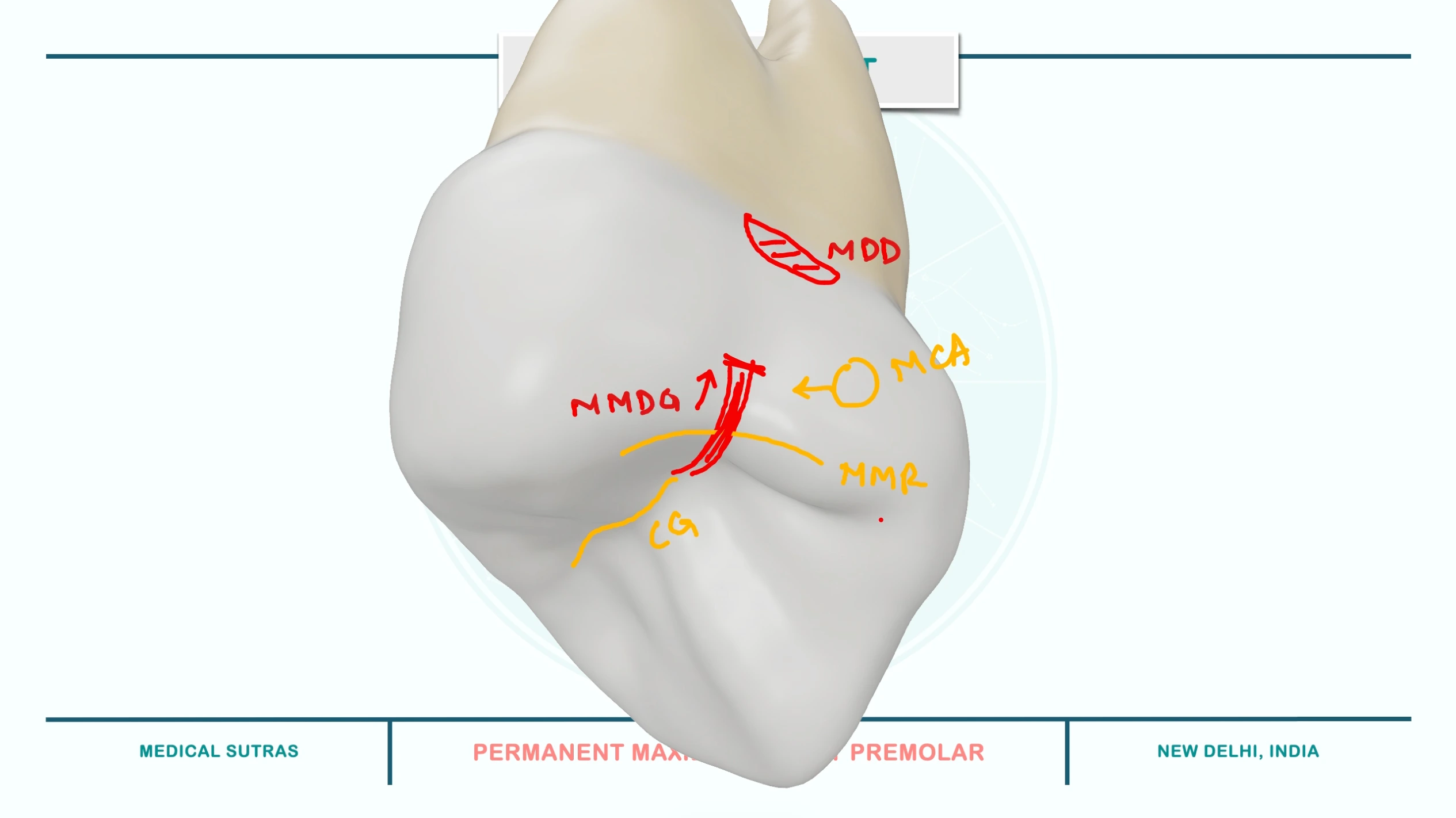
Mesial Surface: Presents two unique distinguishing features:
- Mesial developmental depression: It is a marked depression/concavity at the centre of the mesial surface, immediately cervical to the mesial contact area. It extends apically beyond the cervical line, joins a deep developmental depression between the roots and ends at the root bifurcation.
- Mesial developmental groove: It refers to the well-defined developmental groove present in the enamel of mesial marginal ridge. It extends from the central groove, crosses the mesial marginal ridge immediately lingual to the mesial contact area, and terminates at a short distance cervical to the mesial marginal ridge on the mesial surface. This groove is in alignment with the mesial developmental depression, but not usually connected with it.
-
Cusps
- The lingual cusp is always shorter than the buccal cusp (average difference 1mm).
- The tip of buccal and lingual cusps are within the confines of the root trunk i.e., the distance from buccal cusp tip to lingual cusp tip is less than the buccolingual measurement of the root at cervical portion.
- In premolars having two roots, the buccal cusp tip is directly below the centre of the buccal root, while the lingual cusp tip is in line with the lingual border of lingual root.
-
Buccal outline: It is convex in the cervical region, with the crest of curvature located approximately at the junction of cervical and middle thirds. From the crest of curvature to the tip of buccal cusp, the outline becomes less convex.
-
Lingual outline: It presents as a smooth curved line (more convex) starting from the cervical line and ending at the lingual cusp tip. The crest of curvature is usually near the centre of middle third.
-
Occlusal outline: It is formed by the Mesial Marginal Ridge which is slightly concave, with he height of contour at the centre of the middle third.
-
Cervical line: It may be regular or irregular in outline with slight convexity toward the occlusal (within a fraction of a millimetre). The curvature occlusally is less than the cervical curvature on the mesial side of anterior teeth.
Root
- The buccal and lingual roots are clearly outlined from the mesial aspect.
- The root surface is smooth and convex buccally and lingually, expect for deep developmental groove and depression at or cervical to the bifurcation.
- The developmental depression is present for most of the root length, even when only one root is present. In such cases, roots with buccal and lingual outlines end in a blunt apex above the center of the crown.
- Root trunk: It is long and makes up about half of the root length. When bifurcated, bifurcation is for half of the root length. In teeth with two roots, the bifurcation begins more occlusally on the mesial side than distally.
- Buccal outline of buccal root is straight near the cervical line, with a tendency towards lingual inclination. Apical to the middle third, the buccal roots may take a buccal or lingual inclination.
- Lingual outline of lingual root is straight, and may not exhibit much curvature between the cervix and apex. However, in many premolars, considerable curvature to lingual roots is seen apical to middle thirds. The lingual root may take a buccal or lingual inclination.
Distal Aspect
Crown
- Outline/Shape: Trapezoidal, similar to mesial aspect but smoother.
- Distal surface: The surface is convex at all points, except for a small, flattened arc just cervical to the contact area and buccal to the centre of distal surface. No developmental depression is seen in contrast to the mesial side (Mesial developmental depression).
- Buccal and Lingual outlines are convex and similar to the mesial aspect. The contact area is located at approximately the same level as mesial side, slightly more buccally placed.
- Cervical line: Often straight or nearly flat, with the curvature less than that on the mesial side.
- Developmental groove crossing the distal marginal ridge is not evident, and even if it noticeable, it is shallow and insignificant.
Root
- Root trunk is flattened on the distal surface above the cervical line with no outstanding developmental signs.
- Bifurcation of roots is abrupt near the apical third, with no developmental groove leading to it (as found mesially).
Occlusal Aspect
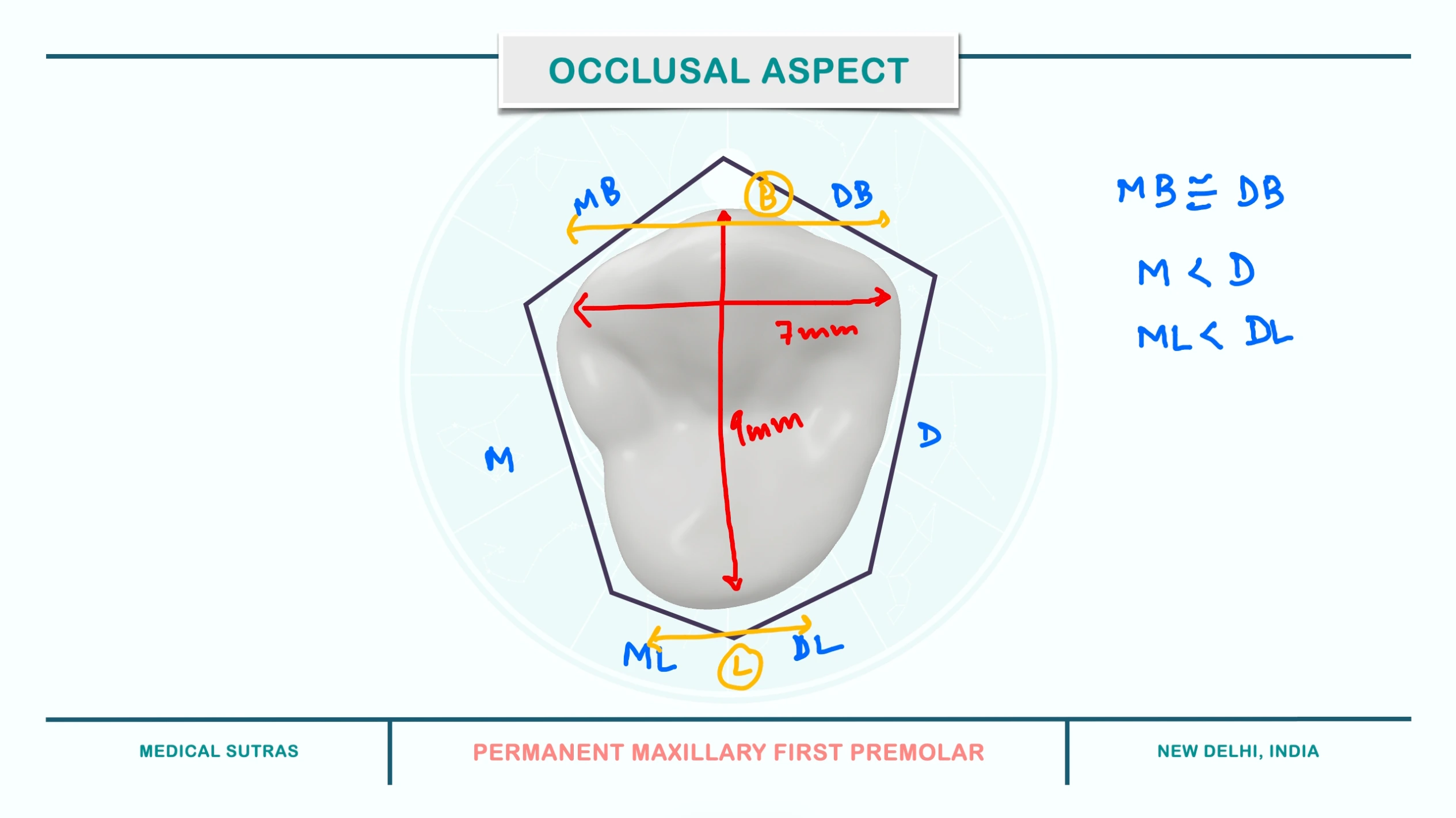
- Shape: Roughly hexagonal (six-sided). The hexagon is made up of MB, DB, Distal, DL, ML and Mesial sides. However, the sides are not equal - the two buccal sides are nearly equal, the mesial side is smaller than the distal side, and the ML side is shorter than the DL side.
- The occlusal surface is circumscribed by the cusp ridges and marginal ridges.
- The Buccolingual dimension (7mm) is greater than the Mesiodistal measurement (5mm). Also, the crown is wider on the buccal side than lingually.
-
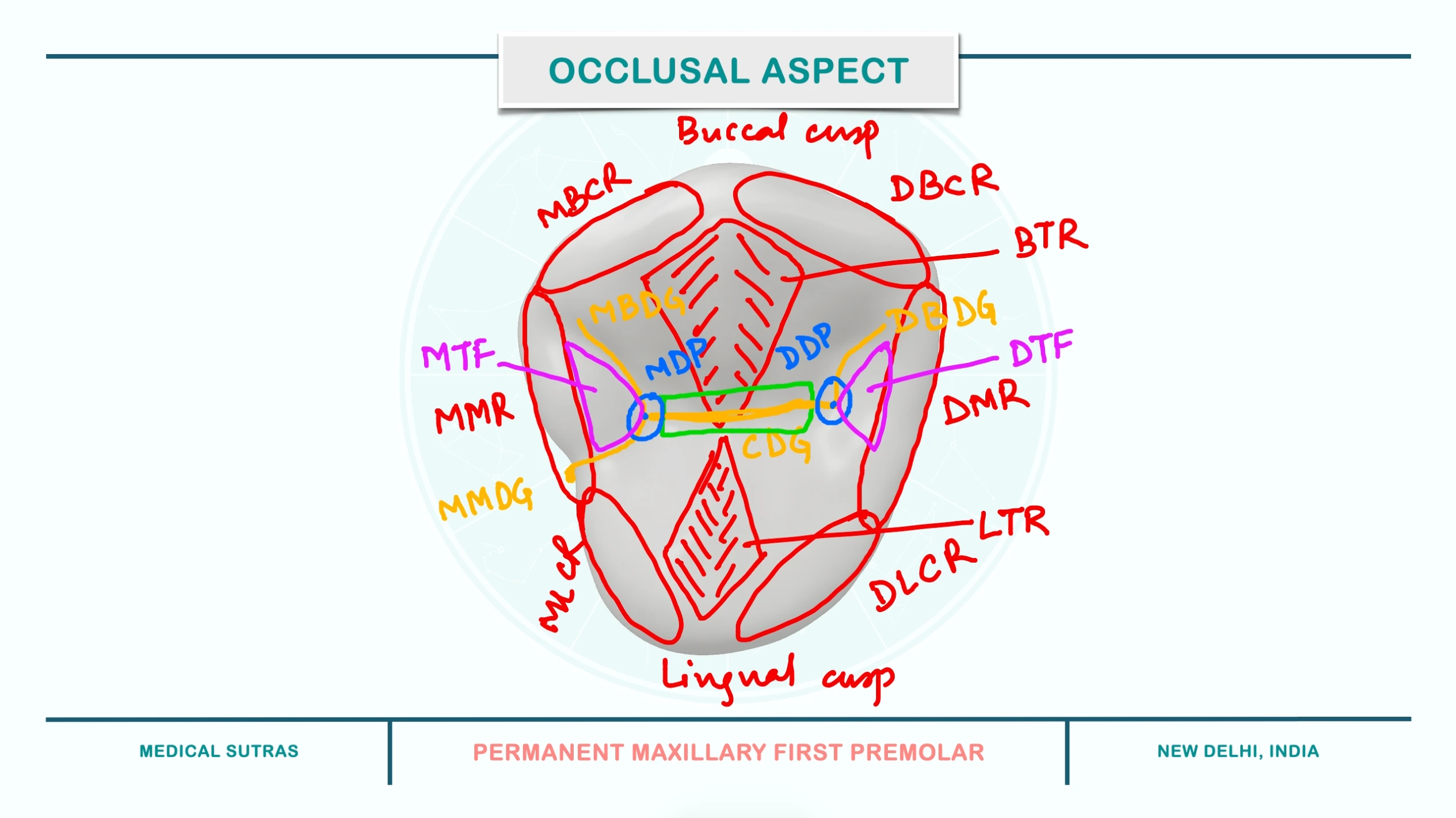
Important features on the occlusal surface include:
- Cusps: Buccal cusp and Lingual cusp
- Ridges: Mesiobuccal cusp ridge, Distobuccal cusp ridge, Mesiolingual cusp ridge, Distolingual cusp ridge, Buccal triangular ridge, Lingual triangular ridge, Mesial marginal ridge, Distal marginal ridge.
- Grooves: Central developmental groove, Mesial marginal developmental groove, Mesiobuccal developmental groove, Distobuccal developmental groove.
- Pits: Mesial developmental pit, Distal developmental pit.
- Fossae: Mesial triangular fossa, Distal triangular fossa.
References
- Wheeler's Dental Anatomy, Physiology and Occlusion(2019), Stanley J. Nelson DDS MS, Elsevier.
*This article is excerpt from the above mentioned book and MedicalSutras does not make any ownership and affiliation claims.