
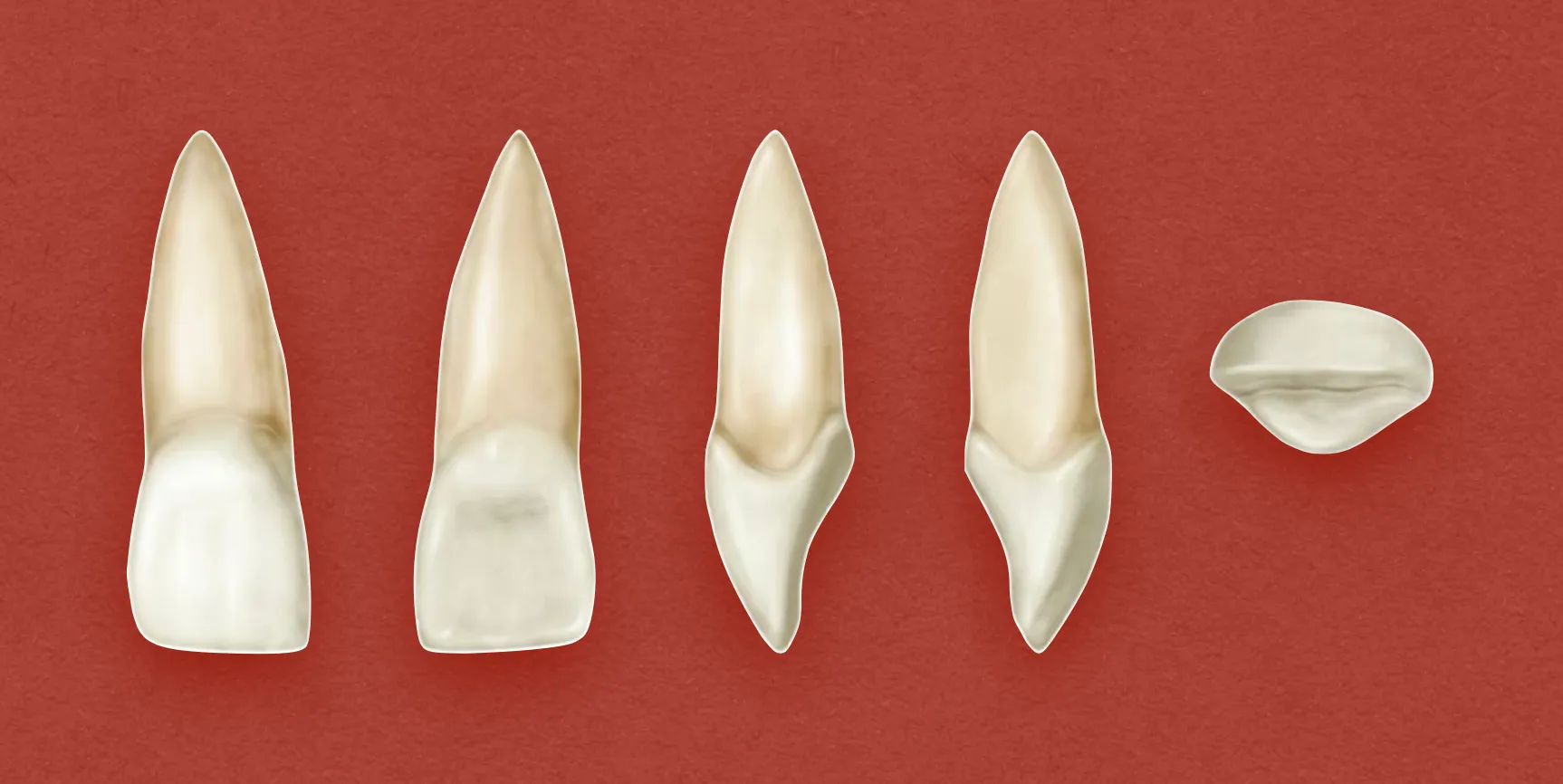
Permanent maxillary central incisors are the most prominent teeth, and the crown present two basic forms when viewed from the labial aspect:
- Relatively wide at the cervix in comparison to the MD width at the contact areas.
- Relatively narrow at the cervix in comparison with the MD width at the contact areas.
The tooth develops normally, and the crown sizes are gender dimorphic (larger in males than females). Sometimes, the following variations/anomalies are found:
- Short root.
- Unusually long crown.
Chronology
- First evidence of calcification: 3-4 months.
- Crown completion: 4-5 years.
- Eruption: 7-8 years.
- Root completion: 10 years.
Dimensions
- Overall length: 23.5 mm
- Crown length: 10-11 mm
- Root length: 13.0 mm
- Mesiodistal diameter of crown: 8-9 mm
- Mesiodistal diameter of crown at cervix: 7.0 mm
- Labiolingual diameter of crown: 7.0 mm
- Labiolingual diameter of crown at cervix: 6.0 mm
- Mesial curvature of cervical line: 3.5 mm
- Distal curvature of cervical line: 2.5 mm
Crown Morphology
Labial Aspect
- The surface is generally smooth, and the tooth looks symmetric, regularly formed, and square or rectangular shaped.
- In newly erupted tooth, mamelons can be seen on the incisal ridge (middle mamelon is the smallest). Also, developmental lines divides the surface into three parts (most noticeable at the middle portion).
- Mesial outline is straight (only slightly convex), with the crest of curvature approaching the mesioincisal angle.
- Distal outline is more convex than the mesial outline, and the crest of curvature is higher (apical) towards the cervical line.
- Mesioincisal angle is sharper than the distoincisal angle (extent of curvature depends on the form of the tooth).
- The crest of curvature on the mesial and distal side represent the contact areas, and any change in the position of this crest affects the level of the contact area.
- Incisal outline is usually regular and straight in a mesiodistal direction, and tends to curve downward toward the center of the crown outline. This makes the crown longer at the center that at the two mesial angles.
- Cervical outline follows a semicircular direction with the curvature towards the root.
Lingual Aspect
- Lingual outline is opposite of that found on the labial aspect. The surface is more irregular, with convexities and a concavity (the largest part of the middle and incisal portions being concave).
- The concavity, known as lingual fossa is bounded by the mesial and distal marginal ridges, lingual portion of the incisal ridge, and the cingulum. This gives a scooplike form to the crown.
- Developmental grooves extends from the cingulum into the lingual fossa.
- Mesial and distal outlines present as marginal ridges, that are confluent with the cingulum.
- The lingual portion of incisal ridge (linguoincisal edge) is somewhat raised, being on a level with the marginal ridges.
- Cervical outline is similar to the labial aspect, but, a smooth convexity known as cingulum is present immediately below the cervical line.
- Shovel-shaped incisor is a genetically determined variation that presents with exaggerated marginal ridges. It is seen in Mongoloid races, incl. North and South American Indians.
- The crown measurement at lingual line angles is less than that at the labial line angles as the crown taper lingually.
Mesial Aspect
- The crown appears wedged-shaped or triangular, with the base at the cervix and apex at the incisal ridge.
- Labial and lingual outline presents crests of curvature immediately coronal to the cervical line, and continues with the outlines of the incisal ridge.
- Labial outline is very slightly convex from the crest of curvature to the incisal ridge.
- Lingual outline is convex at the cingulum, then becomes concave at the mesial marginal ridge, and again, slightly convex at the linguoincisal ridge and the incisal edge.
- Incisal ridge is in line with the center of the root (characteristic of maxillary central and lateral incisors). A line drawn through the center of the tooth usually bisects the apex of the rooth and incisal ridge of the crown, and rarely passes lingual to the incisal edge.
- Cervical line curves incisally to a noticeable degree, and depends on the length of the crown and labiolingual measurement of the crown (3-4 mm for 10-11 mm crown length). This cervical curvature is greater than on any surface of any other tooth.
Distal Aspect
- There is little difference between the mesial and distal outlines.
- Crown appears somewhat thicker towards the incisal third, because the labial surface slopes distolingually and more of the labial surface is seen from the distal aspect.
- Cervical line curvature is lesser in extent than that on the mesial surface.
Incisal Aspect
- The incisal edge is centred over the root, and superimposes the root entirely. The crown conforms to a triangular outline reflected by the outline of the root cross-section at the cervix.
- Labial face is relatively broad and flat in comparison to the lingual surface, esp. towards the incisal third. However, the cervical portion labially is convex (broad arc shaped).
- Incisal edge is easily differentiated from the remaining incisal ridge with its slope toward the lingual.
- Lingual portion tapers lingually toward the cingulum, which makes up the cervical portion of the lingual surface.
- The mesiodistal calibration at the labial line angles (mesiolabial and distolabial) is greater than that at the lingual line angles (mesiolingual and distolingual).
- The labiolingual measurement is more than two-thirds as great as the mesiodistal dimension.
- The mesial and distal contact areas present relatively broad surfaces.
Root Morphology
Labial Aspect
- Root is usually 2-3 mm longer than the crown.
- It appears cone shaped, with a relatively blunt apex.
- Mesial and distal outlines are regular.
- A line drawn through the center of the root and crown tends to parallel the mesial outline of the crown and root.
Lingual Aspect
- The lingual portion of the root is narrower than the labial portion, as the root tapers lingually.
- Root appears triangular in cross-section (at cervix) with rounded angles, and the sides formed by labial, mesial and distal surfaces.
- Mesial side of the triangle is slightly longer than the distal side.
Mesial Aspect
- Root appears cone-shaped, and the apex is usually bluntly rounded.
References
- Wheeler's Dental Anatomy, Physiology and Occlusion(2019), Stanley J. Nelson DDS MS, Elsevier.
*This article is excerpt from the above mentioned book and Medical Sutras does not make any ownership and affiliation claims.