
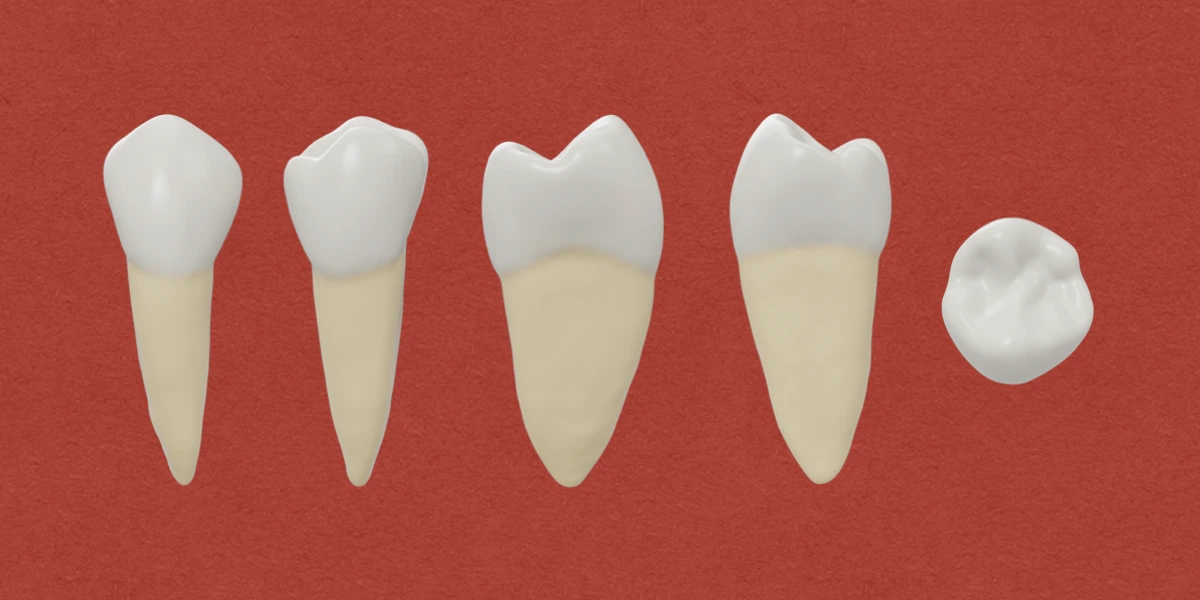
The term "premolar" is a compound word made up of Latin word "Pre" meaning before and molar referring to the molar teeth. So, they are called premolars as they are present before the molars in the dental arch. These teeth are also referred as "bicuspids" which means two cusps. However, in case permanent mandibular second premolar the term is slightly misleading, as it often presents 3 cusps.
Position
- The permanent mandibular second premolar is the 5th tooth from the midline present distal or posterior to first premolar and mesial or anterior to first molar.
Function
- Their primary dunction is to assist molars in grinding of food. They help in intial grinding and transfer of food from canine to molars.
- They are also essential for maintaining facial aesthetics and vertical dimension of occlusion.
Tooth Notation
- FDI system of notation: 35 (Permanent mandibular left second premolar), 45 (Permanent mandibular right second premolar).
- Universal notation system: 20 (Permanent mandibular left second premolar), 29 (Permanent mandibular right second premolar).
- Zsigmondy-Palmer notation system: |5 (Permanent mandibular left second premolar), 5| (Permanent mandibular right second premolar).
Chronology
- First evidence of calcification: 27-30 months
- Crown completion: 6-7 years
- Eruption: 11-12 years
- Root completion: 13-14 years
Dimensions
- Overall length: 22.5mm
- Crown length: 8.0mm
- Root length: 14.5mm
- Mesiodistal diameter of crown: 7mm
- Mesiodistal diameter of crown at cervix: 5mm
- Buccolingual diameter of crown: 8mm
- Buccolingual diameter of crown at cervix: 7mm
- Curvature of cervical line: 1mm (Mesial), 0mm (Distal)
Surfaces, Line Angles, Point Angles
| Surfaces (5) | Line Angles (8) | Point Angles (4) |
|---|---|---|
| Buccal | Mesiobuccal | Mesiobuccoocclusal |
| Lingual | Mesiolingual | Mesiolinguoocclusal |
| Mesial | Distobuccal | Distobuccoocclusal |
| Distal | Distolingual | Distolinguoocclusal |
| Occlusal | Mesioocclusal | |
| Distoocclusal | ||
| Buccoocclusal | ||
| Linguoocclusal |
Tooth Morphology
Buccal Aspect The tooth resembles mandibular first premolar from the buccal aspect only. The mesiodistal diameter of the crown and its general outlline are similar, however, the buccal cusp is shorter.
- Buccal surface: Smooth and convex and presents a prominent buccal ridge extending from the cervical line to the buccal cusp tip.
- Shape of the crown: Trapezoidal.
- Mesial outline: Convex near the cervix, then follows a straight path and again becomes convex as it joins the mesiobuccal cusp ridge.The mesial contact area or height of contour is in the middle third of the crown.
- Distal outline: More convex than the mesial outline, while the distal contact area is also in the middle third of the crown.
- Occlusal outline: Formed by the buccal cusp tip and mesiobuccal and distobuccal cusp ridges. The buccal cusp tip is blunt and the mesiobuccal (MB) and distobuccal (DB) cusp ridges meet at an obtuse angle. The MB cusp ridge/slope is shorter than the DB cusp ridge/slope.
- Cervical outline: Slightly curved towards the apex.
Lingual Aspect
- Lingual surface: Smooth and spheroidal, with a constricted cervical portion and bulbous form above it.
- Crown outllines: Similar to the buccal acpect.
Dissimilarties from the lingual aspect of Mandibular First Premolar
- Lingual lobe shows greater development
- Longer lingual cusp - Less of the occlusal surface and mesial and distal sides of the tooth are visible
- 3 cusp type 2nd premolar - Two lingual cusps (mesiolingual and distolingual) separated by groove in between them.
- 2 cusp type 2nd premolar - No groove but developmental depression present distolingually where the lingual cusp ridge joins the distal marginal ridge.
Mesial Aspect
- Surface: Smoothly convex and devoid of any grooves (No mesiolingual developmental groove as seen in mandibular 1st premolar)
- Buccal cusp: Cusp tip is blunt and buccal to the long axis of the tooth
- Lingual cusp: More developed and is in line with lingual outline of the root
- Crown shape: Rhomboidal (similar to all mandibular posterior teeth)
- Buccal outlline: Convex with the height of contour at the middle 3rd of crown
- Lingual outline: Less convex and height of contour is at the occlusal third of crown. It is generally outside the confinesog the root base.
- Occlusal outline: Formed by the MB cusp ridge, mesial marginal ridge (MMR) and ML cusp ridge. The MMR is at at right angle to the long axis of the tooh (vs Mandibular 1st Premolar where MMR slopes lingually).
- Cervical outline: Curved in occlusal direction (1mm).
Distal Aspect It is similar to the mesial aspect, except that more of the occlusal surface may be seen as the DMR is at a lower level.
- Surface: Smooth and convex
- Shape: Rhoomboidal
- Buccal and Lingual outlines: Convex
- Occlusal outline: Concave, formed by the DB cusp ridge, DMR and DL cusp ridge. The DMR is also at right angle to the long axis of the tooth.
Occlusal Aspect The occlusal morphology of Permanent Mandibular 2nd Premolar varies considerably. There are two common forms:
- 3-cusp type with a Y groove pattern
- 2-cusp type with U or H groove pattern
The two forms are similar in outline (square shaped) in the buccal half but differs lingually. The 3 cusp type appears square lingual to the buccal cusp ridges, while the 2 cusp tupe appears rounded.
3 cusp Type
Elevations: Cusp, Cusp ridges and Marginal ridges
- Cusps: Buccal, Mesiolingual and Distolingual.
- Cusp ridges: Each cusp presents well formed triangular ridges, and mesial and distal cusp ridges | Buccal cusp | ML cusp | DL cusp | | -------- | -------- | -------- | | Lingual triangular ridge | Buccal triangular ridge | Buccal triangular ridge | | MB cusp ridge | Mesial cusp ridge | Mesial cusp ridge | | DM cusp ridge| Distal cusp ridge | Distal cusp ridge |
- Marginal Ridges: These are well-developed and include Mesial marginal ridge and Distal marginal ridge.
Depressions: Grooves, Pits and Fossae
-
Grooves: There are three developmental grooves that separates the three cusps and forms a Y-shaped pattern. Also there are supplementary grooves that radiate from the developmental grooves in the traingular fossae. |Groove| Extension | | ------- | -------- | | Mesial developmental groove | Central pit to Mesial triangular fossa | | DIstal developmental groove | Central pit to Distal triangular fossa | | Lingual developmental groove | Runs in lingual direction between the two lingual cusps and ends on the lingual surface |
-
Pits: Include Central pit, Mesial pit, Distal pit
-
Fossae: Mesial triangular fossa, Distal triangular fossa
2-cusp Type
- Cusps: Buccal and Lingual
- Grooves: Central developmental groove (CDG) extending between the mesial and distal fossae. The grooves may have a "U" pattern where the CDG is crescent-shaped or "H" pattern where the CDG is straight.
- Pits: Mesial and Distal pits (No central pit).
- Fossae: Mesial and Distal fossae present distal to MMR and mesial to DMR respectively. These are irregular in shape, hence not referred as triangular fossa.
References
- Wheeler's Dental Anatomy, Physiology and Occlusion(2019), Stanley J. Nelson DDS MS, Elsevier.
*This article is excerpt from the above mentioned book and Medical Sutras does not make any ownership and affiliation claims.