
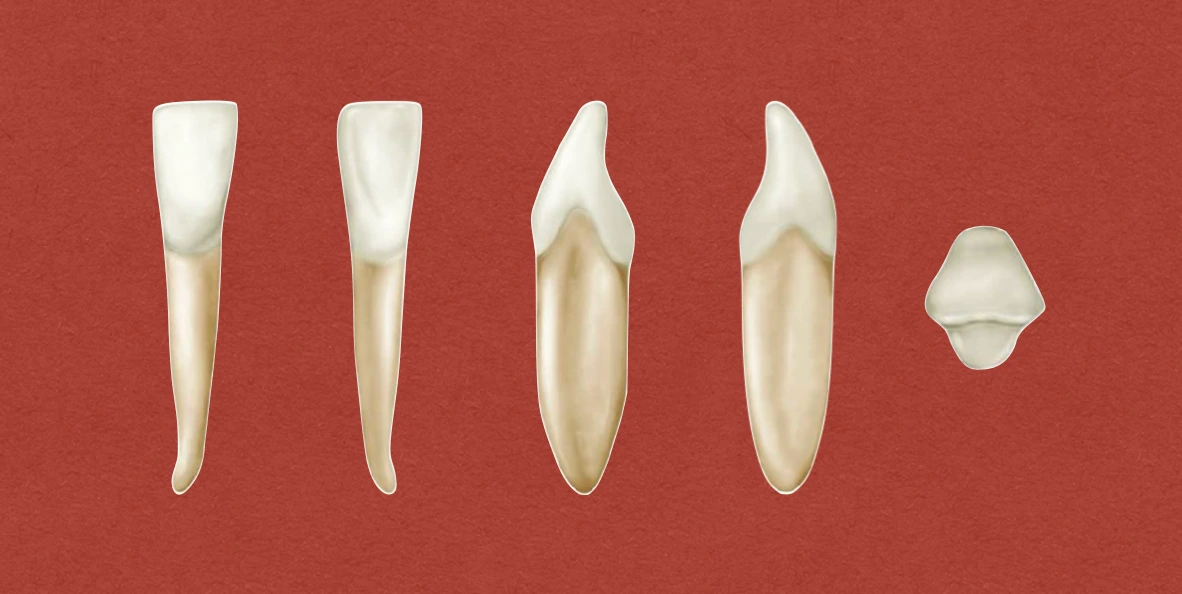
The mandibular central incisors are generally the smallest tooth in the dental arches. They show uniform development, with few instances of malformations or anomalies.
Identification & Function
- Mandibular central incisors are centered in the mandibular arch, one on either side of the median line.
- Their shape is bladelike, and have mesiodistal dimensions smaller than any other teeth.
- Function: Shearing or cutting food during mastication, commonly known as chewing. They also play a role in speech and aesthetics.
Chronology
- First evidence of calcification: 3-4 months.
- Crown completion: 4-5 years.
- Eruption: 6-7 years.
- Root completion: 9 years.
Dimensions
- Overall length: 22 mm.
- Crown length: 9.5 mm.
- Root length: 12.5 mm.
- Mesiodistal diameter of crown: 5.0 mm.
- Mesiodistal diameter of crown at cervix: 3.5 mm.
- Labiolingual diameter of crown: 6.0 mm.
- Labiolingual diameter of crown at cervix: 5.3 mm.
- Curvature of cervical line (Mesial): 3.0 mm.
- Curvature of cervical line (Distal): 2.0 mm.
Crown Morphology
Labial Aspect
- The labial surface is usually smooth, with a flattened incisal third, more convex middle third, and narrowing down to the convexity of root at the cervical portion.
- The tooth appears regular, tapering evenly from the relatively sharp mesial and distal incisal angles to the apical portion of the root.
- Mesial and distal outlines are straight from the incisal angles to the contact areas, and then, taper evenly from the contact areas to the narrow cervix.
- The contact areas are incisal to the junction of the incisal and middle thirds of the crown.
- Incisal ridge is straight and at approximately right angle to the long axis of the tooth. Mamelons on the incisal ridges are worn off soon after eruption, if the occlusion is normal.
Lingual Aspect
- The lingual surface is smooth, with regular and symmetric outline.
- A very slight concavity can be found at the incisal third between the inconspicuous marginal ridges. The lingual surface becomes flat and then convex as it progresses from the incisal third to cervical third.
- In some cases, the marginal ridges are more prominent near the incisal edges, resulting in more distinct concavity between them.
- No developmental lines are seen on the cervical third, and the o
Mesial Aspect
- Mesial surface is convex and smooth at the incisal third, becomes broader and flatter at the middle third cervical to the contact area, and then, becomes quite flat below the middle third, with a tendency toward concavity.
- Labial outline is straight above the cervical curvature and slopes rapidly from the crest of curvature to the incisal ridge.
- Lingual outline is straight and labially inclined for a short distance above the cingulum, then, it joins a concave line at the middle third, and extends upward to join the rounded outline of incisal ridge.
- Cervical line presents a marked curvature, curving incisally approximately one-third the length of the crown.
Distal Aspect
- Similar to the mesial aspect.
- The cervical line curves incisally about 1 mm less than that on the mesial aspect.
Incisal Aspect
- The incisal ridge is smooth and straight, and exhibits bilateral symmetry i.e., the mesial half of the crown is identical with the distal half.
- The incisal edge is almost at right angles to a line bisecting the crown labiolingually (characteristic feature, help to differentiate it from mandibular lateral incisor).
- Labial surface is wider mesiodistally than the lingual surface, and has a tendency toward convexity at the incisal third.
- Lingual surface presents a smooth cingulum, and has an inclination toward concavity at the incisal third.
- Labiolingual diameter of the crown is greater than the mesiodistal measurement.
- When the tooth is viewed from the incisal aspect along the long axis of the tooth, more of the labial surface is seen than the lingual surface.
Root Morphology
Labial Aspect
- The labial surface is regular and convex.
- Mesial and distal outlines of the root are straight with the mesial and distal outlines of the crown down to the apical portion.
- The apical third terminates in a small pointed taper, curving distally in most cases. However, sometimes the roots are straight.
Mesial Aspect
- Mesial surface is flat just below the cervical line, however, most roots have a broad developmental depression for most of their length. The depressions are usually deeper at the junction of the middle and apical thirds.
- The root outline is straight with the crown outline from the cervical line. It begins to taper in the middle third, tapering rapidly in the apical third into a bluntly rounded or pointed root end.
- The root diameter is uniform through the cervical third part of the middle third,
Distal Aspect
- Similar to the mesial aspect.
- The developmental depression may be more marked, with a deeper, better-defined developmental groove at its center.
References
- Wheeler's Dental Anatomy, Physiology and Occlusion(2019), Stanley J. Nelson DDS MS, Elsevier.
*This article is excerpt from the above mentioned book and Medical Sutras does not make any ownership and affiliation claims.