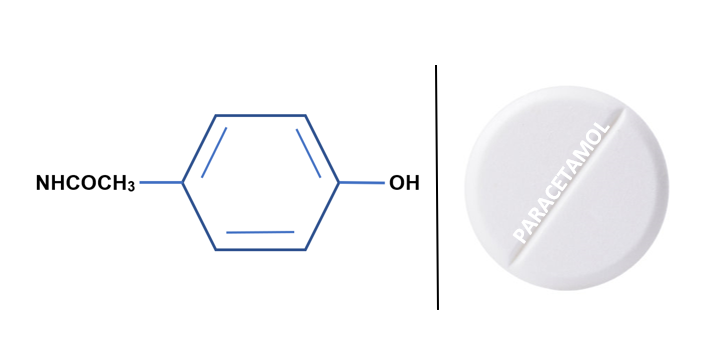
A Non-Narcotic Analgesic - Antipyretic Agent, with weak Anti-inflammatory action
- Non-narcotic : Is not addictive.
- Analgesic : Effective against mild or moderate pain, particularly when inflammation has caused sensitization of pain receptors to normally painless mechanical or chemical stimuli.
- Antipyretic : Lowers body temperature in fever, but do not cause hypothermia in normal conditions.
- Anti-inflammatory : The anti-inflammatory action is negligible and seems to be restricted to a few special cases (e.g. inflammation following dental extraction).
Mechanism of Action
- Prostaglandins(PGs) are released whenever there is inflammation in response to infection, injury (tissue damage) or graft rejection. These PGs are mostly responsible for the pain, fever (hyperthermia) and inflammation associated with these conditions. However, several other mediators are also involved.
- The first enzyme in the prostaglandin synthetic pathway is Prostaglandin G/H synthase, also known as COX. This enzyme converts arachidonic acid (AA) to the unstable intermediates PGG2 and PGH2 and leads to the production of Thromboxane A2 (TXA2 ) and a variety of prostaglandins.
- Paracetamol and other NSAIDs inhibits the COX enzyme and hence, the biosynthesis of PGs in all cell types.
- Their ability to relieve headache may be related to the reduction in vasodilator prostaglandins acting on the cerebral vasculature.
- One explanation offered for the discrepancy between its analgesic-antipyretic and anti-inflammatory actions is its inability to inhibit COX in the presence of peroxides which are generated at sites of inflammation but are not present in the brain.
Pharmacokinetics
-
Absorption : Well absorbed when given orally.
-
Distribution :
- Only about 1/4th is protein bound in plasma and it is uniformly distributed in the body.
- Peak plasma concentration is reached in 30–60 min.
- The plasma half-life of therapeutic doses is 2–4 h, but with toxic doses it may be extended to 4–8 h. Effects after an oral dose last for 3–5 hours.
-
Metabolism / Biotransformation : Occurs mainly in the liver by conjugation with glucuronic acid and sulfate
-
Excretion : Conjugates are excreted rapidly in urine.
Adverse/ Unwanted Effects
- Paracetamol is safe and well tolerated in isolated therapeutic doses. However, nausea and rashes occur occasionally.
- It is possible that regular intake of large doses over a long period may cause kidney damage.
- Toxic doses (10–15 g) can result in potentially fatal hepatotoxicity, and nephrotoxicity (Acute Paracetamol Posioning).
- Chronic, but not acute, alcohol consumption can exacerbate paracetamol toxicity by inducing the liver microsomal enzymes producing the toxic metabolite. In chronic alcoholics, even 5 g taken in one day can result in hepatotoxicity because alcoholism induces CYP2E1 that metabolises paracetamol to NABQI.
Uses
-
Paracetamol is one of the most commonly used ‘over-the-counter’ analgesic for
- headache,
- mild migraine,
- musculoskeletal pain,
- dysmenorrhoea, etc.
-
It is relatively ineffective when inflammation is prominent as in rheumatoid arthritis. Paracetamol is recommended as first choice analgesic for osteoarthritis by many professional bodies.
-
It is one of the best drugs to be used as antipyretic for fever due to any cause, especially in children (no risk of Reye’s syndrome).
-
*However, antipyretics are not useful in fever due to heat stroke, in which only external cooling lowers body temperature.
Dosage
- 325–650 mg (Children 10–15 mg/kg) 3–4 times a day.
- Because paracetamol is an over-the-counter drug, the US-FDA (2009), as a precautionary measure has recommended to reduce the amount of this drug in any single dosage form (tab./cap.) to 650 mg (in place of 1000 mg earlier limit), and the total daily dose for an adult to 2600 mg (in place of 4000 mg earlier).
Points to Note
- Paracetamol is deethylated active metabolite of Phenacetin (Phenacetin is banned as it was implicated in analgesic abuse nephropathy).
- Paracetamol is not recommended in premature infants (< 2 kg) for fear of hepatotoxicity.
- Dose to dose paracetamol is equally efficacious to aspirin for noninflammatory conditions. It is much safer than aspirin as it does not stimulate respiration or affect acid-base balance and does not increase cellular metabolism. It has no effect on CVS. Gastric irritation is insignificant—mucosal erosion and bleeding occur rarely only in overdose. It does not affect platelet function or clotting factors and is not uricosuric.
- Paracetamol can be used in all age groups (infants to elderly), pregnant/lactating women, in presence of other disease states and in patients in whom aspirin is contraindicated.
- It does not have significant drug interactions. Thus, it may be preferred over aspirin for most minor conditions.
- Analgesic action of aspirin and paracetamol is additive.
References
- Essentials of Medical Pharmacology 8th Edition (K.D. Tripathi)-Jaypee Brothers Medical Publishers (P) Ltd.
- James Ritter, Rod Flower, Graeme Henderson, Yoon Kong Loke, David MacEwan, Humphrey Rang - Rang & Dale’s Pharmacology-Elsevier (2019).
- Laurence L. Brunton - Goodman & Gilman's Manual of Pharmacology and Therapeutics-McGraw-Hill Medical (2008).
*This article is an excerpt from the above mentioned books and Medical Sutras does not make any ownership or affiliation claims.