
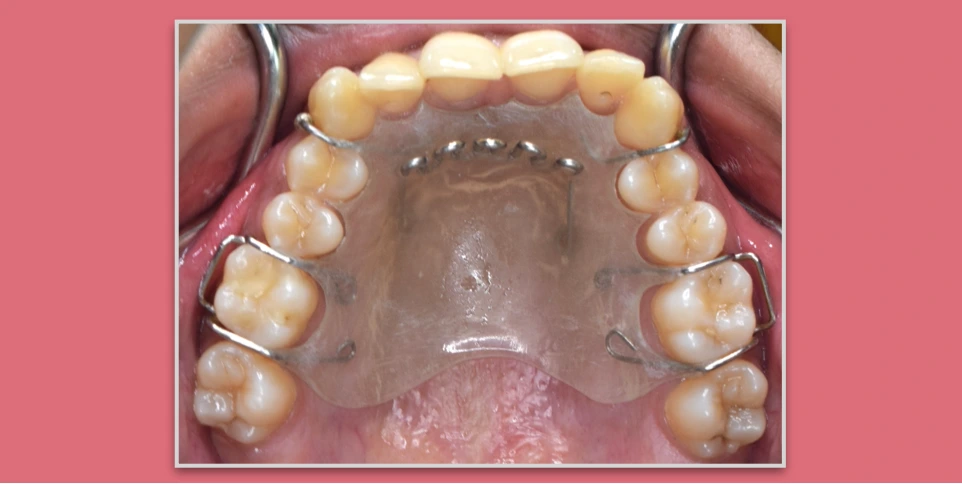
Palatal crib appliance is a habit breaking appliance used in the management of thumb sucking habit.
It prevents the thumb or other offending digit from being placed in the sucking position.
Design Principles
- The first permanent molars are used as anchorage abutments, connected with 0.040" SS orthodontic wire.
- The crib should approximate the cross-arch level of the upper canines and the "fence" should extend vertically to about the level of and just lingual to the lower incisors.
- There should be no occlusal interference in any functional movements.
- It should allow clearance for upper incisors to lingualize into normal inclinations.
Variations of the palatal crib
- Simple wire contoured to the palate without vertical extensions.
- Appliances incorporating reminder aspects, eg. rollers in Bluegrass appliance.
- Use of rakes, spurs or spikes extending from the crib-wire.
However, the basic palatal crib appliance remains the recommended design of choice, since, other designs does not provide any significant advantage in treatment effectiveness.
Mechanism of Action
- The appliance helps in stopping the habit by acting as a reminder whenever the patient places his/her thumb inside the mouth.
- The palatal crib prevents thumb from exerting any force on the palatal aspect of upper incisors, which allows the labial flaring of the incisors to reduce by the action of the upper lip.
- The posterior transpalatal wire provides rigidity and prevents constriction of the maxillary inter-molar width through pressure placed on the fence by the tongue or thumb.
Associated Problems
-
Temporary difficulty with speech and eating upon placement (most children accommodate in a short time).
-
Palatal irritation
- Usually due to pressure from tongue pushing the appliance upward.
- Seen in the initial first month, since, with time, the tongue adapts and reprogram itself from forward positioning.
- More common if second primary molars are used for anchorage.
- Can be resolved by bending the crib away from the tissue (using an intraoral three-pronged plier).
Duration
-
It is recommended to wear the appliance for a period of 6-8 months.
-
Haryett et al reported,
- Nearly, 80% of patients stop the habit within 7 days after insertion.
- If the appliance is removed within 3 months after insertion, there are chances of recurrence.
- Best chance of lasting success occurred when the appliance was left in place for 6-10 months.
Prognosis
-
Positive changes in open bite and overjet should be notable by 3 months.
-
Self-correction should be achieved by 6 months.
-
If the maxillary incisor protrusion and anterior open bite have not self-corrected after the thumb sucking and tongue thrust habits are controlled,
- The discrepancy should be re-evaluated for other problems (eg. lip sucking).
- Orthodontic treatment may be indicated for correction of the condition.
-
Fixed orthodontic treatment is indicated in older children in late mixed dentition or early permanent dentition with more established abnormalities (less likely to self-correct).
Points to Note
- The palatal crib appliance only helps to remind the patient, it cannot break the habit by itself without patient cooperation. Failure may occur in uncooperative patients, as they may physically remove or distort the appliance. Also, they may resort to new habit postures, complains and may cause such a commotion that the parent demands removal of the appliance.
- A removable crib appliance is less likely to succeed than a fixed appliance, since the child may have a strong physical and emotional urge to continue the habit and does not want to quit the habit.
References
- McDonald and Avery's Dentistry for the Child and Adolescent (11th Edition) -Mosby (2021).
*This article is an excerpt from the above mentioned book and Medical Sutras does not make any ownership or affiliation claims.