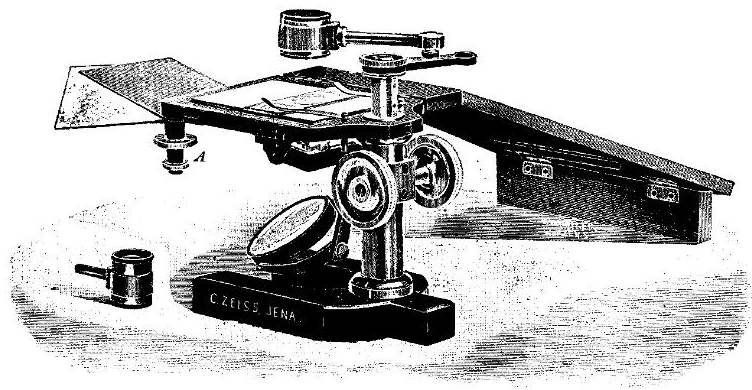
A microscope is a high precision optical instrument that uses a single or a combination of lenses to produce highly magnified images of small specimens or objects.
Principles
Refraction
- Refraction refers to the change in the direction of a ray of light when it passes from one medium to another.
- For example, when light passes from air into glass, which has a greater refractive index, it is slowed out and bent toward the normal (a line perpendicular to the surface). As the light leaves glass and returns to air, a medium with a lower refractive index, it accelerates and is bent away from the normal.
Magnification
- It is the ratio of the size of an object seen under microscope to the actual size observed with unaided eye.
- It is calculated by multiplying the magnifying power of the objective lens by that of eye piece.
- However, maximum magnification does not mean maximum resolution.
Resolution
- Resolution is the minimum distance by which two points can be separated and still be distinguished as separate objects.
- Smaller the distance, higher the resolving power of the microscope.
- The resolving power of human eye is 0.25 mm, light microscope is 0.25 micrometer and electron microscope is 0.5 nanometer.
Numerical Aperture (NA)
- It is the ability of the lens to gather light and gives an estimate of how much light from the sample is collected by the objective.
- Working distance is the distance between the surface of the lens and the surface of the cover slip/specimen when it is in sharp focus. Objectives with large numerical apertures and greater resolving power have short working distances.
- A lens with a larger numerical aperture will be able to visualise finer details and will also collect more light and give a brighter image than a lens with lower numerical aperture.
- It depends on the refractive index of the medium in which the lens works (e.g., air = 1) and the angle of the cone of light entering the objective lens.
- No lens working in the air can have numerical aperture greater than 1, hence, the only practical way to raise the numerical aperture and, therefore, achieve higher resolution is to increase the refractive index with immersion oil (a colorless liquid with the same refractive index as glass).
- If air is replaced with immersion oil, many light rays enter the objective lens that would have otherwise escaped due to reflection and refraction at the surfaces of the lens and slide.
LIght Microscopy
In light microscopy, light from the illuminated specimen is focused by the objective lens, creating an enlarged image within the microscope. It includes,
- Bright field light microscope
- Dark field light microscope
- Phase contrast light microscope
- Fluorescent light microscope
Bright-field Light Microscope
- Dark object, bright background.
- Advantage : Simple setup.
- Disadvantage : Less contrast without staining, limited use on living cells, and staining may introduce artefacts.
Dark-field Light Microscope
- Bright image, dark background.
- Dark field stop/patch stop.
- Hollow cone of light is focused on the specimen in such a way that unreflected and unrefracted rays do not enter the objective. Only light that has been reflected or refracted by the specimen from an image.
- The field surrounding a specimen appears black, while the object itself is brightly illuminated.
- Useful for demonstration of Treponema pallidum, Leptospira, Campylobacter jejuni, and Endospore.
- Advantage : Simple setup, increases contrast and enables observation of more details.
- Disadvantage : Specimen needs to be strongly illuminated which can damage delicate samples.
Phase Contrast Light Microscope
Also called differential interference contrast microscopy, it is an optical illumination technique in which small phase shifts in the light passing through a transparent specimen are converted into contrast changes in the image.
- Light rays in phase produce brighter image.
- Light rays out of phase produce darker image.
- Contrast is created because light waves are out of phase.
Working principle
- Refractive index of bacterial cell structures are greater than of water. Light waves passing through a cell structure will be diffracted and slowed more than light waves passing through the water inside and outside the cell. The deviated light waves are said to be out of phase.
- Phase-contrast microscopy takes advantage of this phenomenon to create differences in light intensity that provide contrast to allow the viewer to see a clearer, more detailed image of the specimen.
- The crests and troughs of the deviated and undeviated waves do not align. Deviated light waves are slowed by about one-fourth wavelength compared to the undeviated light.
- The microscope separates the two types of light so that the undeviated light (primarily from the surroundings) can be manipulated and then recombined with the deviated light (from the bacterium) to form an image.
Advantages
- Phase contrast enables visualisation of the internal cellular components, examination of growth dynamics and behaviour of a wide variety of living cells in cell culture.
- Useful for studying microbial motility, shape of living cells, bacterial structures such as endospores and inclusions.
- Examine living organisms or specimens that would be damaged/altered by attaching to slides or staining.
Disadvantages
- Not ideal for thick specimen (ideal for studying thin specimens).
- Annular or ring limits the aperture to some extents which causes decrease in resolution.
Fluorescent Light Microscope
-
Exposes specimen to UV, violet or blue light. Bright image is visualised from object resulting from the fluorescent light emitted by the specimen.
-
Certain dyes called as fluorochrome after absorbing UV rays are raised to a higher energy level. When the dye molecules return to their normal state, they release excess energy in the form of visible light (fluorescence).
-
Some cells are naturally fluorescent, others must be stained.
-
Bacterial pathogens can also be identified after tagging them with fluorescently labelled antibodies (immunofluorescence).
- Auramine rhodamine : Binds to mycolic acid present in mycobacteria (yellow fluorescence).
- Acridine orange : Orange red fluorescence with RNA and yellow green fluorescence with DNA.
- Calcofluor white : Binds to chitin present in fungal cell walls.
- Fluorescein isothiocyanate (FITC) : Binds to antibodies used in direct and indirect antibody test to detect antibodies in clinical specimens.
Electron Microscopy
- Developed by Max Knoll and Ernst Ruska. Used electrons in place of light.
- The wavelength of electron beam is about 100,000 times shorter than that of visible light. Therefore, the resolution is roughly 1,000 times better than light microscopes.
- Magnifies objects 10,000x-100,000x, and points closer than 0.2 nm can be distinguished. (Light microscopes cannot resolve structures closer than 200 nm).
- Advantage : Provides detailed view of bacteria, viruses, internal cellular structures, molecules, and large atoms.
- Disadvantage : Only dead and dried objects can be examined and cell morphology distorted since the medium is vacuum.
Transmission Electron Microscope (TEM)
- Uses heated tungsten filament in the electron gun to generate a beam of electrons focused on the specimen by the condenser.
- The beam is focussed by doughnut-shaped electromagnets called magnetic lenses, since the electrons cannot pass through glass lens.
- Denser regions in the specimen scatter more electrons and therefore appear darker, while electron transparent regions are brighter.
- Advantage : Fine details.
- Disadvantage : The column containing the lenses and specimen must be under vacuum, only extremely thin slices (20-100 nm) of a specimen can be viewed (because electron beams are easily absorbed and scattered by solid matter).
Scanning Electron Microscope (SEM)
- Produces image from electrons released from an object's surface.
- Scans a narrow, tapered electron beam back and forth over the specimen.
- When the beam strikes a particular area, surface atoms discharge a tiny shower of electrons called secondary electrons and these are trapped by a detector.
- Detector (scintillator) then emits light when struck by electrons.
- Flashes of light are converted to an electrical current and amplified by a photomultiplier.
- The signal is then digitised and sent to a computer, where it can be viewed.
- Advantages : Specimen preparation is relatively easy, surfaces of microbes are visualised in great detail.
References
- Ananthanarayan and Paniker's Textbook of Microbiology, 10th Edition (Editor - Reba Kanungo), Universities Press.
- The image used is is in the public domain. Source : Library of Congress, Prints & Photographs Division, LC-USZC4-3147 (Wikimedia Commons).
*This article is an excerpt from the above mentioned book and Medical Sutras does not make any ownership or affiliation claims.