
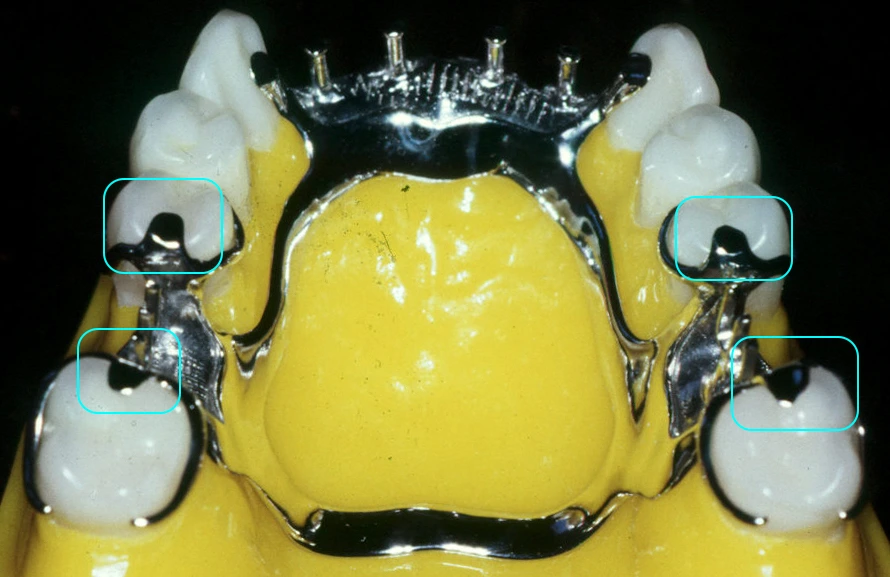
Rests are the components of a removable partial denture on a tooth surface that provides vertical support and transfer forces down the long axes of the abutment teeth.
The prepared surface of an abutment tooth to receive the rest is called the rest seat.
Primary rest : Refers to a rest that is part of a retentive clasp assembly. It prevent vertical movement of a prosthesis toward the tissues and also help transmit applied forces to the supporting teeth.
Auxiliary or secondary rest : A rest that is responsible for additional support or indirect retention. It is used as indirect retainer in extension base removable partial dentures (Class I, Class II and long-span Class IV cases). These are placed anterior or posterior to the axis of rotation to prevent extension bases from lifting away from the underlying ridges.
Functions
The primary purpose of the rest is to provide vertical support for the partial denture. In addition, it also,
- Directs and distributes occlusal loads to abutment teeth : Transmits forces from the prosthesis to abutment apically along the long axis of the tooth.
- Serves as a vertical stop for the prosthesis and maintains established occlusal relationships by preventing settling of the denture.
- Prevents impingement of soft tissue : Firm, positive contact between a rest and rest seat minimises vertical displacement of the prosthesis and prevents injury to the soft tissues.
- Maintains components in their planned position. : A rest must maintain the retentive clasp in its proper position. If the clasp is not supported, it will lose its ability to retain the prosthesis in its intended position.
Occlusal rest & Rest seat
They are seated on the occlusal surfaces of posterior teeth.
- In any tooth-tissue-supported partial denture, the relation of the occlusal rest to the abutment should be that of a shallow ball-and-socket joint, to prevent any possible transfer of stresses to the abutment tooth.
- The rest seats should be shallow and saucer shaped and should function as ball-and-socket joints. This geometry permits dissipation of potentially harmful lateral forces.
- In case of an entirely tooth-supported prosthesis, the rest seats can be deepened to increase the transmission of lateral forces.
Design Considerations
-
Outline form : Should be rounded triangular shape with smooth gentle curves. Sharp angles, walls and ledges must be avoided. Any portion of the rest seat that restricts movement of the rest may transmit undesirable horizontal forces to the tooth.
-
The base of the triangle located at the marginal ridge and the rounded apex directed toward the center of the tooth.
-
Dimensions : The length and width should be similar and the base of the triangular shape should be at least 2.5 mm for both molars and premolars.
-
The rest should occupy 1/3rd to 1/2 the mesiodistal diameter of the tooth and approximately 1/2 the bucco-lingual width of the tooth measured from cusp tip to cusp tip.
-
Thickness : An occlusal rest must be at least 0.5 mm thick at its thinnest point and should be between 1.0 and 1.5 mm thick where it crosses the marginal ridge.
-
The shape of the rest seat should follow the outline of the mesial or distal fossa for the chosen abutment.
-
When viewed in cross section, the deepest part of occlusal rest seat should be located near the center of the mesial or distal fossa. From its depth, the floor of the rest seat should rise gently toward the marginal ridge.
-
Floor of the occlusal rest seat : Should be concave or spoon shaped and apical to the marginal ridge and the occlusal surface.
-
The angle between the occlusal rest and the vertical minor connector from which it originated should be less than 90 degrees. In other words, the enclosed angle formed by a line dropped down the proximal tooth surface (parallel to the tooth's long axis) and the floor of the rest seat must be less than 90 degrees i.e., the occlusal rest seat floor should be inclined slightly towards the center of the tooth. This allows the occlusal forces to be directed along the long axis of the tooth.
-
An angle greater than 90 degrees is not recommended because it :
- Does not transmit occlusal forces along the desired long axis of the abutment tooth.
- Can lead to slippage of the prosthesis away from the abutment.
- Can result in orthodontic-like forces being applied to an inclined plane on the abutment tooth, with possible tooth movement, pain and bone loss.
-
If the occlusal rest preparation is inclined apically toward the reduced marginal ridge and cannot be modified because of fear of perforation of the enamel or restoration : A secondary occlusal rest should be used to prevent slippage of the primary rest and orthodontic movement of the abutment tooth.
-
Most common mistake in preparation of occlusal rest : Insufficient reduction of the marginal ridge resulting an extremely thin rest that might fracture.
Preparation
-
Rests can be placed on sound enamel or any restoration that can resist fracture and distortion when subjected to occlusal forces.
-
Rests placed on sound enamel are not conducive to caries in patients with a low-caries index and good oral hygiene.
-
The preparation of occlusal rest seat should alway follow proximal preparation and never precede it, because,
- Only after alteration of proximal surface, the location of occlusal rest seat in relation to the marginal ridge may be determined.
- The marginal ridge can become too low and too sharp, with the center of the floor of the rest seat too close to the marginal ridge, if the proximal preparation follows occlusal rest seat preparation.
Extended Occlusal Rest
The rest should extend more than 1/2 the mesiodistal width of the tooth, should be approximately 1/3rd the bucco-lingual width of the tooth, and should allow for a minimum of 1 mm thickness of the metal. The preparation should be rounded with no undercuts or sharp angles.
- Indication : Kennedy Class II, modification 1, and Kennedy Class III cases in which the most posterior abutment is a mesially tipped molar.
- Function : To minimise further tipping of the abutment and to ensure that the forces are directed down the long axis of the abutment.
- In case the abutment is severely tilted : The extended occlusal rest can take the form of an onlay to restore the occlusal plane.
Internal Occlusal Rests
Internal or intracoronal rests are used in case of partial denture that is totally tooth supported by means of cast retainers on all abutment teeth.
- Provides both occlusal support and horizontal stabilisation : Occlusal support is derived from the floor of the rest seat, while horizontal stabilisation from the near-vertical walls of the rest seat.
- These are carved in wax or spark eroded in abutment castings.
- Advantages : Facilitates the elimination of a visible clasp arm buccally and permits the location of the rest seat in a more favorable position in relation to the tipping axis (horizontal) of the abutment.
References
- Stewart’s Clinical Removable Partial Prosthodontics (4th edition), Rodney D. Phoenix, David R. Cagna, Charles F. DeFreest, Quintessence Books.
- McCracken’s Removable Partial Prosthodontics (13th edition), Alan B. Carr DMD MS, David T. Brown DDS MS, Elsevier.
- The image used is in public domain (Source : Wikimedia Commons).
*This article is an excerpt from the above mentioned books and Medical Sutras does not make any ownership and affiliation claims.