
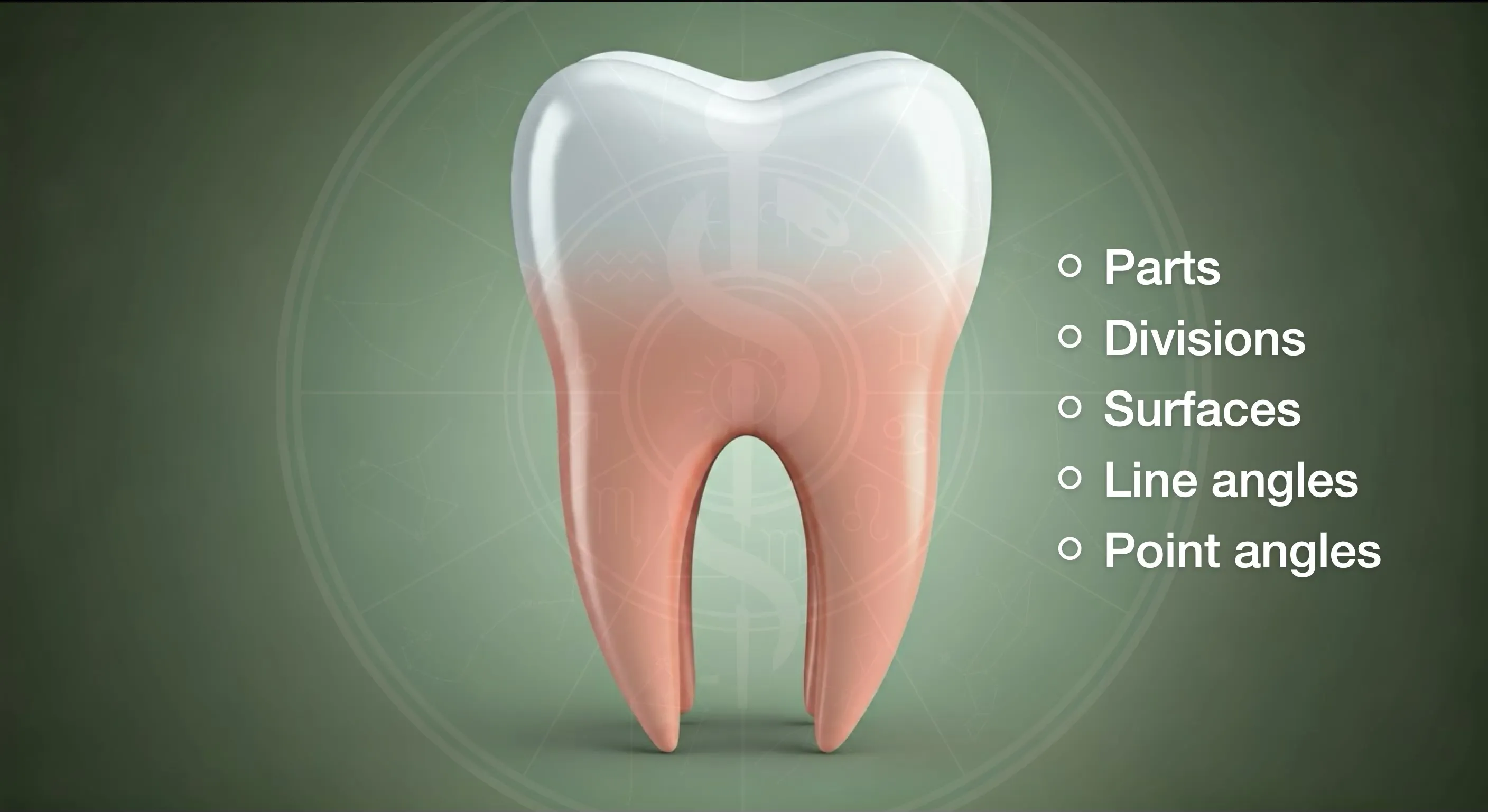
Each tooth is divided into two parts i.e., crown and root. These two parts meet/join at the cemento-enamel junction (CEJ), also called cervical line.
The tooth is composed of four tissues (3 hard and 1 soft tissue)
- Enamel: Hardest tissue in human body, forms outermost covering of the crown portion.
- Dentin: Forms the bulk of the tooth and is present in both crown and root portions.
- Cementum: Covers the root portion of the tooth.
- Pulp: It houses blood vessels and nerves supplying the tooth, and consists of pulp chamber in the crown portion and pulp canal in the root. The pulp chamber and canal are continuous with each other and are collectively referred as the pulp cavity.
Divisions
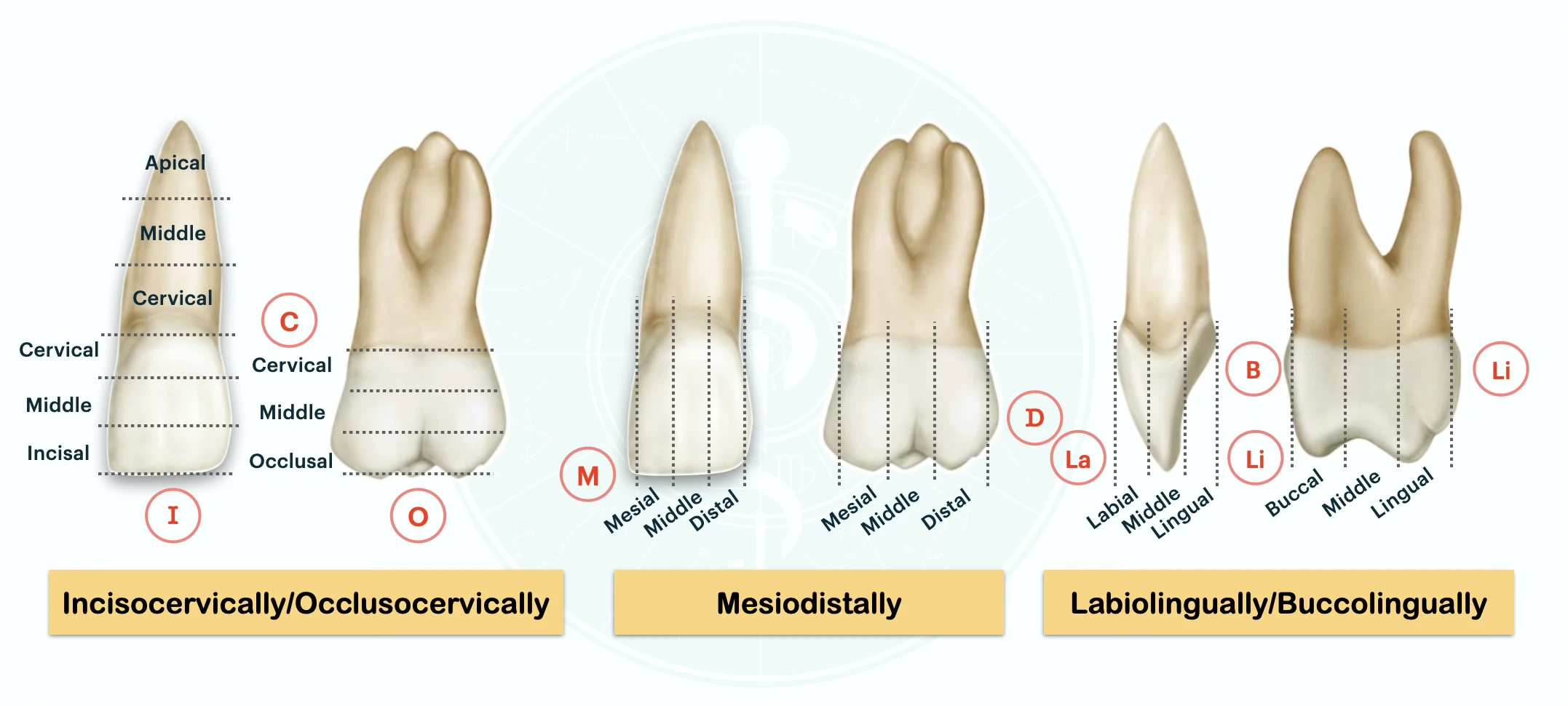
The crowns and roots of teeth are divided into three equal parts for the purpose of description and communication. These divisions are named according to their location.
Divisions of Crown
The crown can be divided into thirds in three directions: incisocervically/occlusocervically, mesiodistally, and labiolingually/buccolingually.
- Incisocervically/Occlusocervically: Incisal, middle & cervical thirds (anterior teeth), and occlusal, middle & cervical thirds (posterior teeth).
- Mesiodistally: Mesial, middle and distal thirds in both anterior and posterior teeth.
- Labiolingually/Buccolingually: Labial, middle and lingual thirds (anterior teeth), and Buccal, middle and lingual thirds (posterior teeth).
Divisions of Root
The root is divided into cervical, middle and apical thirds in both anterior and posterior teeth.
Surfaces
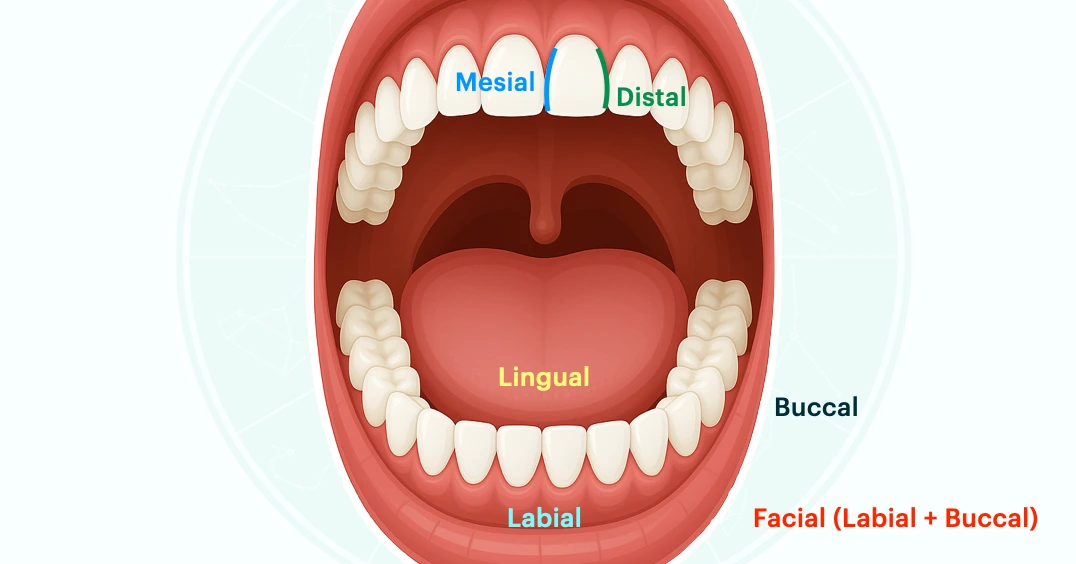
The crowns of incisors and canines have four surfaces and a ridge, while, premolars and molars have five surfaces. These surfaces are named according to their positions and uses.
-
Labial surface: Surface of incisors and canines towards the lips.
-
Buccal surface: Surface of premolars and molars facing the cheek.
-
Lingual surface: Includes all surfaces facing toward the tongue. It is also referred as palatal surface in maxillary teeth.
-
Proximal or proximate surfaces: Surfaces of teeth facing toward adjoining teeth in the same dental arch.
- Mesial surface: Proximal surface that facing towards the median line, following the curve of the arch.
- Distal surface: Proximal surface that is most distant from the midline.
-
Occlusal surface: Surfaces of the premolars and molars that come in contact (occlusion) with opposing teeth. It is referred as incisal surface or edge in incisors and canines.
*Facial surface : Collective term for labial and buccal surfaces, facing toward the lips and cheeks.
Line Angles
It is formed by the junction of two surfaces, and is named from the combination of the two surfaces that join.
Anterior Teeth: Have 6 line angles.
- Mesiolabial
- Mesiolingual
- Distolabial
- Distolingual
- Labioincisal
- Linguoincisal
*Mesioincisal and distoincisal line angles are considered non-existent, since the mesial and distal angles in anterior teeth are rounded. These are referred as mesial distal incisal angles.
Posterior Teeth: Consist of 8 line angles.
- Mesiobuccal
- Distobuccal
- Mesiolingual
- Distoligual
- Mesio-occlusal
- Disto-occlusal
- Bucco-occlusal
- Linguo-occlusal
Point Angles
These angles are formed by the junction of three surfaces, and are named from the combination of the joining surfaces.
Anterior Teeth: Have four point angles.
- Mesiolabioincisal
- Distolabioincisal
- Mesiolinguoincisal
- Distolinguoincisal
Posterior Teeth: Have four point angles.
- Mesiobucco-occlusal
- Distobucco-occlusal
- Mesiolinguo-occlusal
- Distolinguo-occlusal
References
- Wheeler's Dental Anatomy, Physiology and Occlusion(2019), Stanley J. Nelson DDS MS, Elsevier.
*This article is excerpt from the above mentioned book and Medical Sutras does not make any ownership and affiliation claims.