
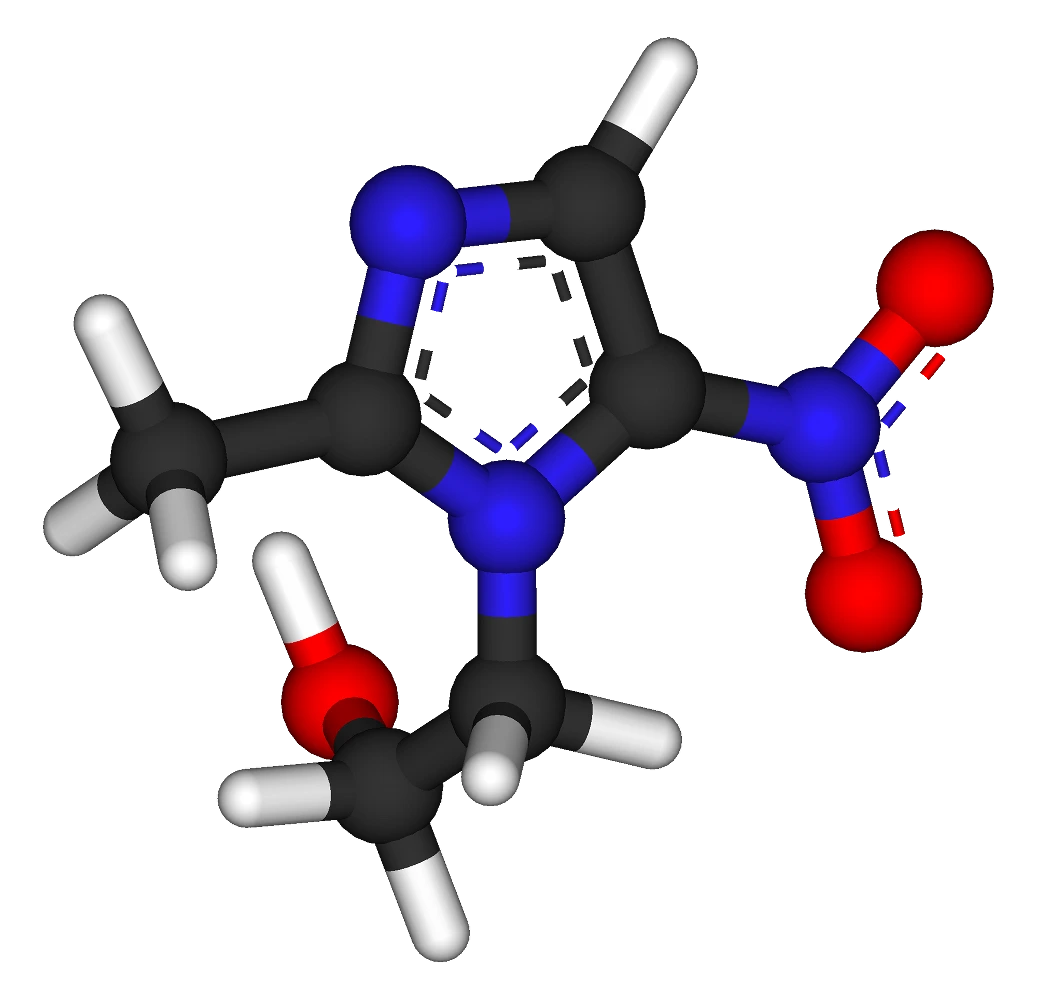
Metronidazole represents prototype nitroimidazole, with a broad-spectrum bactericidal activity against anaerobic protozoa (selectively toxic to anaerobes and micro-aerophilics). The spectrum of action includes :
- Trichomonas vaginalis.
- E. histolytica.
- Anaerobic and microaerophilic bacteria : Bact. fragilis, Fusobacterium, Clostridium perfringens, Cl. difficle, Helicobacter pylori, Campylobacter, peptococci, spirochetes and anaerobic Streptococci.
- Does not affect aerobic bacteria.
Mechanism of Action
-
Enters the cell by diffusion.
-
Inside the cell, its nitro group is reduced to a highly reactive nitro radical by certain redox proteins (operative only in anaerobic microbes).
-
The nitro radical acts as an electronic sink. It competes with the biological electron acceptors of the anaerobic organism, for the electrons generated by the pyruvate : ferredoxin oxidoreductase (PFOR) enzyme pathway of pyruvate oxidation.
-
Thus, the energy metabolism of anaerobes (that have no mitochondria) is dirupted
-
In addition, metronidazole has been found to inhibit cell mediated immunity, to induce mutagenesis and to cause radiosensitisation.
-
Aerobic conditions : Attenuates cytotoxicity of metronidazole by inhibiting its reductive activation. Also, oxygen competes with the nitro radical for the free electrons generated during energy metabolism of anaerobes.
-
Resistance
- The anaerobes become deficient in the mechanism that generates the reactive nitro radical from it or have lower levels of PFOR.
- Clinically significant resistance seen in H.pylori. T. vaginalis have shown decreased responsiveness.
Pharmacokinetics
- Absorption : Almost completely absorbed from the small intestines.
- Distribution : Widely distributed in the body, attaining therapeutic concentrations in vaginal secretion, semen, saliva and CSF.
- Metabolism : Occurs in the liver, primarily by oxidation and glucuronide conjugation, followed by renal excretion. May accumulate in hepatic insufficiency.
- Plasma t1/2 : 8 hours.
Uses and Dosage
-
Amoebiasis : First line drug for all forms of amoebic infections. (Metronidazole is less effective than many luminal amoebicides in eradicating amoebic cysts from the colon, as it is nearly completely absorbed from the upper bowel).
- Mild intestinal disease : 400 mg TDS for 5-7 days.
- Invasive dysentery and liver abscess : 800 mg TDS (children : 30-50 mg/kg/day) for 7-10 days.
- Severe cases of amoebic dysentery or liver abscess : 500 mg (Children : 10-15 mg/kg) IV infusion slowly every 6-8 hrs for 7-10 days or till oral therapy can be instituted.
-
Giardiasis : 400 mg TDS for 7 days or 2 g/day for 3 days.
-
Trichomonas vaginitis : Drug of choice
- Preferred dose : 2 g single dose.
- Alternative dose : 400 mg BD-TDS for 7 days.
- Repeated courses : May be required in some cases, given with gaps of 4-6 weeks.
- Refractory cases : Requires additional intravaginal treatment.
- Recurrent infections : Male partner should be treated concurrently.
-
Anaerobic bacterial infections (Occurs mostly after colorectal or pelvic surgery, appendicectomy, etc., associated with brain abscesses and endocarditis)
- Metronidazole in combination with gentamicin or cephalosporins.
- Serious cases : 15 mg/kg infused over 1 hr, followed by 7.5 mg/kg every 6 hrs till oral therapy can instituted with 400-800 mg TDS.
- Prophylactic use : In high risk situations such as colorectal or biliary surgery.
-
Pseudomembranous enterocolitis (generally associated with use of antibiotics) : 400-800 mg BD-TDS for 10-14 days.
-
Acute Necrotising Ulcerative Gingivitis (ANUG, Trench mouth) :
- Caused by mixed flora of anaerobes like fusobacteria, spirochetes and bacteroides.
- Metronidazole or Tinidazole is the drug of choice.
- Metronidazole 200-400 mg TDS (15-30 mg/kg/day), often combined with amoxicillin, tetracycline or erythromycin for at least 5 days.
-
H. pylori gastritis/peptic ulcer : Metronidazole 400 mg TDS (or Tinidazole 500 mg BD) in combination with amoxicillin/clarithromycin and a proton pump inhibitor (Triple drug regimen).
Adverse Effects
- Most common : Anorexia, nausea, metallic taste and abdominal cramps.
- Less common : Headache, glossitis, dryness of mouth, impairment of concentration and looseness of stool.
- Prolonged use : Peripheral neuropathy, CNS effects.
- Seizures (very high doses).
- Leucopenia (likely with repeated courses).
- Thrombophlebitis of the injected vein (if the solution is not diluted properly).
- Allergic reaction (serious, warrant discontinuation and preclude future use) : Urticaria, flushing, heat, itching, rashes and fixed drug eruptions.
Contraindications
- Neurological disease.
- Blood disorders.
- First trimester of pregnancy.
- Caution in chronic alcoholics : Disulfiram-like intolerance to alcohol occurs in some patients taking metronidazole.
Other Nitroimidazoles
- Tinidazole : Longer half life (t1/2 12 hrs), generally better tolerated.
- Secnidazole : Slower metabolism (t1/2 of 17-29 hours).
- Ornidazole.
- Satranidazole.
References
- Essentials of Medical Pharmacology 8th Edition (K.D. Tripathi)-Jaypee Brothers Medical Publishers (P) Ltd.
- The image used is in the public domain (Source : Wikimedia Commons, Author : Fvasconcellos).
*This article is an excerpt from the above mentioned books and Medical Sutras does not make any ownership or affiliation claims.