
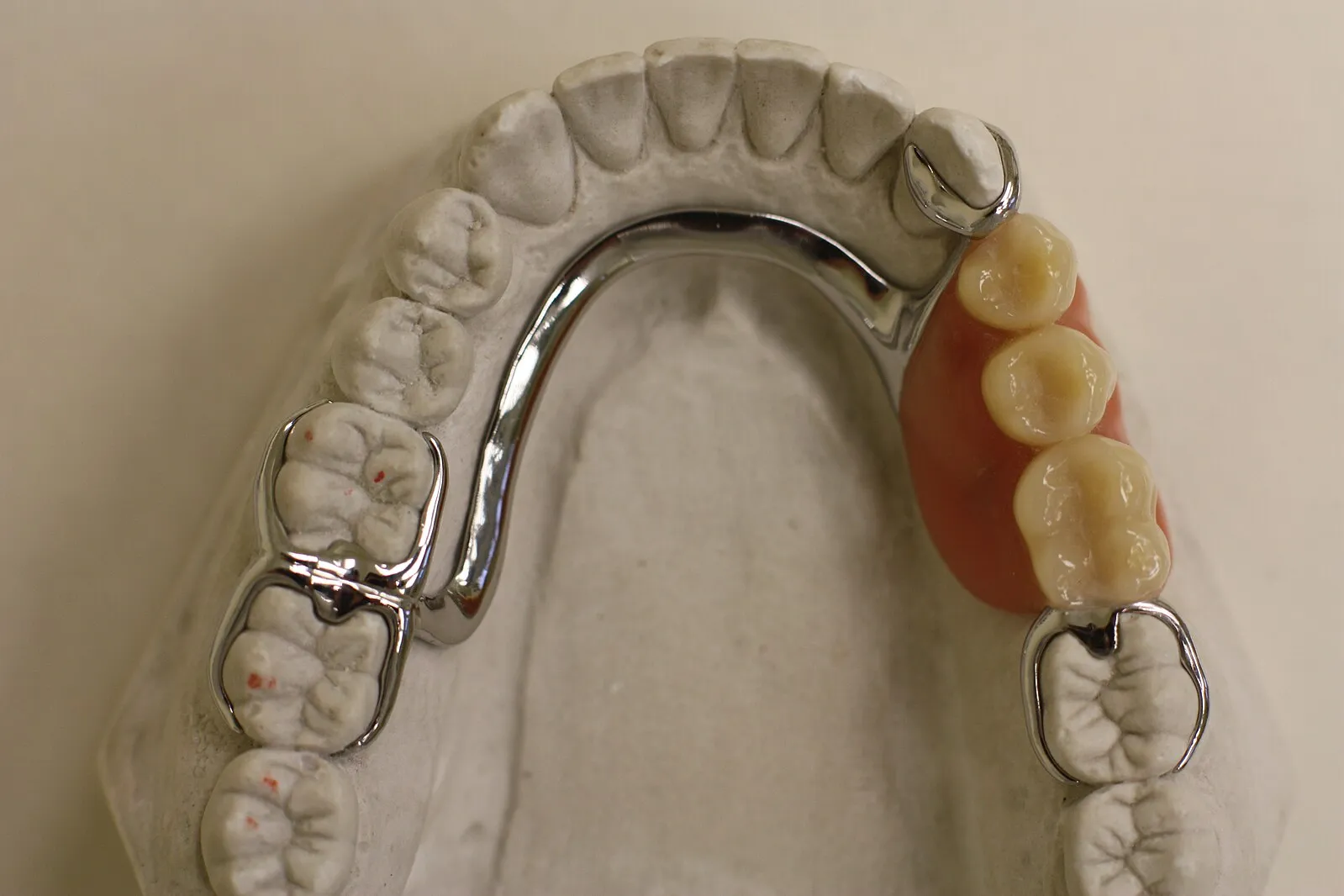
Historically, six types of major connectors have been described for the mandibular arch, of which, lingual bar and linguoplate are most commonly used.
- Lingual bar.
- Lingual plate (Linguoplate).
- Double lingual bar (Kennedy bar or Lingual bar with cingulum bar).
- Sublingual bar.
- Cingulum bar (Continuous bar).
- Labial bar.
Structural requirements
-
Must be rigid without being so bulky that they compromise patient comfort.
-
Must not impinge upon the movable floor of the mouth, the associated frena, or the mandibular tori.
-
Relief should be provided between the rigid metal surfaces and the underlying soft tissue, to prevent laceration of the sensitive lingual mucosa from the margins of the major connector.
- Completely tooth-supported prosthesis : Little or no relief required, as the denture does not tend to move in function.
- Distal extension denture : Moderate amount of relief is indicated, as the prosthesis tends to rotate during function.
- Slope of the anterior ridge also influences the amount of relief needed : Vertical (or, nearly so) requires minimal relief, while more the ridge slopes toward the tongue, greater the amount of relief required (since, any movement of the connector will bring it into contact with the adjacent soft tissues).
- Presence of undercut in the anterior ridge requires sufficient space to be created when the undercut area is blocked.
-
Bead lines are not used, since, contact with the friable mucosa of the lower arch may cause irritation, ulceration and patient discomfort.
How to design ?
- Step 1: Outline the basal seat areas on the diagnostic cast.
- Step 2: Outline the inferior border of the major connector.
- Step 3: Outline the superior border of the major connector.
- Step 4: Connect the basal seat area to the inferior and superior borders of the major connector, and add minor connectors to retain the acrylic resin denture base material.
Lingual bar
It is usually made of a reinforced, 6-gauge, half-pear-shaped wax or a similar plastic pattern, that is tapered superiorly and have the broadest portion at the inferior border.
- Space requirement : At least 8 mm of vertical space must be present between the gingival margins of the teeth and the floor of the mouth. This allows the major connector to have a minimum height of 5 mm, with 3 mm space between the gingival margins and the superior border. Failure to provide 3 mm of space may lead to irritation of the adjacent soft tissues.
- Cross-section : Half-pear shaped with bulkiest portion located inferiorly.
- Contour : It should not present sharp margins to the tongue and cause irritation or annoyance by an angular form.
- Location : Located above the moving tissue but as far inferiorly as possible to avoid interference with the resting tongue and trapping of food substances.
- Superior border : Tapered toward the gingival tissue, and located at least 4 mm inferior to gingival margins (or more, if possible).
- Inferior border : Rounded and located at the ascertained height of the alveolar lingual sulcus when the patient's tongue is slightly elevated, so that it does not impinge on the tissues in the floor of the mouth.
Indication : All tooth-supported prostheses, where sufficient space exists between the floor of the mouth (alveolar lingual sulcus) and lingual marginal gingiva.
Advantages
- Simple design.
- Minimal contact with the remaining teeth and soft tissues.
- Decreased plaque accumulation and increase soft tissue stimulation.
Disadvantages
- Requires extreme care in the design and construction, otherwise, the resulting framework may not be rigid.
- If not constructed properly, lead to concentration of potentially destructive forces upon individual teeth and segments of the lower arch.
Sublingual Bar
It is modification of the lingual bar, with the same bar shape, but is placed inferior and posterior to the usual placement of a lingual bar, lying over and parallel to the anterior floor of the mouth.
Indications
- When the height of the floor of the mouth in relation to the free margins of gingiva is less than 6 mm (i.e, superior border of lingual bar cannot be placed at least 4 mm below the free gingival margin).
- Alternative to linguoplate, if the lingual frenum does not interfere, or there is anterior lingual undercut requiring considerable blockout.
Contraindications
- Interfering lingual tori.
- High attachment of lingual frenum.
- Interference with floor of the mouth during functional movements.
Lingual plate
It consists of a thin, solid, metal apron that extends superiorly to contact cingula of anterior teeth and lingual surfaces of involved posterior teeth at their height of contour.
- Cross-section : Half-pear shaped with the bulkiest portion inferiorly placed.
- Contour : Made as thin as feasible and contoured to intimately contact the lingual surfaces of the teeth above the cingula (scalloped appearance).
- Superior border : Should be knife edged to avoid a ledging effect on the lingual surfaces of the teeth. It is located below the middle third of the lingual surface (except to cover the inter-proximal spaces to the contact points), and follows the natural curvature of the supracingular surfaces of the teeth.
- Inferior border : Should form half-pear shape (provides greatest bulk and rigidity), and positioned as low as possible, but, not interfering with the tongue and soft tissue movements.
- Apron : Used to avoid gingival irritation or entrapment of food debris or to cover generously relieved areas that would be irritating to the tongue.
- All gingival crevices and deep embrasures must be blocked out parallel to the path of placement to avoid gingival irritation and any wedging effect between the teeth.
- Indirect retention : The linguoplate does not itself serve as an indirect retainer. When indirect retention is required, definite rests must be provided.
- Rest : Terminal rest at each end (no farther posterior than the mesial fossae of the first premolars) are recommended, regardless of the need for indirect retention. This helps to prevent rotation of the framework and labial displacement of the remaining anterior teeth.
Indications
- When the lingual frenum is high or the vertical space available for a lingual bar is limited (less than 8 mm).
- In Class I situations, in which the residual ridges have undergone excessive vertical resorption.
- When the remaining teeth have poor periodontal support and require splinting.
- When one or more anterior teeth are periodontally compromised but may provide service for a time : Can be supported by lingual plate, and as the teeth are lost, retentive loop may be soldered to the lingual plate and prosthetic teeth added to the denture.
- When posterior teeth have been lost and there is a need for additional indirect retention.
- May be used in patients where mandibular tori cannot be removed.
Advantages
- Exceptional rigidity and more comfortable.
- Allows the inferior border to be placed more superiorly without irritating the tongue and gingival tissue and compromising the rigidity.
- In Class I cases, correctly designed linguoplate engage the remaining teeth and help in resisting horizontal rotations.
- In cases with periodontally weakened remaining teeth, lingual plate can provide stabilisation, when used with definite rests on sound adjacent teeth.
- Tissue response to small spaces bridged with an apron is better than when they are left open.
Disadvantages
- Extensive coverage may contribute to decalcification of enamel and irritation of the soft tissues in patients with poor oral hygiene.
Interrupted lingual plate (Step back design)
- Consists of step-backs to avoid any unwanted display of metal.
- The superior border covers the cingulum of the individual tooth, extends towards the contact area of the tooth and then, turn apically, following the line angle to the level of the gingiva.
- It is indicated in when the anterior teeth presents reduced periodontal support and large inter-proximal spaces (where linguoplate is indicated but the patient objects to metal showing through the spaces).
Cingulum bar (Continuous bar)
- It consists of a thin, narrow (3 mm) metal strap located on the cingula of anterior teeth, scalloped to follow the inter-proximal embrasures with inferior and superior borders tapered to tooth surfaces.
- It originates bilaterally from the incisal, lingual or occlusal rests of adjacent principle abutments.
- It is indicated when the axial alignment of the anterior teeth is such that excessive blockout of inter-proximal undercuts is required for using lingual plate.
Double lingual bar (Kennedy bar)
It consists of a cingulum bar located on or slightly above the cingula of the anterior teeth, combined with the lingual bar. The position and contour of the upper and lower borders are similar to those of a lingual plate, except for the upper and lower components are not joined by a continuous sheet of metal.
- Upper component : Half oval in cross-section, 2-3 mm in height and 1 mm thick. It should present a scalloped appearance and not run straight across the lingual surfaces of the teeth.
- Lower component : Similar to lingual bar, half-pear shaped in cross section, with greatest diameter at the inferior margin.
- Rests : Should be placed at each end of the upper bar and should be located no farther posterior than the mesial fossae of the first premolars. This prevents the bar from moving inferiorly and causing unwanted movement of the remaining anterior teeth.
Indications : When the remaining anterior teeth exhibit reduced periodontal support (requiring splinting) and open embrasures.
Advantages
- Provides indirect retention, when properly supported by rests at each end.
- Contributes to horizontal stabilisation of the prosthesis.
- Permits free flow of saliva and hence, the marginal gingiva receives natural stimulation.
Disadvantages
- Tendency to trap debris, if the bar does not maintain intimate contact with tooth surfaces.
- May be irritating to the tongue and annoying due to presence of multiple borders and the thickness of the upper bar.
Labial bar
It runs across the mucosa on the facial surface of the mandibular arch.
- Cross-section : Half-pear shaped with bulkiest portion located inferiorly.
- Superior border : Tapered towards the gingival tissue and located at least 4 mm inferior to labial and buccal gingival margins (more, if possible).
- Inferior border : Located in the labial-buccal vestibule at the junction of attached (immobile) and unattached (mobile) mucosa.
Indications
- Presence of malpositioned or lingually inclined remaining teeth that cannot be corrected and prevents the placement of a conventional lingual bar.
- Large mandibular tori that cannot be removed surgically.
- Excessive and abrupt lingual tissue undercuts making the use a lingual bar or lingual plate major connector impractical.
Advantages : Useful in conditions where other major connectors are not feasible. However, its use should be avoided as much as possible.
Disadvantages
- Poor patient acceptance.
- Distorts the lower lip and cause significant discomfort.
- Labial vestibule is not deep enough to permit a sufficiently rigid connector without encroaching on the free gingival margins.
Hinged continuous labial bar (Swing-Lock RPD)
It is a modification of lingual plate, based on the Swing-lock design, and consists of a labial or buccal bar connected to the major connector by a hinge on one end and a locking device (latch) at the other end. Here, the labial component does not serve as the major connector.
Indications
- Missing key abutments, such as, canines.
- Unfavourable tooth contours uncorrectable by recontouring or excessive labial inclinations of anterior teeth
- Extensive soft tissue undercuts.
- Teeth with questionable prognosis (Since, all remaining teeth function as abutments in the Swing-Lock denture, the loss of a tooth does not compromise retention and stability.)
Contraindications
- Poor oral hygiene or lack of patient motivation.
- Presence of shallow buccal or labial vestibule.
- High frenal attachment
Points to Note
Methods to determine the relative height of the floor of the mouth, to locate the inferior border of a lingual mandibular major connector :
- Measure the height of the floor of the mouth in relation to the lingual gingival margins of adjacent teeth with a periodontal probe, with the tongue tip touching lightly on the vermillion border of upper lip. This permits the transfer of measurements to both diagnostic and master casts, thus ensuring a rather advantageous location of the inferior border of the major connector.
- Use an individualised tray with lingual borders 3 mm short of the elevated floor of the mouth, and an impression material that will allow the impression to accurately mold as the patient licks the lips. Thus, the inferior border of the planned major connector can be located at the height of the lingual sulcus of the resulting cast.
References
- McCracken’s Removable Partial Prosthodontics (13th edition), Alan B. Carr DMD MS, David T. Brown DDS MS, Elsevier.
- Stewart’s Clinical Removable Partial Prosthodontics (4th edition), Rodney D. Phoenix, David R. Cagna, Charles F. DeFreest, Quintessence Books.
- The image used is licensed under the Creative Commons Attribution-Share Alike 3.0 Unported license. Author : Sterilgutassistentin, Source : Own Work (Wikimedia Commons).
*This article is an excerpt from the above mentioned books and Medical Sutras does not make any ownership and affiliation claims.