
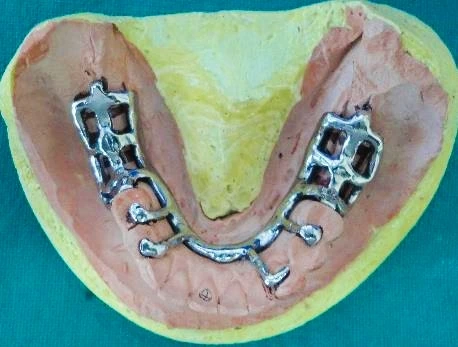
A major connector is the component of the partial denture that connects the parts of the prosthesis located on one side of the arch with those on the opposite side.
Functions
- Unification of the major parts of the prosthesis.
- Distribution of the applied force throughout the arch to the selected teeth and tissue.
- Minimisation of torque to the teeth.
Characteristics
Characteristics of major connector contributing to health and well-being,
- Made from an alloy compatible with oral tissue.
- Rigid and provides cross-arch stability through the principle of broad distribution of stress.
- Does not irritate the tongue and/or interferes with its function.
- Does not substantially alter the natural contour of the lingual surface of the mandibular alveolar ridge or of the palatal vault.
- Does not impinge an oral tissue when the restoration is placed, removed or rotates in function.
- Covers no more tissue than is absolutely necessary.
- Does not contribute to retention or trapping of food particles.
- Have support from other elements of the framework to minimise rotation tendencies in function.
- Contribute to the support of the prosthesis.
Guidelines
The guidelines for design and location of major connectors are as under:
- Should be free of movable tissue.
- Avoids impingement of gingival tissue.
- Avoids bony and soft tissue prominences during placement and removal.
- Should have enough relief to prevent settling into areas of possible interference, such as inoperable tori or elevated median palatal sutures.
- Should be located and/or relieved to prevent impingement of tissue that occurs due to rotation of distal extension denture during function.
Mandibular Major Connectors
- Lingual bar.
- Linguoplate.
- Sublingual bar.
- Lingual bar with cingulum bar (Continuous bar).
- Cingulum bar / Continuous bar.
- Labial bar.
Maxillary Major Connectors
- Single palatal strap.
- Combination anterior and posterior palatal strap-type connector.
- Palatal plate-type connector.
- U-shaped palatal connector.
- Single palatal bar.
- Anterior-posterior palatal bars.
Points to Note
-
A properly designed rigid major connector effectively distributes forces throughout the arch, reduces load to any one area and controls the movement of prosthesis during function.
-
Failure of the major connector to provide rigidity may be manifested by,
- Traumatic damage to periodontal support of abutment teeth.
- Injury to residual ridge.
- Impingement of underlying tissue.
-
The gingival tissue must have an unrestricted superficial blood supply to remain healthy.
-
Margins of major connectors adjacent to gingival tissue should be located far enough from the tissue to avoid any possible impingement.
- To accomplish this, it is recommended that the superior border of a lingual bar connector be located a minimum of 4 mm below the gingival margins.
- In maxillary arch, the amount of relief required is directly proportional to the difference in displaceability of the tissue covering the midline of the palate and the tissue covering the residual ridge.
- It is recommended that the borders of the palatal connector be placed a minimum of 6mm away from and parallel to the gingival margins.
-
Minor connectors that need to cross the gingival tissue should do so abruptly, and join the major connector at nearly a right angle. In this way, the maximal freedom is ensured for gingival tissue.
References
- McCracken’s Removable Partial Prosthodontics, (13th edition), Alan B. Carr DMD MS, David T. Brown DDS MS, Elsevier.
*This article is an excerpt from the above mentioned book and Medical Sutras does not make any ownership and affiliation claims.