
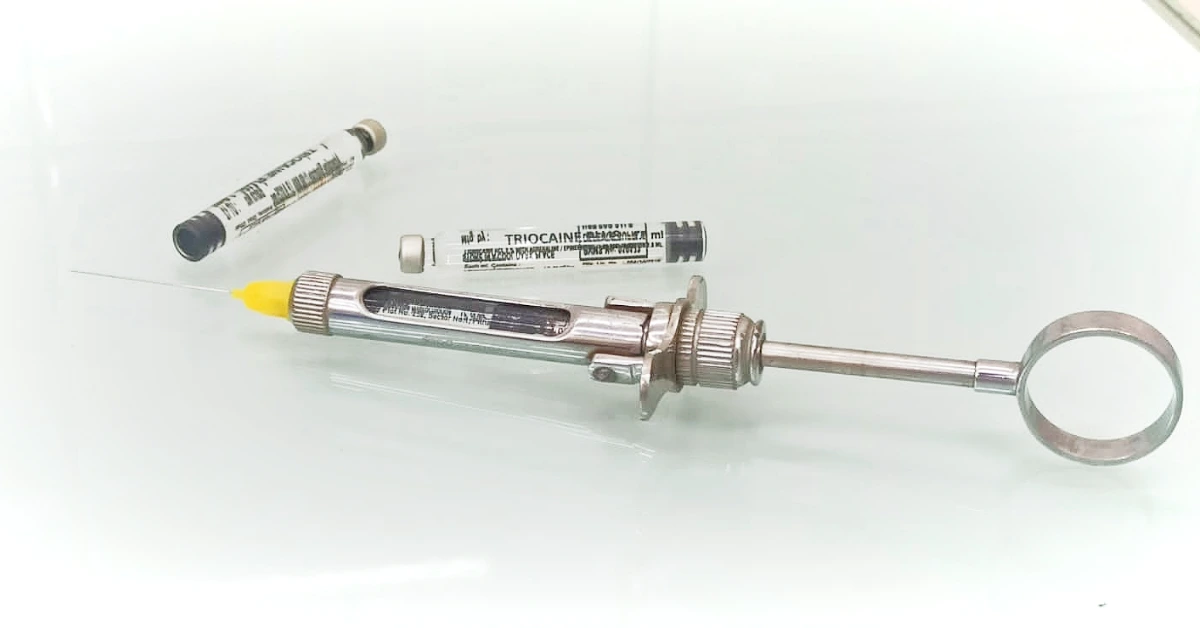
The primary pharmacologic action of local anesthetics is inhibition of the excitation conduction process in peripheral nerves. However, this action is not limited solely to peripheral nerves, and any excitable membranes (such as those in the heart, brain or neuromuscular junction) can get altered by local anesthetics if they reach a sufficient tissue concentration.
Maximum Recommended Dosage
The commonly used local anesthetic cartridge contains 1.8ml of local anesthetic solution : 2% (20 mg/ml) Lignocaine with 1:100,000 (0.01 mg/ml) Epinephrine. This equates to 36 mg of lignocaine and 0.018 mg of epinephrine.
- Lignocaine : 7 mg/kg.
- Epinephrine : 0.2 mg per appointment.
Calculating the maximum number of cartridges for a healthy adult weighing 70 kg :
- Lignocaine (2%) = 36 mg per cartridge.
- Maximum recommended dose (7 mg/kg) = 490 mg.
- Number of cartridges = 490/36 = 13.6 (around 13 cartridges).
- Quantity of local anesthetic used (in ml) = 24.5 ml.
- Quantity of epinephrine used = 0.23 mg.
However, the maximum recommended dose of epinephrine per appointment is only 0.04 mg in patients with significant cardiovascular disease. Hence, the maximum dose local anesthetics with epinephrine should be restricted to 4 ml (2 cartridges) of 2% lignocaine with 1:100,000 epinephrine, in patients with compromised cardiac function (As higher dose can produce systemic vasoconstriction leading to myocardial ischemia in high-risk cardiac patients).
Causes
- Inadvertent or accidental intravascular injection.
- Administration of a large dose.
- Rapid rate of injection.
Clinical Manifestations
Mild Toxicity
- Increased patient confusion, Talkativeness and Anxiety.
- Slurring of speech.
- Increased heart rate, pressure and respiration.
Moderate Toxicity
- Stuttering speech.
- Muscular twitching and tremors.
- Nystagmus.
- Headache (due to local anesthetic-induced dilation of cerebral blood vessels).
- Lightheadedness and dizziness.
- Visual and auditory disturbances : Difficulty in focusing, blurred vision, and tinnitus (ringing in the ears).
- Numbness of the tongue and peri-oral tissues.
- Drowsiness and disorientation (Depressant phase).
Severe Toxicity
- Generalised tonic-clonic seizures.
- Cardiac dysrhythmia and cardiac arrest.
- Unconsciousness, respiratory depression or respiratory arrest (Depressant phase).
*Depressant phase : As the cerebral blood level of local anesthetic decreases, the stimulatory or excitatory phase is replaced by a period of generalised CNS depression. The degree of severity of depressant phase is proportionate to the degree of previous stimulation.
Management
Most local anesthetic overdose reactions are self-limiting, as the effect decreases overtime with redistribution and biotransformation of the drug and subsides once the cerebral blood level of local anesthetics falls below the toxic levels.
- Terminate all dental procedure.
- Place the patient in a comfortable (supine) position.
- Assess patency of circulation, airway and breathing.
- Monitor vital signs.
Mild to moderate toxicity
- Administer oxygen : Patient should be asked to purposefully hyperventilate by deep breathing on room air or oxygen (via a full-face mask or nasal hood).
*Lowered PaCO2 level can be used to patient's advantage, as it elevates the seizure threshold of a local anesthetic.
- Administration of anti-convulsant : Usually not indicated in mild overdose reaction. If needed, Diazepam or Midazolam may be administered IV, titrated at a rate of 1 ml per minute until the clinical signs (muscular twitching) abates.
- Call for medical emergency services.
- Observe in office for 1 hour or as long the patient recovers.
Seizures
- Protect the patient from nearby objects, and if vomiting occurs, remove contents of oral cavity by suction.
- Administer oxygen.
- Administer Diazepam (0.2 mg/kg at 5 mg/min interval) or Lorazepam (0.1 mg/kg at 2 mg/min interval).
- If patient does not respond to Benzodiazepines : Administer Propofol or Thiopental.
- Start Basic Life Support, if necessary.
- If the patient's BP remains depressed for an extended period (more than 30 minutes) and medical assistance is not available : Administer a vasopressor such as ephedrine (25-50 mg IM) or 1000ml IV fluid (Normal saline or 5% Dextrose and water solution) to elevate blood pressure.
- Contact medical emergency services and shift to a hospital.
- Persistent seizures : Administer a small dose of Succinylcholine (0.5 mg/kg).
Cardiac arrest
-
Start Advanced Cardiac Life Support (ACLS) measures.
-
Administer Epinephrine : 1 mg IV every 3-5 minutes in a pulseless arrest algorithm.
-
Administer 20% lipid emulsion : 1-2 ml/kg bolus dose, repeated upto a total of 5 ml/kg, followed by an infusion of 0.25-0.5 ml/kg/min.
- Propofol is not a substitute.
- If it fails, consider pulmonary bypass.
-
Avoid administration of vasopressin or calcium channel blockers.
Points to Note
- Minimum level of lidocaine in the brain that can induce seizure activity : 7.5 microgram per ml of blood.
- Signs and symptoms of mild local anesthetic overdose may resemble psychomotor or temporal lobe epilepsy.
- In some cases (esp. lidocaine and mepivacaine), the excitatory phase may be extremely brief or even absent. The overdose reaction may appear initially as drowsiness and nystagmus, leading directly to either unconsciousness or seizure activity.
- Vasopressors should be considered only when the doctor is well trained in their administration and in the recognition and management of complications associated with vasopressors.
References
- Medical Emergencies in the Dental Practice (7th Edition), Stanley F. Malamed, Daniel L Orr II, Mosby Elsevier.
- Medical Emergencies in Dental Practice, Orrett E. Ogle, Harry Dym, Robert J. Weinstock, Quintessence Publishing Co, Inc.
- Contemporary Oral and Maxillofacial Surgery (6th Edition), James R Hupp, Edward Ellis III, Myron R Tucker, Mosby Elsevier.
- Handbook of Local Anesthetia, 6th Edition, Stanley F Malamed, Elsevier Mosby
*This article is an excerpt from the above mentioned books and Medical Sutras does not make any ownership or affiliation claims.