
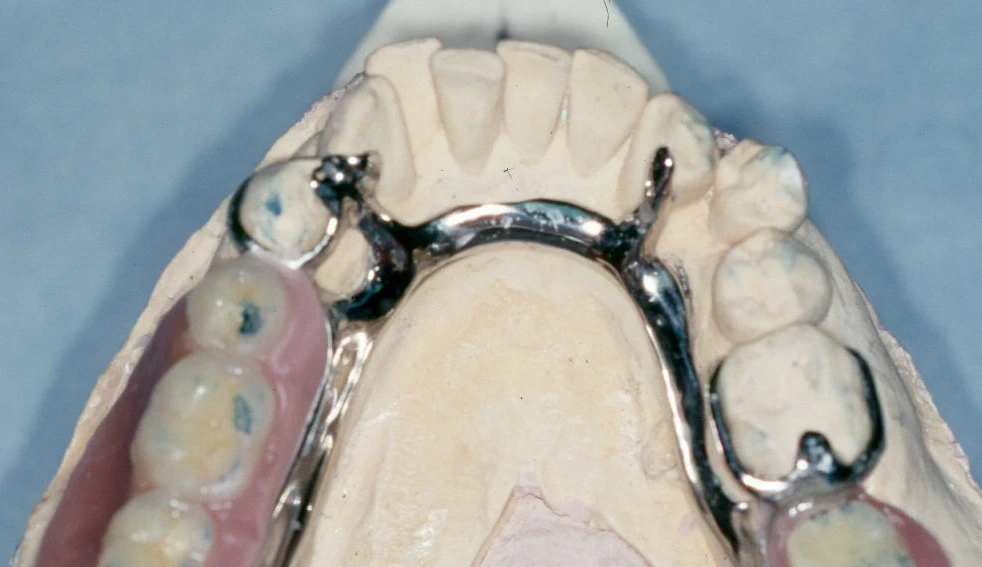
Lingual or cingulum rests are seated on the lingual surfaces of anterior teeth, usually maxillary canines. They are indicated when an anterior tooth is the only abutment available for occlusal support of denture.
Incisors
- Lingual rests on incisors are rare.
- The main indication for their use is missing canines : Multiple rests spread over several incisor teeth are preferred so as to distribute the stress over a number of teeth.
Canines
- Lingual rests are used primarily on maxillary canines, as the normal morphology of a maxillary canine permits preparation of a satisfactory rest seat with minimal tooth reduction.
- Rarely satisfactory on mandibular canines, since the lingual slope of the mandibular canine is usually too steep and it lacks appropriate enamel thickness.
Premolars
- A lingual rest can be used successfully.
- However, an occlusal rest in the mesial fossa of the first premolar is preferred, if the occlusion permits. An occlusal rest is located in a more favorable orientation (nearly horizontal), and the accompanying rest seat is easier to prepare.
Design Consideration
-
The form of lingual rest seat should be V shaped when viewed in cross section.
-
Dimensions:
- Mesiodistal length : 2.5-3mm (minimum).
- Labiolingual width : 2mm.
- Incisal-apical depth : 1.5mm (minimum).
-
The preparation should display a relatively upright lingual wall that originates at the level of the cingulum and extends incisally. The remaining wall should originate at the crest of the cingulum and incline labiolingually toward the center of the tooth. This wall must provide a definite seat for the rest and must prevent the migration of the abutment away from the framework.
-
When viewed from the lingual aspect, the outline form of a lingual rest seat should be crescent shaped. This geometry provides some freedom of movement in a mesiodistal direction. Hence, the rest and rest seat may function as a ball-and-socket assembly.
-
Sharp line angles and corners must be avoided because they complicate the fit of the cast framework and may serve as stress concentrators.
-
Placement of lingual rest seat in enamel surfaces is a sound practice provided the following circumstances exist:
- Cingulum is prominent enough to permit appropriate tooth recontouring.
- The patient practices good oral hygiene.
- The caries index is low.
Fabrication
The anterior tooth can be prepared in one of the two ways:
Rest seat on enamel
- A slightly rounded V (with apex directed incisally) is prepared on the lingual surface, at the junction of the gingival and middle one third of the tooth.
- All line angles must be eliminated, and the rest seat must be prepared within the enamel and must be highly polished.
- Predetermined path of placement for the denture must be kept in mind when the rest seat is prepared.
- The floor of the rest seat should be toward the cingulum rather than the axial wall.
- Any enamel undercut that interferes with placement of undercut should be avoided.
Lingual rest seats on Cast restorations
It is the most satisfactory lingual rest from the standpoint of support.
-
The rest seat should be placed in the wax pattern.
-
The cingulum of the restoration should be accentuated to allow development of a rest seat that will direct occlusal forces along the long axis of the tooth.
Points to Note
A lingual rest is preferred to an incisal rest, because it is placed closer to the horizontal axis of rotation of the abutment, resulting in lesser tendency to tip the tooth.
- The longer lever arm associated with an incisal rest magnifies the rotational movement of the prosthesis and may result in significant tooth movement.
- Lingual rests are less subject to breakage and distortion, because of their configuration.
- LIngual rests are more esthetically acceptable, since they are confined to the lingual surface.
References
- McCracken’s Removable Partial Prosthodontics (13th edition), Alan B. Carr DMD MS, David T. Brown DDS MS, Elsevier.
- Stewart’s Clinical Removable Partial Prosthodontics (4th edition), Rodney D. Phoenix, David R. Cagna, Charles F. DeFreest, Quintessence Books.
- The image used is available in the public domain. Source : Wikimedia Commons.
*This article is an excerpt from the above mentioned books and Medical Sutras does not make any ownership and affiliation claims.