
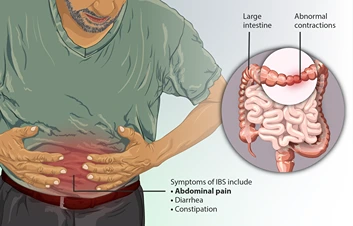
Irritable Bowel Syndrome (IBS) is a functional disorder, characterised by abdominal pain or discomfort and altered bowel habits without any detectable structural abnormalities.
Pathogenesis
The etiology of IBS is poorly understood, however, several factors have been implicated in the pathogenesis of IBS.
-
Abnormal gut motor and sensory activity : Proposed mechanisms responsible for visceral hypersensitivity includes,
- Increased end-organ sensitivity with recruitment of silent nociceptors.
- Spinal hyper-excitability with activation of nitric oxide and other neurotransmitters.
- Cortical and brainstem modulation of cauded nociceptive transmission
- Development of long-term hyperalgesia due to neuroplasticity.
-
CNS dysfunction : IBS patients show preferential activation of the pre-frontal lobe.
-
Psychological disturbances such as stress (influences pain threshold) : Recorded in 80% cases.
-
Post-infective IBS, following Campylobacter enteritis.
Clinical Features
The symptoms of IBS tends to come and go over time and often overlap with other functional disorders such as fibromyalgia, headache, backache and genito-urinary symptoms.
IBS affects all age group (first symptoms mostly appear before 45 years) and is three times more common in females than males.
Abdominal Pain (pre-requisite clinical feature)
- Highly variable in intensity (mild to severe) and location (Hypogastrium : 25%, Right side : 20%, Left side : 20%, Epigastrium : 10%).
- Patients with severe IBS wake repeatedly during the night.
- Pain is often exacerbated by eating or emotional stress and improved by passage of flatus or stool.
- In females, symptoms may worsen during premenstrual and menstrual phases.
Altered Bowel Habits
-
Most common pattern is constipation alternating with diarrhea, with usually one symptom predominating.
-
IBS-constipation predominant (IBS-C)
- Presents with weeks or months of constipation interrupted with brief periods of diarrhea.
- Initially, constipation may be episodic, but eventually becomes continuous and refractory to treatment.
- Stools are usually hard with narrowed caliber (possibly reflecting dehydration due to prolonged colonic retention and spasm).
- Sense of incomplete evacuation, leading to repeated defecation attempts at short intervals.
-
IBS-diarrhea predominant (IBS-D)
- Consists of small volumes (less than 200 ml) of stools, accompanied by large amount of mucus.
- May be aggravated by eating or emotional stress.
Gas and Flatulence
- Complain of abdominal distention, increased belching and flatulence.
- Amount of intestinal gas may be normal, but there is impaired transit and tolerance of intestinal gas loads.
- Patients tend to reflux gas from the distal to the more proximal intestine, that may cause belching.
Upper gastro-intestinal symptoms
- Dyspepsia, heartburn, nausea and vomiting.
- Found in 25-50% patients.
Diagnosis
Since IBS is not associated with any pathognomonic abnormalities, diagnosis relies on presence of positive clinical features and elimination of other organic diseases.
Diagnostic Criteria
Criteria to be fulfilled for the last 3 months, with symptom onset at least 6 months prior to diagnosis : Recurrent abdominal pain or discomfort* at least 3 days per month, in the last 3 months associated with two or more of the following :-
- Improvement with defecation.
- Onset associated with a change in the frequency of stool.
- Onset associated with a change in the form (appearance) of stool.
- *Discomfort refers to an uncomfortable sensation not described as pain.
Supportive symptoms (Not part of the diagnostic criteria) : Defecation straining, urgency or a feeling of incomplete bowel movement, small-volume stool, passing of mucus and no evidence of blood in stool, bloating, association with stress or emotional upset and absence of systemic symptoms such as fever and weight loss.
*Bleeding is not a feature of IBS, unless haemorrhoids are present.
Differential Diagnosis
- Epigastric or peri-umbilical pain : Biliary tract disease, Peptic ulcer disorders, Intestinal ischemia and Carcinoma of the stomach or pancreas.
- Lower abdomen pain : Colon diverticulitis, Inflammatory bowel disease (incl. Ulcerative colitis and Crohn's disease) and Carcinoma of the colon.
- Postprandial pain with bloating, nausea and vomiting : Gastroparesis or partial intestinal obstruction, and Giardia lamblia infection.
- Diarrhea : Lactase deficiency, Laxative abuse, Malabsorption, Celiac sprue, Hyperthyroidism, Inflammatory bowel disease and Infectious diarrhea.
- Constipation : Side effect of anticholinergic, anti-depressant, anti-hypertensive and other medications, Endocrinopathies such as hypothyroidism and hypoparathyrodism, Acute intermittent porphyria and Lead poisoning.
Investigations
- Complete blood count (Anemia and elevated ESR argue against IBS).
- Sigmoidoscopy.
- Stool samples (in case of IBS-D) : To examine for ova and parasites.
- More than 40 years : Air-contrast barium enema or colonoscopy.
- Hydrogen breath test or 3-week lactose-free diet : To rule out lactase deficiency, in cases with diarrhea and increased gas.
- Gluten-free diet and serology testing : To rule out celiac sprue, in IBS-D cases.
- Concurrent symptoms of dyspepsia : Upper g.i. radiographs or esophagogastrodudenoscopy.
- Postprandial right upper quadrant pain : USG of gall bladder.
Management
Management of IBS usually involves education, reassurance and dietary/lifestyle changes, along with pharmacologic treatment for dominant symptoms.
Patient counselling and dietary alterations
- Reassurance and careful explantation of the disorder.
- Meticulous dietary history to identify items that aggravate symptoms, eg. excessive fructose and artificial sweeteners such as sorbitol or mannitol may cause diarrhea, bloating, cramping or flatulence.
- Encourage patients to avoid any food item that appear to produce symptoms.
- High-fiber diet : May contribute to increased stool bulk, because of their water-holding action and ability to increase fecal output of bacteria.
- Antiflatulence therapy : Patients should be advised to eat slowly and not chew gum or drink carbonated beverages.
Stool-bulking agents
- Binds with water and prevents both excessive hydration or dehydration of stool.
- Useful in patients with IBS-C.
- Psyllium husk : 3-4 g BID with meals, then adjust.
- Methylcellulose : 2 g BID with meals, then adjust.
Laxatives (for consipation)
- Lactulose syrup : 10-20 g BID.
- Sorbitol (70%) : 15 ml BID.
- Polyethylene glycol 3350 : 17 g in 250ml water QD.
Antidiarrheal agents (in severe, painless diarrhea)
- Loperamide : 2-4 mg every 4-6 hours or when necessary (Max 12 g/day).
- Cholestyramine resin : 4 g with meals.
Antispasmodic agents
- May provide temporary relief for symptoms related to intestinal spasm such as painful cramps.
- Recommended to be used 30 minutes before meals, for postprandial pain (inhibits gastrocolic reflex).
- Dicyclomine is preferred as it produces fewer side effects.
Tricyclic antidepressants
- The beneficial effects of tricyclic agents in IBS occurs at a lower dose and appears to be independent of their antidepressant effects.
- Start with 25-50 mg HS, then adjust.
Selective Serotonin Reuptake Inhibitor (SSRI) : Paroxetine accelerates orocecal transit and may be useful in IBS-C patients.
References
-
Harrison's Principles of Internal Medicine (17th edition), Fauci, Braunwald, Jasper, Hauser, Longo, Jameson, Loscalzo, The McGraw-Hill Companies.
-
The image used is licensed under the Creative Commons Attribution-Share Alike 4.0 International license.
- Description : Depiction of a person suffering from Irritable Bowel Syndrome (IBS).
- Source : https;//www.myupchar.com/en/disease/irritable-bowel-syndrome.
*This article is an excerpt from the above mentioned book and Medical Sutras does not make any ownership or affiliation claims