
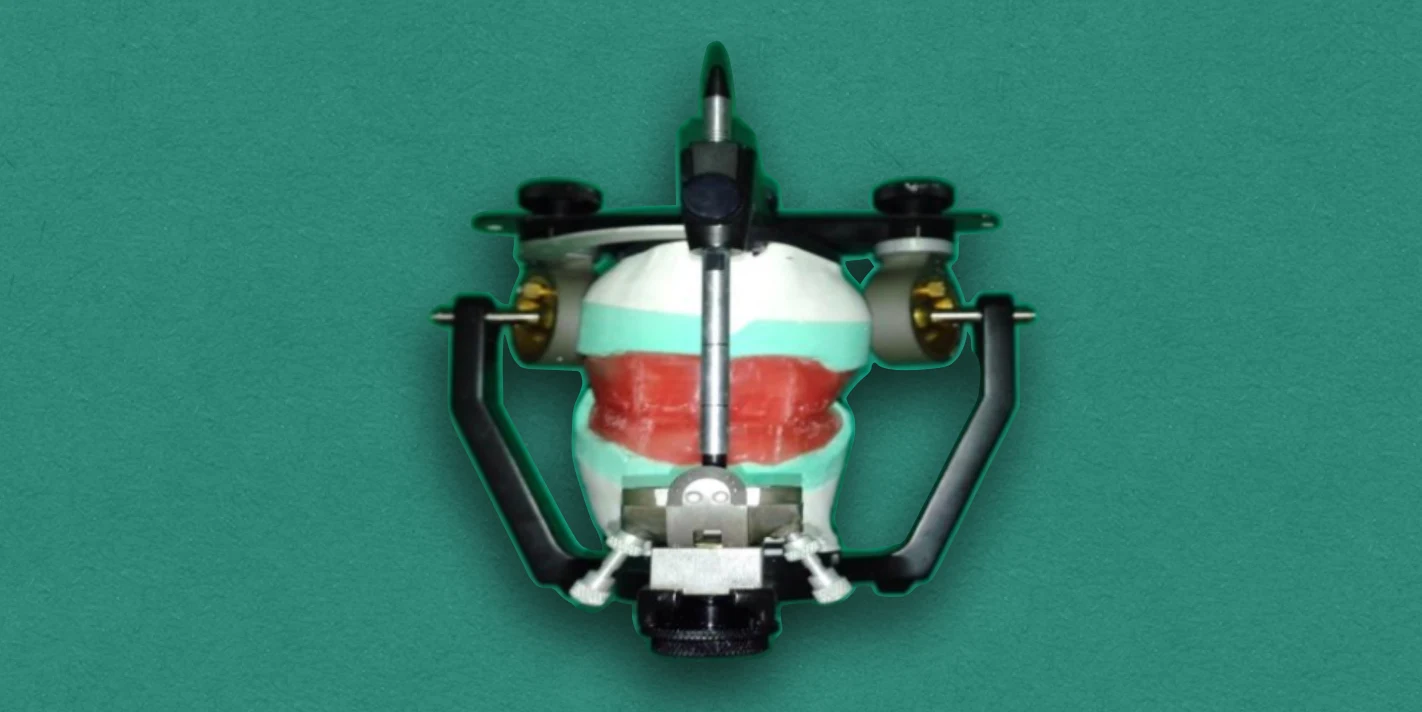
Maxillomandibular relationship record is a registration of any positional relationship of the mandible relative to the maxilla; these records may be made at any vertical, horizontal, or lateral orientation (GPT 9)
Steps in Recording Jaw Relation
- Fabrication of occlusal rims.
- Deciding the level of occlusal plane.
- Orienting the casts with the opening axis of the articulator and facebow record.
- Establishing the vertical dimension of occlusion.
- Determining the centric relation at the accepted vertical dimension.
Level/Height of Occlusal Plane
Establishing the correct level or height of the occlusal plane requires an understanding of the neutral zone concept and the functions of lingual and modiolus muscles in denture stability.
Neutral Zone
- It is the potential space between the lips and cheeks on one side, and the tongue on the other; that area or position where the forces between the tongue and cheeks or lips are equal (GPT-9).
Modiolus
- It is the area near the corner of the mouth where eight muscles converge; it functionally separated the labial vestibule from the buccal vestibule (GPT-9).
- The 8 muscles are Orbicularis oris, Buccinator, Levator anguli oris, Depressor anguli oris, Zygomaticus major, Zygomaticus minor, Risorius, Quadratus labii superioris, Quadratus labii inferioris.
- The modiolus becomes fixed every time the buccinator muscle contracts, which is a natural accompaniment of all chewing efforts. The contraction of the modiolus presses the corner of the mouth against the premolars so the occlusal table is closed in front.
Marking the Mandibular Occlusal Plane
- Food is crushed by the premolars and molars and does not escape at the corner of the mouth. The corners of the mouth are marked on the occlusal rims to provide the dentist and technician with anterior landmarks for the height of the first premolars.
- The anterior 2/3rd of the retromolar pad marks the posterior landmark.
- Joining these two landmarks, the resultant occlusal plane is almost invariably parallel to the residual alveolar ridge and the interpupillary line.
- Its height will conform to activities of the tongue, cheek, and corner of the mouth, which tends to enhance mandibular denture stability.
- The maxillary occlusal rim is next adjusted to meet evenly with the mandibular rim.
Marking the Maxillary Occlusal Plane
- Here, the maxillary occlusal rim is first adjusted.
- It includes shaping the occlusal rim such that the incisal plane is parallel to the interpupillary line and is at a height that allows for the length of the natural tooth plus the amount of tissue resorption that has occured.
- Posteriorly, the occlusal plane is made parallel to the ala-tragus line (Campers line) on the basis of the position of most natural occlusal planes.
- Then, the lower occlusal rim is adjusted to meet evenly with the upper rim and reduced until sufficient interocclusal distance has been obtained.