
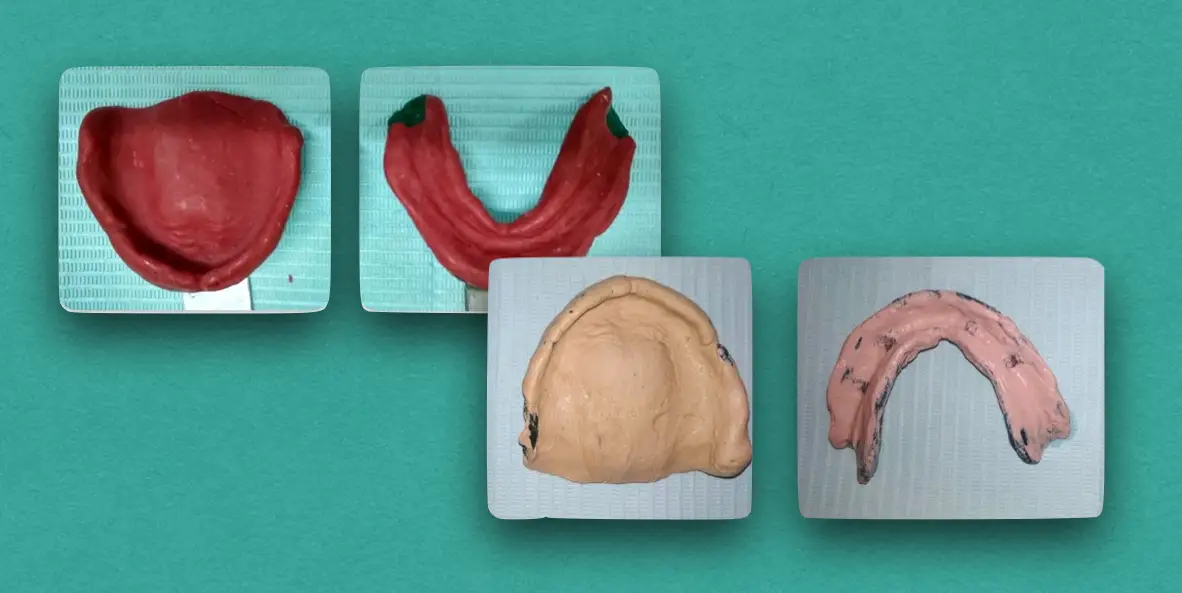
An ideal impression should capture all potential denture-bearing surfaces and tissues, so as to provide support, retention and stability for the denture under function.
An impression can be mucostatic (records tissue with minimum displacement) or mucodisplacing (displaces the tissues). The method of choice is based on the oral conditions, concept of the function of the tissues surrounding the denture, and ability to handle the available impression materials.
Theories of Impression Making
...
Pre-requisites of Impression Making
- Healthy oral tissues.
- The impression should extend to include the entire basal seat area, within the limits of function of the supporting and limiting tissues.
- Space must be created within the denture, for any redundant tissue or boney projections of the ridge that cannot be surgically removed.
- Proper space for the selected impression material should be provided within a properly fitting impression tray.
- A guiding mechanism should be provided for correct positioning of the impression tray in the mouth.
- A physiological type of border molding procedure should be performed by the clinician or by the patient under the guidance of the clinician.
- The external shape of the impression must be similar to the external form of the complete denture.
Objectives
...
Points to Note
-
The most important part of the impression-making procedure is the tray.
- A properly fitting tray allows to carry the impression material to the mouth and control it without distortion or with minimal distortion that can be corrected in the denture fabrication process.
- If the tray is too large, it will distort the tissues around the borders of the impression and will pull the soft tissues under the impression away from the bone, distorting the dimensions of the sulcus in the process.
- If it is too small, the border tissue will collapse inward onto the residual ridge. This too will distort the accurate recording of the border extension of the denture and prevent the proper support of the lips by the denture flange.
-
Overextension of peripheral borders is preferred to under-extension : This will result in a overextended preliminary cast and a slightly overextended custom tray will be fabricated. The final impression will require minimal or less addition of border material and will be less time consuming.
-
Most effective way of resolving inflammation of the oral tissues prior to impression making : Ensure that patients leave their dentures out of the mouth during night and for at least 24 hours before the impressions are made. (Alternative : Tissue conditioners are effective, however, patients should still be encouraged to leave their old dentures out as much as possible before the impressions are made.)
References
- Prosthodontic Treatment for Edentulous Patients Complete Dentures and Implant-supported Prostheses (13th edition) , Zarb, Hobkirk, Eckert, Jacob, Mosby Elsevier.
*This article is an excerpt from the above mentioned book and Medical Sutras does not make any ownership and affiliation claims.