
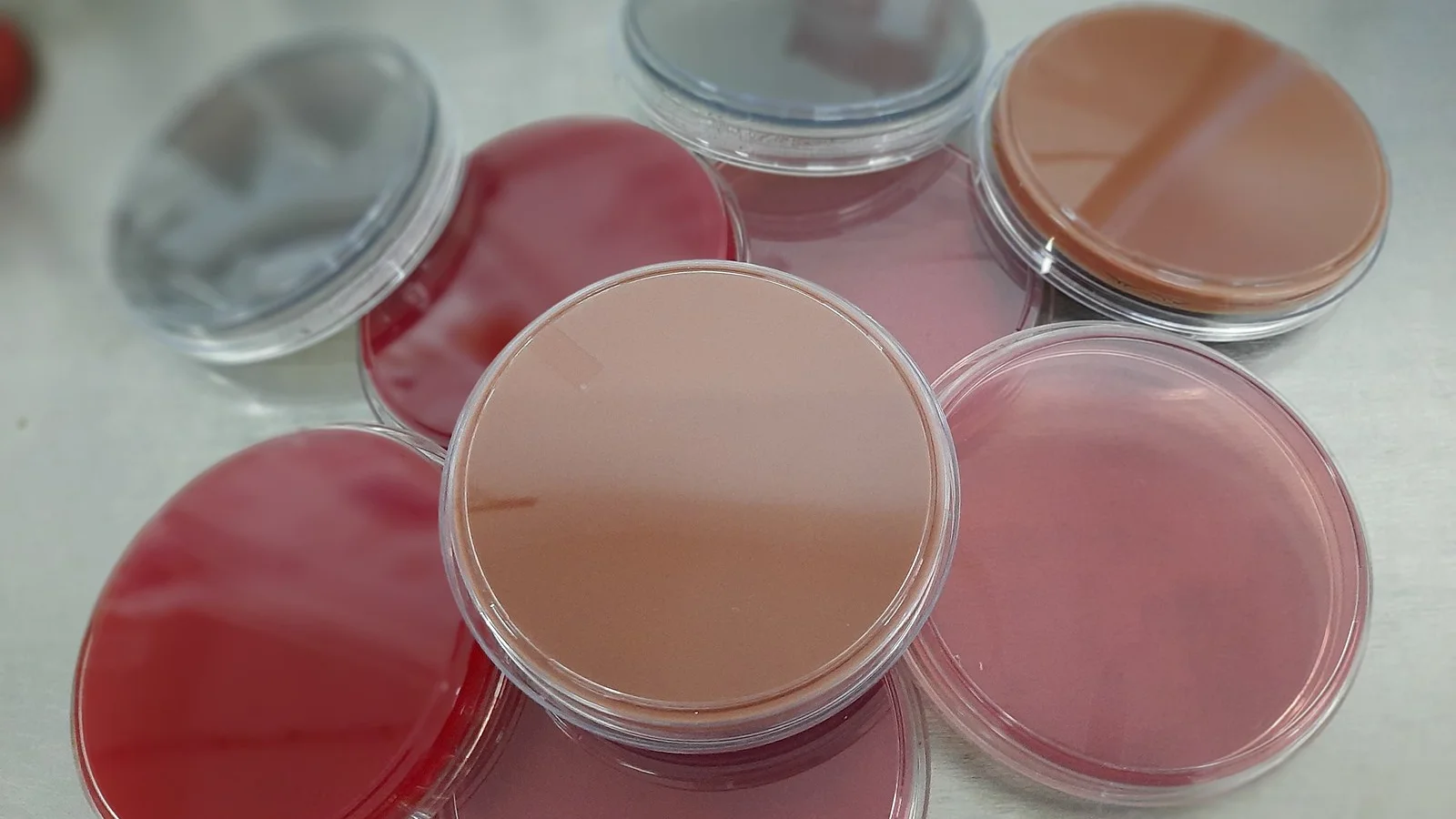
A culture/growth medium is a liquid or gel that allows the growth of microorganisms, which replicate and form colonies in solid media or suspensions in liquid media.
- It is composed of basic elements such as water and nutrients, with different growth factors added for specific organisms that are necessary for their growth.
- Inoculation of samples in culture media forms the starting point in the identification and antibiotic susceptibility testing of a microorganism.
Liquid Media
In liquid culture media, also called culture broths, nutrients are dissolved in water. The growth of bacteria in this type of medium can be demonstrated by the appearance of a turbidity in the medium, although this is not always the case.
Indication
- To obtain bacterial growth from blood or water when large volumes have to be tested.
- To prepare bulk cultures of antigens or vaccines.
Advantages
- Facilitate access to nutrients for bacteria: The nutrients are more accessible as the culture media are incubated under agitation, allowing a renewal of nutrients for bacteria.
Disadvantages
- Difficult to isolate a microorganism specifically.
- Bacteria obtained from a sample inoculated into the culture broth are all mixed with each other.
- Does not allow the morphological characteristics of bacterial species to be identified.
Solid Media
Solid culture media are prepared by adding a gelling agent, such as agar, to the culture broth.
Gelling Agents
-
Gelatin
- One of the first gelling agents used in culture media.
- However, it melts at 37°C, which is the incubation temperature of most bacteria.
- Gelatinase, present in some bacteria causes the digestion and degradation of gelatin.
-
Agar
- Obtained from a type of seaweed.
- Have virtually no nutritive value and not affected by bacterial growth.
- Melts at 98 oC and sets at 42 oC depending on agar concentration (usually 2%).
- Agarase present in some bacteria destroys agar, hence, preventing the isolation of these bacteria.
- Can inhibit the growth of some anaerobic bacteria because inhibitory growth compounds can be produced from autoclaving phosphate with agar.
- Can cause inhibition of PCR of fungal DNA when extracted directly from the solid culture medium.
- Forms a network too dense to allow motility and optimal growth of certain bacteria.
- Over-consumption of agar has led to a reduction in its source, red algae which has increased costs.
-
Carrageenan gums (κ-carrageenan)
- Resists very alkaline pH (> 12.5), hence, can isolate very highly alkaliphilic bacteria.
- Can be used to replace agar, as many bacteria grow on κ-carrageenan-based media.
-
Sodium alginate
- Produced from brown seaweed extract, forms a flexible gel in the presence of calcium ions.
- However, it does not provide a gel firm enough to grow bacteria.
-
High-methoxyl pectins
- Require sugar and high acidity to gel.
- Gel setting is slow and results in the formation of a ‘spreadable’ gel.
-
Low-methoxyl pectins: Form brittle gels in the presence of Ca2+.
-
Gellan gum: Polysaccharide produced by a bacterial genus, Sphingomonas spp.
Advantages
- Isolated colonies of different bacterial species can be obtained and identified.
- Morphology and characteristic features such as pigmentation or hemolysis of the microorganism can be described.
Disadvantages
- Access to nutrients for bacteria may be limited.
- Media with high gel content, such as agar, will form smaller colonies than low gel content media because nutrient flow and toxin removal are reduced.
References
- Ananthanarayan and Paniker's Textbook of Microbiology, 10th Edition (Editor - Reba Kanungo), Universities Press.
- Bonnet M, Lagier JC, Raoult D, Khelaifia S. Bacterial culture through selective and non-selective conditions: the evolution of culture media in clinical microbiology. New Microbes New Infect. 2019 Nov 30;34:100622. doi: 10.1016/j.nmni.2019.100622. PMID: 31956419; PMCID: PMC6961714.
- The image used is licensed under the Creative Commons Attribution-Share Alike 4.0 International license (Author: Ajay Kumar Chaurasiya. Source: Wikimedia Commons).
*This article is an excerpt from the above mentioned sources and Medical Sutras does not make any ownership and affiliation claims.