
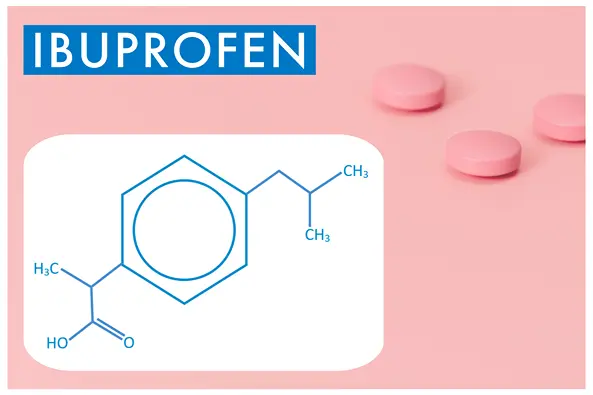
Ibuprofen is the first member of the Propionic acid class of NSAIDs to come into general use. It has been rated as the safest traditional NSAID by the spontaneous adverse drug reaction reporting system in U.K.
-
Some common Propionic Acid Derivatives includes :
- Ibuprofen (Weakly COX-1 selective)
- Naproxen (Weakly COX-1 selective)
- Fenoprofen (Non-selective)
- Ketoprofen (Weakly COX-1 selective)
- Flurbiprofen (Very COX-1 selective)
Mechanism of Action
- Ibuprofen and other propionic acid derivatives are nonselective COX inhibitors with the effects and side effects common to other traditional NSAIDs.
- All members inhibit PG synthesis. Naproxen being the most potent but their in vitro potency to inhibit COX does not closely parallel in vivo anti-inflammatory potency.
- Inhibition of platelet aggregation is short-lasting with ibuprofen, but longer lasting with naproxen.
Pharmacokinetics
- Ibuprofen and other propionic acid derivatives are well absorbed orally and are highly bound to plasma proteins (90–99%).
- However, displacement interactions are not clinically significant - dose of oral anticoagulants and oral hypoglycemics need not be altered.
- They undergo hepatic metabolism (90% is metabolized to hydroxylate or carboxylate derivatives) and excreted in urine as well as in bile.
- The half life (t1/2) is 2 hours.
- Slow equilibration with the synovial space means that its antiarthritic effects may persist after plasma levels decline.
- All NSAIDs of this class enter brain, synovial fluid and cross placenta.
Adverse effects
- Ibuprofen and all its congeners are better tolerated than Aspirin.
- Side effects are milder and their incidence is lower. Nevertheless, 5–15% of patients experience GI side effects like gastric discomfort, nausea and vomiting
- Less frequent adverse effects include thrombocytopenia, rashes, headache, dizziness, blurred vision, and in a few cases toxic amblyopia, fluid retention, and edema.
- Patients who develop ocular disturbances should discontinue the use of Ibuprofen.
- Excretion into breast milk is thought to be minimal, so Ibuprofen also can be used with caution by women who are breastfeeding.
- They are not to be prescribed to pregnant women and should be avoided in peptic ulcer patient.
Drug Interaction
- Because they inhibit platelet function, use with anticoagulants should be avoided.
- Similar to other NSAIDs, they are likely to interfere and decrease diuretic and antihypertensive action of thiazides, furosemide and β blockers.
- The increase the risk of bleeding with warfarin and the risk of bone marrow suppression with methotrexate.
- Ibuprofen also has shown to interfere with the antiplatelet effects of aspirin and precipitate aspirin-induced asthma.
- Concurrent treatment with Ibuprofen has been found to prevent irreversible COX inhibition by low dose aspirin, because it reversibly occupies the active serine residue of COX-1 and protects it from irreversible acetylation by aspirin. Thus, the antiplatelet action of ibuprofen is short lasting, and it abolishes the antiplatelet and cardioprotective effect of low dose aspirin.
Dosage and Indications
- Ibuprofen is used as a simple analgesic and antipyretic in the same way as low dose of aspirin.
- It is particularly effective in dysmenorrhoea in which the action is clearly due to PG synthesis inhibition.
- Ibuprofen and its congeners are widely used in rheumatoid arthritis, osteoarthritis and other musculoskeletal disorders, especially where pain is more prominent than inflammation.
- They are indicated in soft tissue injuries, fractures, vasectomy, tooth extraction, postpartum and postoperatively, wherein they suppress swelling and inflammation
- It is available as an ‘over-the-counter’ drug supplied as tablets containing 200–800 mg : only the 200-mg tablets are allowed without a prescription.
- Doses of up to 800 mg four times daily can be used in the treatment of rheumatoid arthritis and osteoarthritis, but lower doses often are adequate.
- The usual dose for mild-to-moderate pain, such as that of primary dysmenorrhea, is 400 mg every 4–6 hours as needed.
Points to Note
- The anti-inflammatory activity of Naproxen is stronger and it is particularly potent in inhibiting leucocyte migration - may be more valuable in acute gout : Dose 750 mg stat followed by 250 mg 8 hourly till attack subsides.
- Naproxen is also recommended for rheumatoid arthritis and ankylosing spondylitis. It may have slightly better efficacy with regard to analgesia and relief of morning stiffness.
- Epidemiological studies suggest that while the relative risk of myocardial infarction is unaltered by Ibuprofen, it is reduced by around 10% by naproxen, compared to a reduction of 20–25% by aspirin. This suggestion of benefit accords with the clinical pharmacology of naproxen that suggests that some but not all individuals dosed with 500 mg twice daily sustain platelet inhibition throughout the dosing interval.
References
- Essentials of Medical Pharmacology 8th Edition (K.D. Tripathi)-Jaypee Brothers Medical Publishers (P) Ltd.
- James Ritter, Rod Flower, Graeme Henderson, Yoon Kong Loke, David MacEwan, Humphrey Rang - Rang & Dale’s Pharmacology-Elsevier (2019).
- Laurence L. Brunton - Goodman & Gilman's Manual of Pharmacology and Therapeutics-McGraw-Hill Medical (2008).
*This article is an excerpt from the above mentioned books and Medical Sutras does not make any ownership or affiliation claims.