
application, classification, types, setting reaction, mode of supply, properties, factors affecting setting, manipulation, biocompatibility, advantages, disadvantages, uses and all other relevant information
Also known as Glass polyalkenoate cement, GIC is an adhesive tooth-colored cement that hardens following an acid-base reaction between fluoroaluminosilicate glass powder and an aqueous-based polyacrylic solution.
Composition
POWDER
- Silica.
- Alumina.
- Calcium fluoride, Aluminium fluoride, Sodium fluoride: Fluoride acts as a ceramic flux and causes phase separation within the glass particles, that creates opacity.
- Metal oxides (Barium, Strontium): Provides radiopacity.
- Particle size : 10-50 micrometers (Coarser powders are used for restorations, while finer ones are used for cementation or pulp protection).
LIQUID
-
Polyacrylic acid (Copolymers of Itaconic, Maleic or Tricarboxylic acids).
-
Tartaric acid (used as a rate-controlling additive)
- Improves handling, decreases viscosity and increases working time.
- Shortens setting time.
- Extends the shelf life of the liquid.
-
Water: Provides the medium for reaction and hydrates the reaction products.
*Addition of 5-10% tartaric acid enables the use of lower-fluoride-content GICs, that makes the restorations more translucent and aesthetic.
Setting Reaction
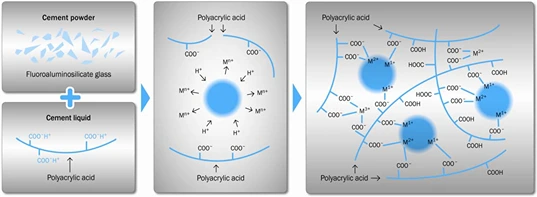
- When the GIC powder and liquid are mixed, the acid dissolves the powder and releases calcium, aluminium, sodium and fluoride ions into the liquid.
- When the ions are leached, a silica-rich gel is formed that covers the undissolved portion of the powder particles.
- Calcium and aluminium ions form polysalts with the carboxyl groups of polyacrylic acid, resulting in a cross-linked matrix. (Sodium and fluoride ions do not form crosslinks).
- The set GIC, thus, consists of undissolved powder particles with a silica gel coating, embedded in an amorphous matrix of hydrated calcium and aluminium polysalts containing fluoride ions.
How To Use
MIXING
- The prepared tooth surface must be clean (uncontaminated) and dry (not desiccated deep into the tubules).
- To remove the smear layer produced by cavity preparation, pumice slurry can be used or the tooth can be etched with phosphoric acid (34-37%) or polyacrylic acid (10-20%) for 10-20 seconds, followed by 20-30 second water rinse.
- A nonabsorbent paper pad or a cool, dry glass slab should be used for mixing. (Cool glass slab retards the reaction and extends the working time.)
- Firstly, half of the powder is mixed into the liquid for 5-15 seconds, then the remaining powder is added quickly and mixed by folding the cement on itself until a uniform and glossy appearance is achieved.
* A glossy appearance indicates that unreacted polyacid is present for bonding to the tooth surface, while a dull appearance indicates the setting reaction has progressed too far.
APPLICATION
Restoration
- During the initial setting, the surface of fresh GIC should be covered with a plastic matrix for about 5 minutes to avoid excess water sorption. Otherwise, saliva will dilute the matrix-forming cations and anions and destroy the hydrated matrix, resulting in a weak restoration.
- After the plastic matrix is removed, the surface must be protected with varnish or petroleum jelly while excess GIC is removed from the margins.
- Finishing of the GIC surface is done only after the cement has set properly (avoid excessive drying while finishing).
- The restorations should again be coated with varnish or petroleum jelly after final finishing.
Luting
- GIC is applied with a plastic instrument to coat the entire inner surface of the prosthesis before seating.
- Excess cement can be removed immediately after prosthesis placement and a protective coating should be applied after removal of the excess cement.
Properties
- Compressive strength: Varies with the powder-liquid ratio (Luting GIC : 85 MPa, Restorative GIC : 150 MPa).
- Lower fracture toughness than composite restorations.
- More susceptible to occlusal wear and cervical abrasion.
- Chemical bond to tooth structure (Ionic bond between the carboxyl groups of the polyacrylic acid and the calcium present in enamel and dentin).
- Anti-cariogenic: Persistent fluoride release.
Classification
- Type I : Luting cement.
- Type IIa : Esthetic restorative cement.
- Type IIb : Reinforced restorative cement.
- Type III : Lining cements and bases.
Uses
- Aesthetic restoration of anterior teeth eg. Class III and V sites.
- Intermediate restorations.
- Pit and fissure sealants.
- Cavity liners and bases.
- Core buildup materials.
- Luting cement for fixed prostheses.
- Cementation of orthodontic bands (GIC can be easily weakened with desiccating air spray).
Metal Reinforced GIC
-
Consists of metallic fillers incorporated into glass ionomer cements.
-
Types :
- Alloy admix : Silver alloy powder is mixed with restorative type GIC.
- Cermet : Silver particles are sintered to glass particles.
-
Shows faster setting and more fluoride release.
-
Indications :
- Core buildup of teeth to be restored with cast crowns.
- Restoration of occlusal surfaces of primary molars with SS crowns.
- Cementation of pins and other retentive forms.
Atraumatic Restorative Treatment (ART)
- Preventive and restorative treatment used when sufficient infrastructure (such as electricity, equipment or piped water system) is not available to carry conventional dental treatment.
- High viscosity GIC is the material of choice, since there are chances of caries to be left behind after excavation with hand instruments and a good chemical bond and fluoride releasing ability of GIC prevents chances of secondary caries.
Points To Note
- Water-settable GIC : Specialised cement formulated with freeze-dried polyacrylic acid blended with the powder. For clinical use, the powder is mixed with water or an aqueous solution containing tartaric acid. They have an extended working time as additional time is required to dissolve the dried polyacrylic acid in water and initiate the acid-base reaction.
- The glass slab used for mixing GIC should not be colder than the dew point of the room temperature, otherwise it will lead to water condensation and dilution of the liquid.
- The powder and liquid should be dispensed just before mixing, else evaporation of water will increase the acidity of the liquid.
- Mixing time : 45 seconds or as instructed by the manufacturer.
- For cavities with remaining dental thickness less than 0.5mm : A protective liner such as Calcium hydroxide should be used.
- High Viscosity GIC : Consists of smaller particle sizes and is used with higher powder-liquid ratio (increased compressive strength).
References
-
[](https://amzn.to/3USt5AE) Phillips' Science of Dental Materials, 13th Edition, Shen, Rawls, Esquivel-Upshaw, Elsevier
 Basic Dental Materials, 4th Edition, John J Manappallil, Jaypee Brothers Medical Publishers (P) Ltd
-
The image used is licensed under the Creative Commons Attribution-Share Alike 4.0 International license.
- Source : Lohbhauer, Ulric (2009-12-28). "Dental Glass Ionomer Cements as Permanent Filling Materials? – Properties, Limitations and Future Trends". Materials (in.
- Author : Lohbhauer, Ulric.
*This article is an excerpt from the above mentioned books and Medical Sutras does not make any ownership or affiliation claims.