
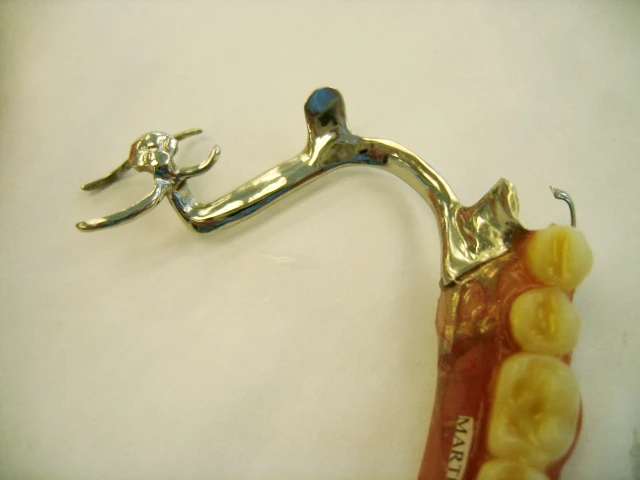
Class I Removable Partial Dentures
Exhibit bilateral distal extension bases and derive support from the remaining teeth and residual ridges. They present a significant challenge for patients and dentists, since, they must provide an equal force distribution to preserve the remaining teeth and residual ridges.
Design Considerations
-
Broad coverage (Snowshoe effect)
- Full extension of the denture base allows a more favourable force distribution and helps in providing optimal support to the denture.
- Inadequate soft tissue coverage may result in stress concentration, breakdown of underlying bone and a decrease in ridge volume.
-
Direct retention
- Must be flexible to prevent the application of harmful torquing forces to the abutments.
- The soft tissues are displaced more (1.0 mm or more) as compared to the teeth (~0.2mm), which results in vertical movement of the denture bases upon loading and stresses on the most posterior abutments.
- Each direct retainer should be designed to flex or move in an area of greater undercut as forces are applied to the denture.
- Improperly designed direct retainers may magnify the stress on abutments, resulting in rocking forces, that, may damage the soft tissues and produce mobility of the abutment teeth.
-
Indirect retention
- Resists rotation if the denture base, when an unseating force is applied to the denture.
- Displacement of the denture base away from the supporting tissues (eg. due to sticky foods) produces rotation of the denture around the most posterior abutment , which may cause damage to the remaining teeth and soft tissues.
- Auxiliary rests are used to minimise rotation and should be placed as far as possible from the fulcrum line.
- Auxiliary rests also help in retention of the associated prosthesis, hence, referred as indirect retainers.
Class IV Removable Partial Dentures
While considering the design process, the Class IV design should be regarded as a Class I RPD in reverse, particularly if the edentulous span is lengthy. The prosthesis must include :
- Well-adapted denture base.
- Properly designed direct retention.
- Appropriately positioned indirect retention.
Class III Removable Partial Dentures
Often function like fixed prosthesis as they are supported by teeth or dental implants at both ends of the edentulous space.
Design Considerations
- They do not rotate or lift away from the underlying tissues, and therefore, compensation for rotational forces is not needed.
- Support should be provided entirely by the abutment teeth.
- Residual ridges should be used for support only when the edentulous spaces are long or when the abutments have decreased periodontal support.
- Appropriate direct retention must be incorporated into the design, to prevent dislodgement of the prosthesis.
- Indirect retention may be required, if direct retention cannot be obtained on one or more abutment teeth.
Class II Removable Partial Dentures
Must embody features of both Class I and Class III designs. The unilateral distal extension side must be designed as a Class I RPD, whereas the tooth-supported side must be designed as Class III RPD. The prosthesis must include :
- Well-adapted denture base.
- Properly designed direct retention.
- Appropriately positioned indirect retention.
References
- Stewart’s Clinical Removable Partial Prosthodontics (4th edition), Rodney D. Phoenix, David R. Cagna, Charles F. DeFreest, Quintessence Books.
- The image used has been released into the public domain by its author, DRosenbach at English Wikipedia.
*This article is an excerpt from the above mentioned book and Medical Sutras does not make any ownership and affiliation claims.