
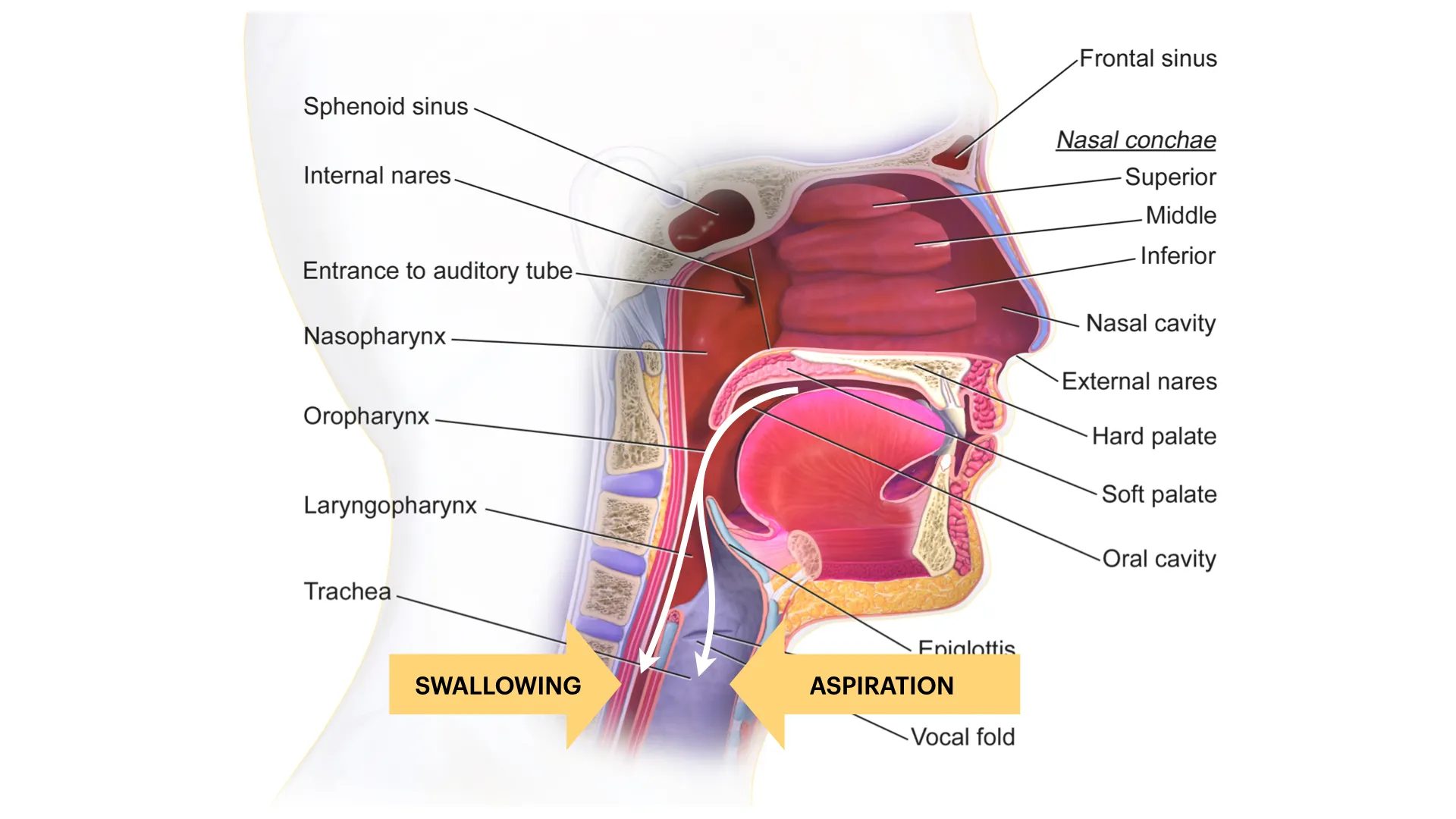
During dental treatment small objects such as pieces of restoration or debris may drop into the oropharynx of the patient and subsequently be swallowed or aspirated.
Swallowing
-
During swallowing the epiglottis seals the tracheal opening so any object swallowed enters the gastrointestinal tract (not the trachea).
-
In the gastrointestinal tract the swallowed object is most likely to get impacted in the esophagus, since it is a collapsed tube through which liquids and solids are forced.
-
More than 90% of swallowed objects that successfully cross the esophagus, pass through the stomach and intestines completely without any complication.
-
Complications:
- GI blockage.
- Peritoneal abscess.
- Perforation.
- Peritonitis.
Aspiration
-
Aspirated objects can enter the trachea or pass on to the bronchi.
-
In the tracheo-bronchial tree, the aspirated object is most likely to enter the right bronchus, since, the right main bronchus branches off the trachea at a 25 degree angle (Left bronchus : 45 degrees).
-
Complications :
- Trachea : Foreign body airway obstruction.
- Bronchus : Infection, Lung abscess, Pneumonia, Atelectasis.
Prevention
- Use of rubber dam : Effectively isolates the operative field from the oral cavity and airway, thus not allowing any foreign object to enter oropharynx.
- Use of oral packing : 4" x 4" gauze pads are recommended across the posterior portion of oral cavity, that forms a pharyngeal curtain. It is particularly useful for sedated patient in whom the protective airway reflexes are compromised.
- Chair position : If there is an incidence of drop of any object inside the oral cavity, the patient should be turned onto his or her side and leaned into head-down position with the upper body hanging over the side of the chair. (Supine position should be avoided as it makes it difficult for the patient to push the object out.)
- Dental assistant : The dental assistant must be available with one or more devices (such as pickup forceps or haemostat) to retrieve the fallen object from the mouth.
- High-volume suction : Helpful in prompt retrieval of object from patient's mouth when other instruments are not readily available.
- Use of ligature (Dental floss) : Dental floss should be secured to rubber dam clamps, endodontic instruments, cotton rolls, gauze pads, around pontics in fixed bridges and to any other small object placed in the oral cavity during treatment.
- Magill Intubation Forceps : It is designed to facilitate retrieval of objects from the posterior regions of the oral cavity and is recommended to be included in the basic emergency kit.
Management
If the object is visible
- Move the chair into a more reclined position and the patient on his or her side.
- Place the patient in Trendelenburg position with the upper body hanging over the side of the chair.
- Ask the assistant to pick up the object with Magill intubation forceps.
If the object is swallowed
- Consult a radiologist and obtain radiograph to determine the location of the object.
- Refer the patient to appropriate specialist for medical opinion and further management.
If the object is aspirated
-
Position : Place the patient in left lateral decubitus position and encourage the patient to cough.
-
If the foreign body is retrieved : Consult a medical specialist before discharge.
-
If the foreign body is not retrieved : Check for signs of airway obstruction (choking).
-
If there are no signs of airway obstruction :
- It is likely that the object is in the tracheo-bronchial tree.
- Consult a radiologist and obtain radiograph to determine the location of the object.
- Procedure : Fiberoptic bronchoscope (to visualise the object) and bronchoscopy (to retrieve it).
-
If there are signs of airway obstruction : Recommended management techniques to be followed :
- Basic airway manoeuvres (BLS) : Head tilt-chin lift, Jaw-thrust (if indicated).
- Non-invasive procedure : Back blows (Back slaps), Abdominal thrust, Chest thrust.
- Invasive procedures : Tracheostomy and Cricothyrotomy.
Points to Note
- Oral packing should not be used in unsedated patients, as it may incite the gag reflex and also interfere with swallowing or inhalation through mouth.
- 2" x 2" gauze pads are not recommended for airway protection as they are too small and may easily get dislodged and aspirated / swallowed.
- Trendelenberg position : The patient's head is placed low and the body and legs are elevated by 15-30 degrees.
References
- Medical Emergencies in the Dental Practice (7th Edition), Stanley F. Malamed, Daniel L Orr II, Mosby Elsevier. https://amzn.to/4bsbBkf
- Contemporary Oral and Maxillofacial Surgery (6th Edition), James R Hupp, Edward Ellis III, Myron R Tucker, Mosby Elsevier. https://amzn.to/3HJehMO
- The image used is licensed under the Creative Commons Attribution 3.0 Unported license. (Attribution : Blausen.com staff (2014). "Medical gallery of Blausen Medical 2014". WikiJournal of Medicine 1 (2). DOI:10.15347/wjm/2014.010. ISSN 2002-4436).
*This article is an excerpt from the above mentioned books and Medical Sutras does not make any ownership or affiliation claims.