
Fluoroquinolones (FQs) are quinolone antimicrobials having one or more fluorine substitutions.
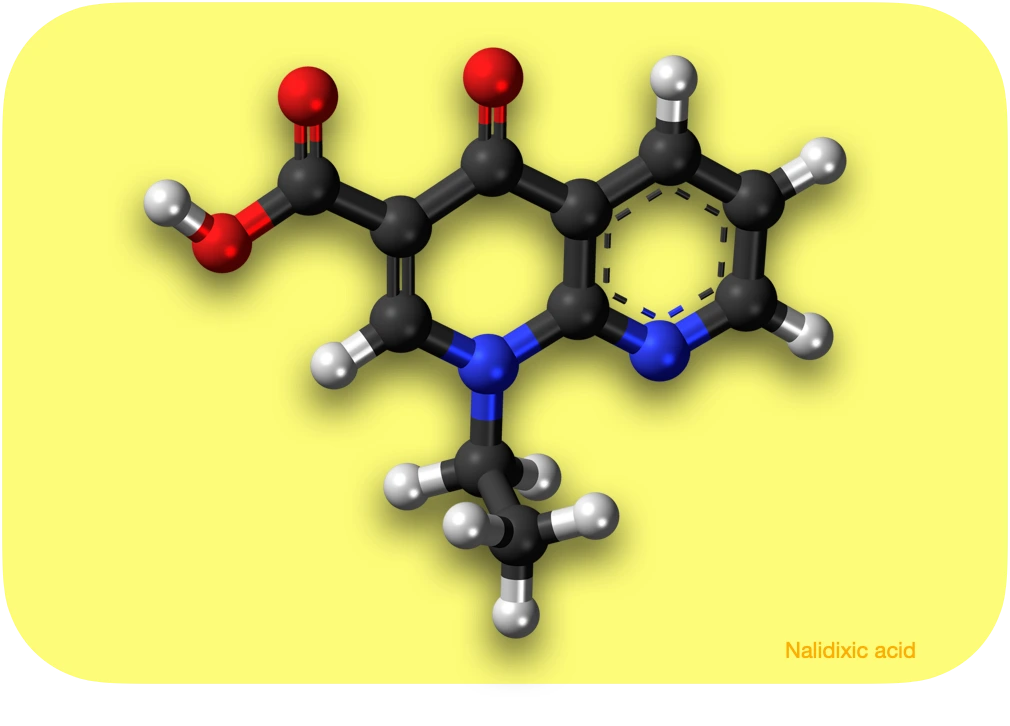
Quinolones are synthetic antimicrobials having a quinolone structure and include Nalidixic acid (first member). Its use is limited to urinary and g.i. tract infections due to low potency, modest blood and tissue levels, restricted spectrum and high frequency of bacterial resistance.
- First Generation FQs: Introduced in 1980s, have one fluoro substitution and include Norfloxacin, Ciprofloxacin, Ofloxacin, Pefloxacin.
- Second Generation FQs: Introduced in 1990s, have additional fluoro and other substitutions, and include Levofloxacin, Moxifloxacin, Gemifloxacin, Prulifloxacin, Lomefloxacin, Sparfloxacin.
Antibacterial spectrum
- Highly susceptible: E. coli, Neisseria gonorrhoeae, K. pneumoniae, N. meningitidis, Enterobacter, H. influenzae, Salmonella typhi, H. ducreyi, Nontyphoid Salmonella, Campylobacter jejuni, Shigella, Yersinia enterocolitica, Proteus, Vibrio cholerae.
- Moderately susceptible: Pseudomonas aeruginosa, Legionella, Brucella, Mycoplasma, Listeria, Chlamydia pneumophila, Staph. epidermidis, Bacillus anthracis, Branhamella catarrhalis, M. tuberculosis.
Mechanism of Action
Fluoroquinolones primarily inhibit the enzyme bacterial DNA gyrase (gram-negative bacteria) and topoisomerase IV (gram-positive bacteria).
- DNA gyrase nicks double-stranded DNA, introduces negative supercoils and then, reseals the nicked ends. FQs bind to the A subunit of the enzyme and interfere with its strand cutting and resealing function.
- Topoisomerase IV nicks and separates daughter DNA strands (catenated DNA molecules) that results from DNA replication. This is the primary target in gram-positive bacterias.
Bactericidal action: Probably due to digestion of the DNA by exonucleases whose production is signalled by the damaged DNA.
Mammalian cells: Contains topoisomerase II, that removes positive supercoils and have very low affinity for FQs. This results in low toxicity to host cells.
Resistance: Reported in Bacteroides fragilis, Clostridia, Salmonella, Pseudomonas, Staphylococci, Gonococci and Pneumococci. The resistance is slow to develop and usually occurs due to:
- Chromosomal mutation producing DNA gyrase or topoisomerase IV with reduced affinity for FQs.
- Reduced permeability/increased efflux of these drugs across bacterial membranes.
Pharmacokinetics
Absorption
- Well absorbed after oral administration. Peak serum levels occur within 1-3 hrs of an oral dose.
- Foods does not impair oral absorption, but may delay the time to peak serum concentrations.
Distribution
- High volume of distribution, with concentrations in urine, kidney, lung and prostate tissue, stool, bile and macrophages and neutrophils higher than serum levels.
- Concentration in CSF, bone and prostatic fluid is lower than in serum.
- Levels of pefloxacin and ofloxacin in ascites fluid approach serum levels.
- Ciprofloxacin, ofloxacin and pefloxacin have been detected in human breast milk.
Metabolism & Excretion
- Most FQs are cleared predominantly by the kidney (glomerular filtration and tubular secretion), and dose must be adjusted for renal failure.
- Pefloxacin and moxifloxacin are metabolised predominantly by the liver and should not be used in patients with hepatic failure.
- None is removed efficiently by peritoneal or hemodialysis.
Indications & Dosage
Urinary tract infection (UTI)
- FQs are most efficacious than cotrimoxazole.
- Norfloxacin shows relatively low serum levels which limits its usefulness in urinary tract infection.
Prostatitis
- Norfloxacin, ciprofloxacin and ofloxacin are effective for the treatment if prostatitis caused by sensitive bacteria.
- Administered 4-6 weeks appear to be effective in patients not responding to cotrimoxazole.
Sexually transmitted diseases
- Chlamydial urethritis/cervicitis: Ofloxacin or sparfloxacin (7-day course), alternative to 7-day course with doxycycline or a single dose of azithromycin.
- Pelvic inflammatory disease: Treated effectively with 14-day course of ofloxacin combined with an antibiotic active against anaerobes such as clindamycin or metronidazole.
- Chancroid (infection by H. ducreyi): Ciprofloxacin (500 mg BD) for 3 days, second line alternative to ceftriaxone/azithromycin.
- Gonorrhea: Single dose of ofloxacin or ciprofloxacin is effective, but has become non-dependable as there is an increase in resistance (Ceftriaxone is the first-line agent).
Gastrointestinal and Abdominal infections
- Traveler's diarrhea (frequently caused by enterotoxigenic E. coli): FQs are equally effective as cotrimoxazole.
- Shigellosis: Norfloxacin, ciprofloxacin and ofloxacin given for 5 days.
- Enteric fever (caused by S. typhi): Ciprofloxacin (750 mg BD for 10 days), Ofloxacin (400 mg BD) or Levofloxacin (500 mg OD/BD), in sensitive strains. (Ceftriaxone is currently the most reliable and fastest acting bactericidal drug for enteric fever).
- Bacteremic nontyphoidal infections in AIDS patients.
Respiratory tract infections
- Community acquired pneumonia and bronchitis: Newer FQs such as gatifloxacin and moxifloxacin have excellent activity against S. pneumoniae.
- Atypical pneumonia: Highly active against common respiratory pathogens incl. H. influenzae, Moraxella catarrhalis, S. aureus, Mycoplasma pneumoniae, Chlamydia pneumoniae, and Legionella pneumophila.
- Cystic fibrosis: Mild-to-moderate respiratory exacerbations owing to P. aeruginosa responds to oral FQs.
Bone, Joint and Soft tissue infections
- Chronic osteomyelitis: 500 mg every 12 hr (750 mg BD, if severe). Bone and joint infections may require treatment for 4-6 weeks or more. Dosage should be reduced for patients with severely impaired renal function. Failures have been associated with the development of resistance in S. aureus, P. aeruginosa and Serratia marcescens.
- Diabetic foot infections: Commonly polymicrobial, FQs in combination with antibiotics active against anaerobes are a reasonable choice.
Other infections
- Prophylaxis of anthrax.
- Treatment of tularemia.
- MDR tuberculosis, Atypical mycobacterial infections and M. avium complex infections in AIDS.
- Neutropenic cancer patients with fever: FQ + Aminoglycoside is comparable to beta-lactam-aminoglycoside combination.
- Fever in low-risk patients with granulocytopenia secondary to cancer chemotherapy: Ciprofloxacin + Amoxicillin-clavulanate is effective oral empirical therapy.
Adverse Effects
- GI tract (most common): Mild nausea, vomiting, and/or abdominal discomfort.
- CNS: Mild headache, dizziness, restlessness, anxiety, insomnia, impairment of concentration and dexterity (caution while driving).
- Hallucinations, delirium and seizures have occured in patients receiving theophylline or NSAID (Ciprofloxacin and pefloxacin inhibit metabolism of theophylline and may induce toxic levels, while NSAIDs may augment displacement of GABA from its receptors by FQs).
- Dermatologic: Rash, pruritus, urticaria and photosensitivity reactions.
- Rare side effects: Achilles tendon rupture or tendinitis, leukopenia, eosinophilia, mild elevations in serum transaminases, diarrhea and antibiotic-associated colitis.
Contraindications
- Pregnancy.
- Children (FQs have produced arthropathy in animal models).
- Gatifloxacin: Diabetic patients (serious reports of hypoglycemia and hyperglycemia). Risk factors include older age, renal insufficiency, and concomitant use of glucose-altering medications.
- FQs should not be used for Shiga toxin-producing E. coli, as they have shown in vitro ability to induce Shiga toxin (causes hemolytic-uremic syndrome).
References
- Laurence L. Brunton - Goodman & Gilman's Manual of Pharmacology and Therapeutics-McGraw-Hill Medical (2008).
- Essentials of Medical Pharmacology (8th Edition), K.D. Tripathi -Jaypee Brothers Medical Publishers (P) Ltd.
- The image used is made available under the Creative Commons CC0 1.0 Universal Public Domain Dedication (Author: Jynto, Souce: Wikimedia commons)
*This article is an excerpt from the above mentioned books and Medical Sutras does not make any ownership or affiliation claims.