
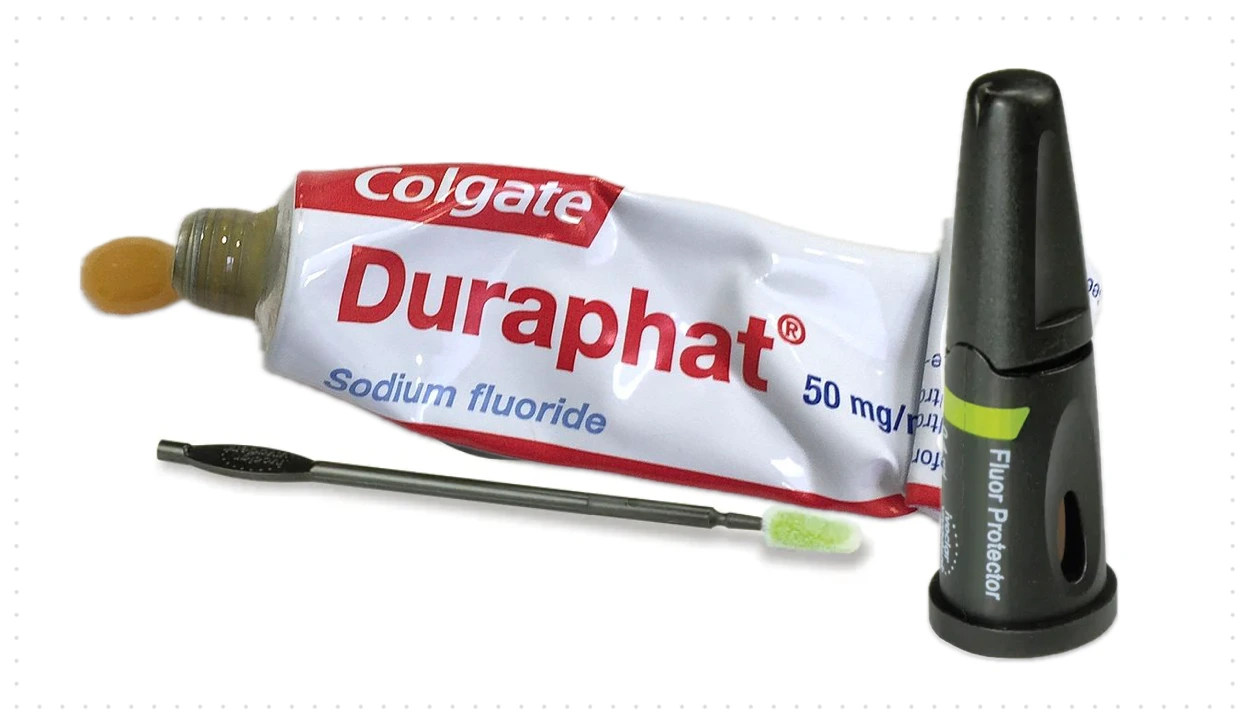
Fluoride varnish is a professionally applied adherent material that holds fluoride in close contact with the tooth and allows application of high fluoride concentration in small amounts.
Rationale
There is substantial leaching of absorbed fluoride from the enamel surface after topical application. However, fluoride incorporated in varnishes that have the ability to adhere to enamel for a long period, can prevent this immediate loss.
It will slowly release fluoride, hence, significantly increasing the fluoride concentration and exposure time, compared to other fluoride agents.
Mechanism of Action
When varnish is applied on the tooth surface, it acts as depot from which fluoride ions (F-) are continuously released. The ions react with hydroxyapatite over a longer period of time, which leads to deeper penetration and significant anticaries effect.
Fluor protector: Fluoride deposition in enamel is twice as more than Duraphat, but, the caries inhibiting ability is far less.
- Silane fluoride reacts with water to produce considerable amount of Hydrofluoric acid (HF-) which penetrates into enamel more rapidly than F-.
- It penetrates the porosities of enamel and forms 0.5-1 mm long tags, that acts as fluoride reservoir. However, these tags block the pathways for fluoride and prevents the remineralisation of initial lesion, thus, leading to less caries inhibition.
Types
Duraphat: First fluoride varnish to be tested.
- Contains 5% sodium fluoride (NaF) in Colophonium base.
- Concentration: 2.26% NaF or 22.6 mgF/ml.
- Hardens into a yellowish brown coating in the presence of saliva.
Fluor protector
- Contains 0.7% silane fluoride (7000 ppm fluoride) in polyurethane base.
- Leaves a clear transparent film on the teeth.
Durafluor (22.6 mg/ml): 5% NaF in alcoholic suspension of natural resins, with sweetening agent (xylitol).
Cavity shield: 5% NaF in resinous base.
CAREX: Tested in Norway, contains 1.8% fluoride, preventive efficacy found to be equivalent to that of Duraphat.
Method of Application
The frequency of application should be decided based on the caries risk of the patient.
- Teeth are cleaned and dried. (*Not to be isolated with cotton rolls, since, varnish stick to cotton.)
- The varnish is applied first to the mandibular teeth, as saliva collects rapidly on the lower arch.
- A small amount (0.3-0.5 ml or 2 drops for the entire primary dentition) is dispensed on the applicator dish or pad.
- The varnish is applied with single tufted brush starting with proximal surfaces. Dental floss can be used to ensure that it reaches interproximal areas.
- No drying is required, since, the varnish sets rapidly on contact with saliva. However, the patient should sit with mouth open for 4 minutes. Contact with the soft tissue should be avoided.
- The patient is instructed not to rinse or drink anything for 1-2 hours, and not to eat anything solid and avoid brushing till next morning. Only liquids or semisolid food is allowed, as this allows to maintain the contact between varnish and tooth for longer period.
Recommended Dosage: A total of 0.3-0.5 ml is required to cover the entire primary dentition.
- 0.5 ml Duraphat contains 11.3 mgF.
- 0.5 ml Fluor protector contains 3.1 mgF.
Advantages
- Well accepted and considered to be safe (no risk of over ingestion of fluoride).
- Application is simple and requires minimal training.
- Cost-effective.
- More convenient to carry in field situations.
- Evidences suggest that it can arrest existing smooth surface lesions of primary teeth and roots of permanent teeth.
Disadvantages
- Most varnishes (sodium fluoride) causes temporary change (yellow) in tooth color. The parents and patient should be informed that the yellow discoloration is temporary and will disappear on brushing next day.
- Contraindicated in patients with ulcerative gingivitis, stomatitis and history of allergy (a component of Duraphat have very small risk of allergy).
References
- C. M. Marya - A Textbook of Public Health Dentistry, Jaypee Brothers Medical Publishers (P) Ltd (2011). https://amzn.to/3SHP36G
- S. S. Hiremath - Textbook of Public Health Dentistry, Elsevier India (2016). https://amzn.to/49mh2jw
*This article is an excerpt from the above mentioned books and Medical Sutras does not make any ownership and affiliation claims.