
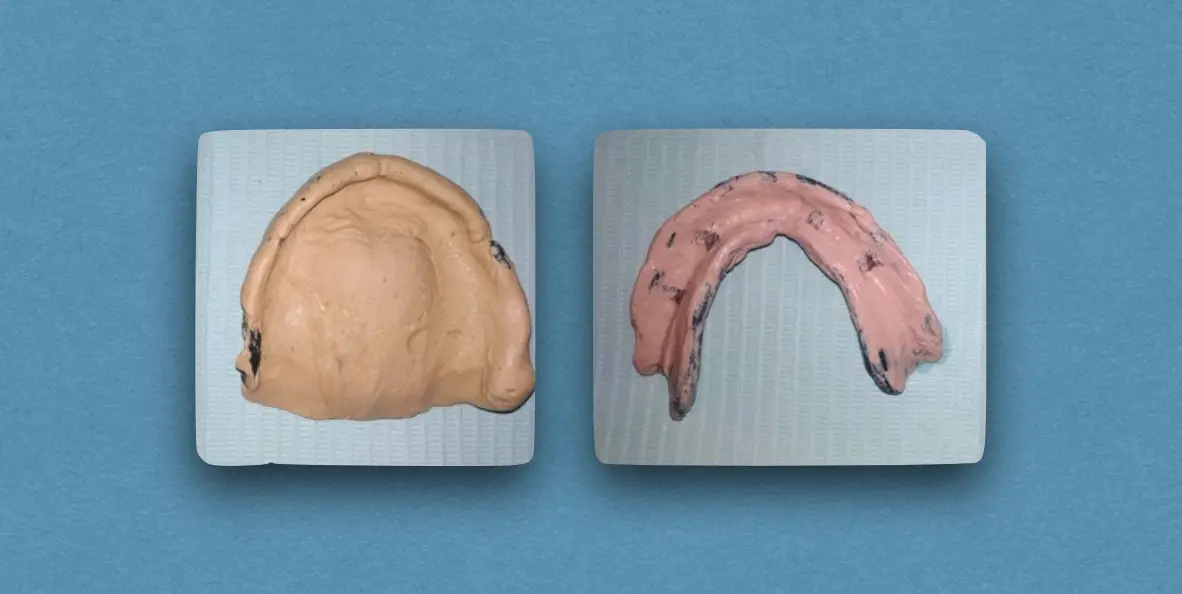
The final impression is made with the custom or special tray that is constructed as per the primary cast. The borders of custom tray can be adjusted, so that they control the movable soft tissues around the impression and do not distort them. Also, space is to be provided inside the tray, so that the shape of the tissues covering the denture-bearing area can be recorded with minimal or selective displacement in the primary denture-bearing areas.
Fabrication of Custom Tray
-
The tray should be made of a rigid material and be approximately 3-4 mm thick.
-
Marking the borders
- The border is marked 2-3 mm short of the intended denture border, with generous relief for the frena and extending to the vibrating line and hamular notch area.
- Over-extensions can be reduced at the time of try-in of the tray before final impression.
- The borders of custom tray are determined by outlining the impression with an indelible marker on the impression at chair-side, or the outline can be marked on the cast in the laboratory.
- The completed impression should be observed next to the patient's mouth and the junction of the attached and unattached mucosal tissue visually identified on the border of the impression.
-
Cast pouring : The impression is poured in artificial stone and the custom tray outline should be evident or marked on the cast.
-
Wax Spacer
- Provides space in the tray for the final impression material.
- Prepared with baseplate wax (1-2 mm thick), that is placed on the cast within the outlined border.
- Secondary stress bearing areas and sharp undercuts may be relieved with additional baseplate wax on the cast, or holes can be drilled through the tray in these areas to allow the impression material to escape and reduce pressure on the tissues.
- The posterior palatal seal and the buccal shelf areas on the cast are not covered with the wax spacer, as the completed custom tray will contact the mucous membrane across the posterior palate and on the buccal shelves.
- The wax spacer should be removed from the remaining periphery of the tray approximately 2-3 mm to allow placement of the border molding material.
- Wax spacer is left inside the body of the tray, as it helps in proper placement of the tray in the mouth while refining the borders of the tray.
- The anterior handle should be vertical and should not restrict muscular movement or interfere with border molding of the lip.
- Some dentists prefer creating an occlusal rim made of wax or tray material to act as a handle and to support the patient's facial musculature during impression procedure.
Impression Materials
Impression materials with lesser viscosity are recommended so that the surface details can be captured accurately.
Plaster of Paris and ZOE
- Have minimal viscosity, hence, causes minimal tissue displacement and require no spacer in the tray.
- However, low viscosity and absence of spacer makes it difficult to control seating pressure and accuracy of seating the tray.
- Contraindicated in patients with severe undercuts, as become rigid on setting.
- Less tolerated in patients with dry mucosa or burning mouth.
Elastomeric impression materials
- Material of choice for final impression.
- Requires a spacer in the tray, for making accurate impression.
Alginate : Lower viscosity alginate is recommended to avoid displacing the border tissues.
Technique
-
Preparing the custom tray for final impression
- After the custom tray is fabricated, border molding is done.
- The wax spacer should be removed.
- The internal aspect and undercuts in the molding material should be reduced/ beveled with a scalpel or bur (silicone materials) to eliminate the stair-step that might have occurred from the wax spacer.
- The length and external width of the borders should not be reduced because this will become an intimate part of the final impression.
- The posterior palatal seal should not be reduced to allow the posterior border seal to remain intact and slightly displace the tissues.
- Holes should be drilled in the tray at this time, if there are areas where the tissue is mobile and distortion is likely.
-
Mixing : The final impression material is mixed according to the manufacturer's instructions.
-
Loading : The material should be uniformly distributed within the tray, and all borders must be covered.
-
Placement : The tray is positioned in the mouth using the labial frenum and tray handle as a reference. The tray should be gently seated in a similar manner as done in the preliminary impression.
-
The clinician can place gauze over the holes immediately after seating to decrease the continued escape of material.
-
The impression should be reviewed for thick and thin areas or borders (due to incorrect positioning of the tray) and any voids in the material. If the voids are small, they may be repaired with impression wax.
Points to Note
-
Some practitioners use impression compound for the final impression : They consider that the epithelial detail is not desired in the intaglio acrylic resin denture surface.
-
Patients with existing dentures : Cast can be prepared by placing putty inside the dentures, or if minimal undercuts are present in the denture, stone can be poured.
-
Most effective way of resolving inflammation of the oral tissues prior to impression making : Ensure that patients leave their dentures out of the mouth during night and for at least 24 hours before the impressions are made. (Alternative : Tissue conditioners are effective, however, patients should still be encouraged to leave their old dentures out as much as possible before the impressions are made.)
-
Final impression with stock trays and alginate
- Used in dental school environments to reduce patient visits.
- Also, processed bases were fabricated for the jaw record appointment to further reduce the number of visits.
- The students were carefully supervised by faculty to assure that the outline of the functional anatomy was delimited on the cast for the processed base.
- Retrospective study revealed that the number of visits were less for overall fabrication and adjustments, and the need for relines was no different as compared to the conventional primary and secondary impressions and conventional trial base technique.
- The key to success was deemed to be overextended alginate impressions in carefully selected stock trays and understanding denture anatomy for denture base fabrication space.
References
- Prosthodontic Treatment for Edentulous Patients Complete Dentures and Implant-supported Prostheses (13th edition) , Zarb, Hobkirk, Eckert, Jacob, Mosby Elsevier.
*This article is an excerpt from the above mentioned book and Medical Sutras does not make any ownership and affiliation claims.