
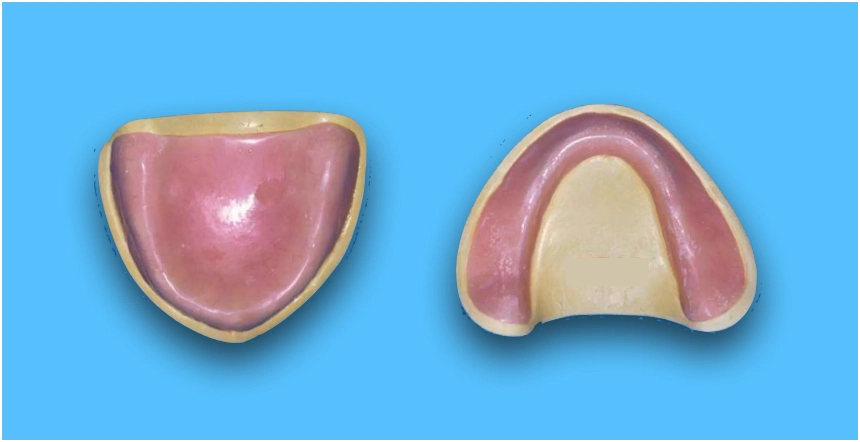
The fabrication of record base involves three basic steps:
- Treatment of master cast.
- Adaptation of baseplate.
- Stabilisation of baseplate.
Treatment of Master Cast
Each master cast should be examined carefully for defects (such as nodules and voids), border extension and undercuts. Depending on the findings, the cast can either be corrected or the final impression is made again.
-
Nodules: Nodules on the surface of the cast may result from entrapment of air in the impression material during mixing. Small nodules must be removed with a small, sharp instrument.
-
Voids: Voids in the surface of the cast can result from air entrapment during mixing of the dental stone or during cast pouring. These voids should be carefully filled with a suitable gypsum material.
-
Borders: The cast must be trimmed to provide adequate access to the border reflections, so as to facilitate accurate adaptation of the baseplate and easy removal.
- Posterior region: The integrity of the essential contours and dimensions of the border reflections should be maintained.
- Anterior region: Only a slight amount of area beyond the greatest depth of the reflection is maintained.
-
Undercuts: Must be relieved/blocked out to permit removal and replacement of the baseplate and to prevent scoring, marring, abrading or breaking the surface of the master cast. This can be done with materials such as wax, modeling clay or wet asbestos.
Adaptation of baseplate
The procedure of adaptation varies according to the type of material used for record base.
Shellac Baseplate
It is one of the commonly used material for record base and is available commercially in forms corresponding to shape of maxillary and mandibular arches.
These are inexpensive and easy to adapt. However, being brittle, they can break easily and should be reinforced using wires of 12-14 gauge. The wire is place across the posterior border in the maxillary arch, while, in the mandibular arch, it is adapted within the lingual flange.
Steps:
- The master cast is first dusted with talcum powder, or soaked in water for some time until the surface is moist, or tin foil (0.001") is adapted. This is done to prevent the base material from sticking to the cast.
- The shellac is placed on the cast and a brush flame from Bunsen burner is moved slowly over the shellac, until it appears shiny and slumps into the cast.
- The shellac is adapted to the cast using firm pressure, applied with wet fingers or wet cotton. The palatal portion of the maxillary cast and the lingual surface of the mandibular cast are adapted first.
- It is then reheated and adapted over the crest of the ridge and into the reflections.
- After this, it is removed from the cast and trimmed with scissors, while it's warm and soft. Approximately, 5mm of the material beyond the edge of the cast is left.
- The shellac is repositioned and reheated and carefully readapted.
- The trimmed edges are heated using a Hanau torch, elevated from the cast and folded onto themselves.
- The folded edges are then burnished with No. 7 wax spatula to form a smooth, rounded border.
Autopolymerizing acrylic resin
There are three basic techniques to fabricate record base using self-cure acrylic resin.
- Nonflasking method.
- Alternating application of powder and liquid.
- Flasking method.
Nonflasking method
- A layer of tin foil (0.001"), a thin layer of petroleum jelly (petrolatum) or two thin coats of tin-foil substitute is applied to the prepared master cast.
- Tray resin is mixed as per the manufacturer's instructions and when it reaches the doughy stage, it is rolled into a cigar shape and placed on a roller board. The tray resin is rolled to the desired thickness i.e., 2-3 mm.
- The resin sheet is then transferred to the cast with wet fingers or petrolatum applied to the fingers (to avoid the material from sticking to the hands).
- It is adapted to the master cast, firstly, to the hard palate area of the maxillary cast or lingual surface of the mandibular cast, followed by, the crest of the ridge and then, into the reflection area.
- Excess resin is trimmed with a sharp instrument, while it is in soft, moldable state.
- After completion of polymerisation, the resin base is removed and trimmed with dental lathe and the borders are further adjusted with burs.
- The external surface can be polished with wet pumice and rag wheels.
- The thickness on the facial slope of the ridge and extending over the crest of the ridge is reduced to approximately 1mm.
Alternating application of powder and liquid
- A thin layer of powder/polymer is dusted over a small surface area of the cast and sufficiently wetted with liquid/monomer to produce a slight flow.
- Alternate applications of powder and liquid are made until a thickness of 2-3 mm is achieved.
- The base should be allowed to polymerise properly (20-30 minutes) and should not be removed during polymerisation, so as to prevent distortion.
- After polymerisation, the base is removed, trimmed and polished.
Advantage: Polymerisation shrinkage is minimum, since any shrinkage that occurs in first application is partially compensated by each subsequent application.
Flasking method
- The master cast should be duplicated, since there is possibility of breakage.
- Wax pattern is formed on the duplicate cast as per the desired dimensions.
- The duplicate cast is invested in a flask, the wax eliminated with hot water and a suitable separating media is applied to the cast.
- Autopolymerizing resin is mixed in a porcelain or glass container and then covered. When it reached the doughy stage, it is placed into the mold and the flask is closed.
- The resin is allowed to polymerise for 20-30 minutes and then, the base is removed from the flask. It is then trimmed and polished.
Advantage: Record bases are accurate and stable.
Disadvantage: Fabrication requires considerable and hence, more costly.
Vacuum-formed base
It provides a fast and efficient means of forming rigid, accurate-fitting record base.
- A sheet of baseplate resin is inserted in the frame located below the electric heater coil and the heater is activated.
- Heating is continued until the resin begins to sag approximately one-half inch. At this time, the sagging sheet of softened resin is lowered into the cast by means of the supporting frame, and the vacuum is turned on.
- The sheet of softened resin is drawn into close adaptation to the cast,
- The heater is turned off and the base is allowed to cool for one minute.
- The base is removed from the cast and is trimmed and finished.
Baseplate wax
These are inexpensive, easy to form and esthetic. However, they lack rigidity, dimensional stability and can easily be distorted.
- A strengthening wire is adapted in the posterior palatal seal area of the maxillary base or into the lingual flange of the mandibular base.
- To prevent the wax sticking to the cast, talcum powder is applied or the cast is immersed in water for short period until moist.
- The wax is softened over a Bunsen burner flame and adapted to the cast.
- Excess wax is removed with a sharp instrument and the borders rounded and smoothed.
Processed resin
The record bases fabricated from heat-processed resin are rigid, accurate and stable. They are permanent and become part of the final denture. Also, they result in destruction of the master cast.
- Undercuts are not blocked out.
- Wax form of desired shape and dimension is adapted onto the master cast, and definite finish lines are incorporated into the wax pattern.
- The pattern is invested in a flask, wax eliminated with hot water, and a separating media is applied.
- The denture resin is mixed and packed into the mold. It is processed as per the manufacturer's instructions.
- The processed record base is then recovered and finished.
- Undercuts on the record base are blocked out, and, dental plaster/stone is poured into the base to from mounting casts for the transfer of jaw relation records.
Cast alloys
The cast alloys also form permanent record base as they are rigid, accurate and dimensionally stable.
Advantage: Adds more weight to the mandibular denture and more thermal conductivity to the maxillary denture.
Disadvantage: They are more costly, as they require considerable amount of time for fabrication.
Steps:
- Refractory casts are prepared from the master cast.
- A wax pattern is formed on the refractory cast.
- The wax pattern is sprued, invested in a suitable investment, and the wax is burned out.
- The molten alloy is cast into the mold cavity.
- On cooling, the casting is removed from the investment, finished and polished, and then, returned to the final cast.
Stabilisation of baseplate
Additional stability is frequently desired for shellac, resin or wax record base. The materials available for stabilisation include,
- Zinc-oxide Eugenol impression paste.
- Light-bodied rubber base impression material.
- Soft denture-liner resins.
Zinc-oxide Eugenol impression paste.
- Tin foil (0.001") is burnished to the master cast.
- ZOE is mixed and flowed onto the tissue surface of the record base, and the base is pressed firmly against the cast.
- It is ensured that only a thin layer of the set material remains between the base and the cast. A thick layer could decrease the available interarch space.
- The stabilised base is removed and excess impression paste is cut away from the borders with a sharp instrument.
- Baseplate wax is flowed on any rough areas of the record base border to provide a smooth surface.
Light-bodied rubber base impression material
Stabilisation of the record base with elastomers is useful in cases where the residual ridge exhibits moderate to severe undercuts and the record base lacks retention and stability due to blocking out of the undercuts.
- The material used to block out undercuts is removed and the master cast is covered with tin foil.
- Rubber base adhesive is applied to the entire tissue surface of the record base.
- Light-body elastomer is mixed and placed into the record base.
- The record base is pressed firmly onto the master cast.
- After complete setting of the elastomer (10 minutes), the record base is removed and inspected.
- The borders are adjusted and finished.
*Similar technique is used for soft denture-liner resin that contain varying amounts of plasticizers to provide resilient behaviour.
Points to Note
- Wet asbestos is recommended for blocking undercuts when shellac is used as record base, since, shellac requires heat to soften and this heat could distort wax and other plastic materials.
- Care must be taken to avoid overheating the shellac (bubbling, smoking or change of color to black). This will cause the molten shellac to penetrate the pores of the stone and adhere to the cast surface on cooling.
References
- Essentials of Complete Denture Prosthodontics, 2nd edition, Sheldon Winkler, AITBS Publishers India.
*This article is an excerpt from the above mentioned book and Medical Sutras does not make any ownership and affiliation claims.