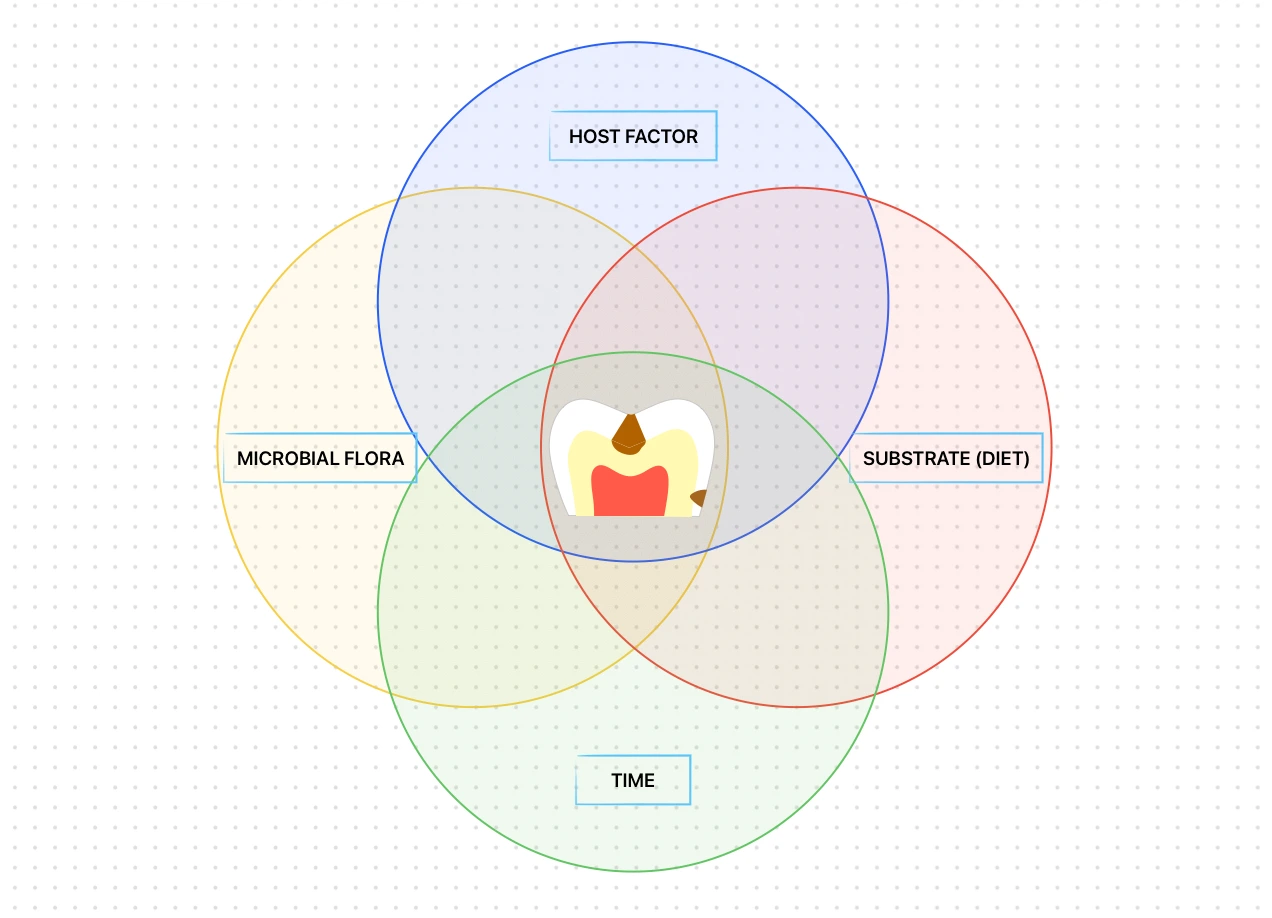
Dental caries is a multifactorial disease with interplay of three primary factors: the host, the microbial flora and the substrate, with time as an inevitable fourth factor. In other words, caries requires a susceptible host, a cariogenic flora and a suitable substrate that must be present for a sufficient length of time.
Host factors
- Tooth factors: Composition, Morphology, Position.
- Saliva: Composition (organic or inorganic), pH, quantity, buffer capacity, viscosity, antibacterial properties.
- Systemic factors: Heredity, pregnancy and lactation.
Microbial Flora
- S. mutans.
- Lactobacillus species.
- A. viscosus.
- A. naeslundii.
- Other filamentous rods.
Substrate (Diet factor)
- Physical form: Nature of diet.
- Local factors: Carbohydrate, vitamin and fluoride content.
Theories of Dental Caries
The formation of dental caries or cariogenesis is a complex process that is complicated by several indirect factors obscuring the direct etiology. No single theory has been universally accepted as the etiology of dental caries.
Early theories
The Legend of Worms
- Earliest reference to tooth decay (5000 BC), based on the idea that caries is caused by worms.
Endogenous Theories (Theories of Greek physicians)
- Humoral theory (dental caries was thought to be produced by internal action of acids and corroding humors).
- Vital theory (tooth decay originated, like a bone gangrene, from within the tooth itself).
Chemical Theory
- Proposed that an unidentified chymal agent was responsible for caries.
- supported by the fact that dental decay was caused by acid formed by fermentation of food particles around the teeth (Robertson, 1835).
Parasitic Theory
-
Relates microorganisms to caries on a causative basis. This was further supported by several findings that concurred bacteria were essential to caries formation.
-
Erdl, 1843 described filamentous organisms in the membrane removed from teeth.
-
Ficnus, 1847 attributed dental caries to denticolae, the generic name he proposed for decay related microorganisms.
Newer Theories
- Miller's chemico-parasitic or acidogenic theory.
- Proteolytic theory.
- Proteolysis-chelation theory.
- Sucrose-chelation theory.
Miller's chemico-parasitic Theory (Acidogenic theory)
According to Willoughby D Miller, dental decay is a chemico-parasitic process consisting of two stages,
- Preliminary stage: Decalcification of enamel (results in its total destruction) and decalcification of dentin, followed by,
- Dissolution of the softened residue.
- However, in case of enamel the second stage is practically lacking, since decalcification of enamel signifies its total destruction.
Essential factors: He assigned an essential role to three factors in caries process:
- Oral microorganisms, involved in acid production and proteolysis.
- Carbohydrate substrate, required for microorganism to produce acid.
- Acid, causes dissolution of tooth minerals.
Limitations: It could not explain:
- Predilection of specific sites on a tooth to dental caries.
- Initiation of smooth surface caries.
- Some populations are caries free.
- Phenomenon of arrested caries.
Proteolytic Theory
Gottlieb (1944) and Gottlieb, Diamond and Applebaum (1946) postulated that caries is essentially a proteolytic process.
- The microorganisms invade the organic pathways and destroy them in their advance.
- They did admit that proteolysis is accompanied by acid formation: Gottlieb held that yellow pigmentation was characteristic of caries and was due to pigment production by proteolytic organisms.
Drawbacks
- No satisfactory evidence to support the claim that the initial attack on enamel is proteolytic.
- Gnotobiotic studies shows that caries can occur in the absence of proteolytic organisms.
Conclusion
- Proteolysis in the initiation of dental caries is likely to be of no significance, but its role in the progression of more advanced carious lesions cannot be ruled out.
Proteolysis-chelation Theory
Proposed by Schatz et al (1955), it considers dental caries to be a bacterial destruction of teeth that involves simultaneous microbial degradation of the organic components (proteolysis) and the dissolution of the minerals of the tooth by the process called chelation.
- The initial attack is essentially on the organic components of enamel that results in breakdown products.
- These products have chelating properties and thereby dissolve the minerals in the enamel.
Limitation: Studies have found that saliva and plaque do not contain substances in sufficient concentrations to chelate calcium in detectable amounts from enamel.
*******Chelation is the process of formation of highly stable, poorly dissociated or weakly ionised compounds, by complexing of metallic ion through a covalent bond.
Sucrose-chelation Theory
Egglers-Lura (1967) proposed that sucrose itself, and not the acid derived from it, can cause dissolution of enamel by forming an ionised calcium saccharate.
- They postulated that calcium saccharates and calcium complexing intermediates require inorganic phosphate, which is subsequently removed from enamel by phosphorylating enzymes.
Limitation: Investigations by other workers showed that soluble complex can be formed, even at alkaline pH values between sucrose and calcium oxide and calcium hydroxide, although not with calcium phosphate.
References
- Shafer, Hine, Levy Shafer's Textbook of Oral Pathology (7th edition), Arya Rajendran, Shivapatha Sundaram, Elsevier.
*This article is an excerpt from the above mentioned book and Medical Sutras does not make any ownership or affiliation claims.