
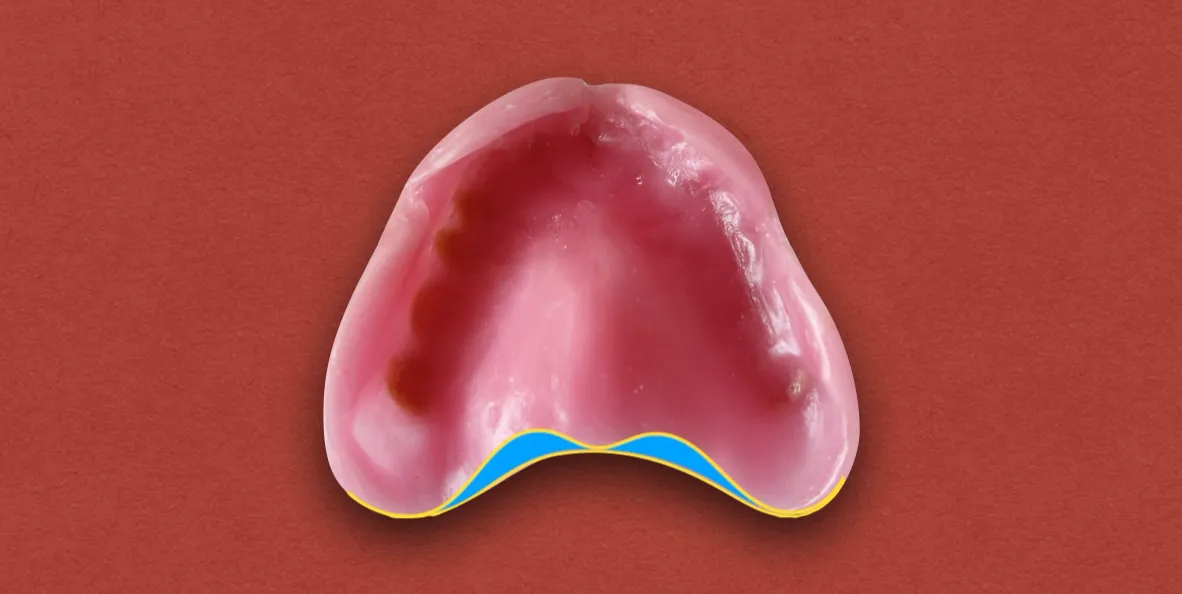
The most common cause for failure of the posterior palatal seal is the underextended distal denture border. Other causes include,
- Underpostdamming.
- Overpostdamming.
- Overextension.
Underextension
The underextension of posterior denture border may occur due to following reasons:
- Using fovea palatini as landmark to terminate denture base.
- Improper recording in patients with gag reflex.
- Lack of careful examination of the hard and soft palate, while making note of the palatal configuration.
- When the lab technician is asked to trim and polish the processed denture borders.
Using fovea palatini as landmark
- The tissues covering the hard palate are firmly attached to the underlying periosteum and is unable to move in concert with the denture base.
- This results in loss of retentive properties when the patient begins to function.
- It may result in 4-12 mm less tissue coverage along the posterior denture border.
Patients with gag reflex
- Clinicians who are unsure of the techniques or lacks understanding of a properly extended posterior palatal seal, may comply with the patient's pressure and wishes.
- The posterior denture border may remain underextended due to inability of the patient to tolerate any material far back against the palate and frequent gag.
Methods to overcome gag reflex
- Ask the patient to concentrate upon a point on the wall while taking even and equal breaths through the nose (esp. helpful during the impression procedures).
- Patient requiring more conditioning : Construct a highly polished self-cure acrylic resin tray on the master cast, with extension upto the posterior vibrating line. The patient is asked to wear this appliance in the comfort of his/her home and when he/she can successfully maintain this base in the mouth, proceed with the fabrication of the denture.
Underpostdamming
There is insufficient displacement of the tissues at some points along the terminal border of the denture.
It may result due to recording the tissues with the mouth wide open during the final impression.
- When the mouth is wide open, the pterygomandibular fold becomes taut. This results in a space between the denture base and the tissue, when the patient assumes any position other than a wide open position, since the fold is no longer activated.
Diagnosing the problem
-
Place the wet denture base into the mouth and while observing the distal denture border, slowly press in the midpalate region until it is firmly seated.
-
If air bubbles can be seen escaping from beneath the distal border, it implies that the denture case is underpostdammed at that point.
Correcting the problem
- Conventional approach : Scrap the case further and readapt the trial base.
- Fluid wax technique : Add more wax in the area and advise the patient from opening the mouth wide.
Overpostdamming
Excessive bulk of the denture base in the postdam region may occur due to aggressive scrapping of the master cast. This results in displacement of the tissues by the posterior palatal seal, and may be presented as,
- Tissue irritation across the posterior palatal region (moderate cases).
- Inferior displacement of the posterior denture border (severe overpostdamming).
Correction : The denture border should selectively reduced with a carbide bur, followed by lightly pumicing the area while maintaining its convexity.
Overextension
The posterior denture may be placed too far distally, in an attempt to maximise the retentive qualities of the denture. This results in draping of the soft palate against the denture base.
- Patient frequently complains of pain and difficulty in swallowing. If the pterygoid hamulus is covered by the denture base, the patient will experience sharp pain, esp. during function.
- Usually the entire border is not overextended, and small ulcerated areas in the soft palate will be evident.
Correction : The areas of overextension should be marked with an indelible pencil and transferred to the denture base, followed by removal with a bur and careful repolishing of the surface.
References
- Essentials of Complete Denture Prosthodontics, 2nd edition, Sheldon Winkler, AITBS Publishers India.
*This article is an excerpt from the above mentioned book and Medical Sutras does not make any ownership and affiliation claims.