
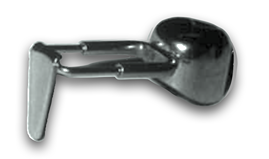
Distal shoe space maintainer consists of a metal or plastic guide plane (distal shoe) attached to a SS crown or band placed on the primary first molar.
The distal shoe consists of a horizontal component, which bridges the mesiodistal space left over by the premature loss of deciduous second molar and vertical component, which extends 1-1.5mm below the mesial marginal ridge of the unerupted permanent first molar.
Rationale
If a second primary molar is lost at the age of 2-5 years, there is no space loss as the permanent molar is in the basal bone. However, as the permanent first molar erupts, considerable loss in arch length (4-6 mm) can occur.
- Maxillary quadrant: There is forward displacement of the permanent first molar through bodily crown-root movement and mesiolingual rotation around the palatal root.
- Mandibular quadrant: The lower first molars shows pronounced mesial tipping of the crown and less bodily tooth movement. Also, the distal movement & retroclination of teeth anterior to the space can add to the space loss.
Loss of second primary molar after complete eruption of permanent first molars and establishment of cuspal interdigitation: There is mesial movement of permanent first molars due to lack of buttressing support from the primary second molar, resulting in space loss of 2-3 mm in each quadrant (sufficient to compromise positioning of the permanent canines and premolars).
*After the permanent first molar is guided into position, it is recommended to replace distal shoe with a different appliance such as reverse band and loop, and lingual holding arch, transpalatal arch or Nance appliance (when there is exfoliation of primary first molar).
Fabrication
Distal shoe appliance can be prepared with the molar band cemented on the crown or as a single sitting appliance with SS crown as retainer.
-
The first primary molar is prepared with a SS crown or well-adapted band, that provides a retentive base for the distal shoe.
-
An impression is made to prepare a working model.
- Primary second molar not extracted: Cut it off the model and make a hole with a bur that simulates the position of the distal root of the tooth.
- Primary second molar has been extracted: Positioning of the tissue extension is determined with measurements on IOPA or bitewing radiographs or by measuring the mesiodistal width of the contralateral second molar.
-
The extension blade is contoured and extended distally into the prepared opening on the model and the loop is soldered to the band or crown.
-
The band or crown is seated and a radiograph is made to verify the position of the extension with the unerupted permanent first molar.
-
Final adjustments in length and contour made to ensure that mesial contact of the permanent first molar is provided.
-
The crown or band is cemented to the primary first molar.
Gerber extension: It is an adjustable extension involving a trombone-type attachment with the sleeve portion tack welded or soldered to the band or crown.
Items required for chairside fabrication of the appliance:
- SS crown(s).
- Extraction forceps.
- Distal shoe appliance kit.
- Electric spot welder.
- Heavy wire-cutting pliers.
- Heatless stone.
- Dental stone.
Indications (Hicks, 1973)
- Premature loss or extraction of the second primary molar prior to the eruption of the first permanent molar.
- Advanced root resorption and periapical bone destruction of the second primary molar prior to the eruption of the first permanent molar.
- A primary second molar with advanced caries that is not restorable.
- Ectopic eruption of the permanent first molar.
- Ankylosis of the primary second molar.
Contraindications (Hicks, 1973)
- Multiple loss of teeth in the same quadrant (inadequate abutments).
- Poor patient or parental cooperation.
- Missing permanent first molar.
- Poor oral hygiene.
- Systemic diseases such as blood dyscrasias, immunosuppression, congenital heart defects, history of rheumatic fever, and diabetes (affects healing and require antibiotic prophylaxis prior to dental treatment).
Treatment options when distal shoe is contraindicated:
- Allow the tooth to erupt and regain space later.
- Pressure-type appliance: Removable or fixed appliance that does not penetrate the tissue but places pressure on the ridge mesial to the unerupted permanent molar.
Points to Note
- If the primary first and second molars are missing, the appliance must be removable and the guide plane is incorporated into a partial denture because of the length of the edentulous span.
- When fixed distal shoe appliance is used, band is preferred over crown, since it can be easily replaced by another type of space maintainer after the permanent first molar erupts.
- The appliance extension is well tolerated by the soft tissue overlying erupting permanent first molar, although a small metallic tattoo in the gingiva may occur.
- The most common problems associated with distal shoe appliance are faulty positioning and loss of appliance.
- The appliance provides no functional replacement for the missing tooth.
- After the permanent first molar is guided into position, it is recommended to replace distal shoe with a different appliance, since, continued vertical development will result in tipping of the permanent first molar over the top of the blade extension.
References
- McDonald and Avery's Dentistry for the Child and Adolescent, 11th Edition, Jeffrey A. Dean, Elsevier Mosby.
- Contemporary Orthodontics, Proffit, William R, Elsevier Mosby (2018).
- Brill WA. The distal shoe space maintainer chairside fabrication and clinical performance. Pediatr Dent. 2002 Nov-Dec;24(6):561-5. PMID: 12528949.
*This article is an excerpt from the above mentioned sources and Medical Sutras does not make any ownership or affiliation claims.