
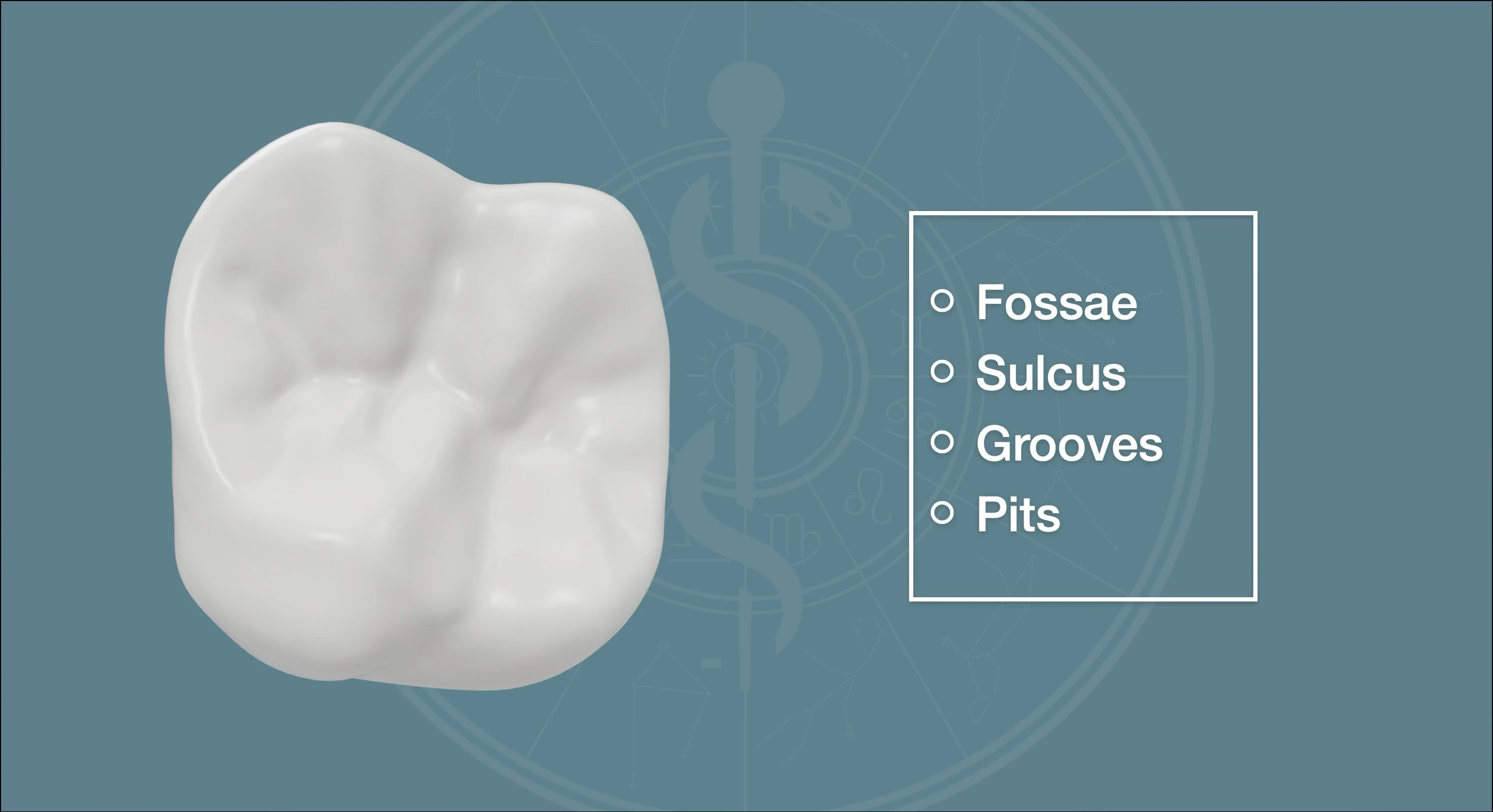
Depressions on tooth surface refers to any concavity or low-lying areas that are below the surrounding tooth structure. These include fossae, sulcus, grooves and pits.
Fossae
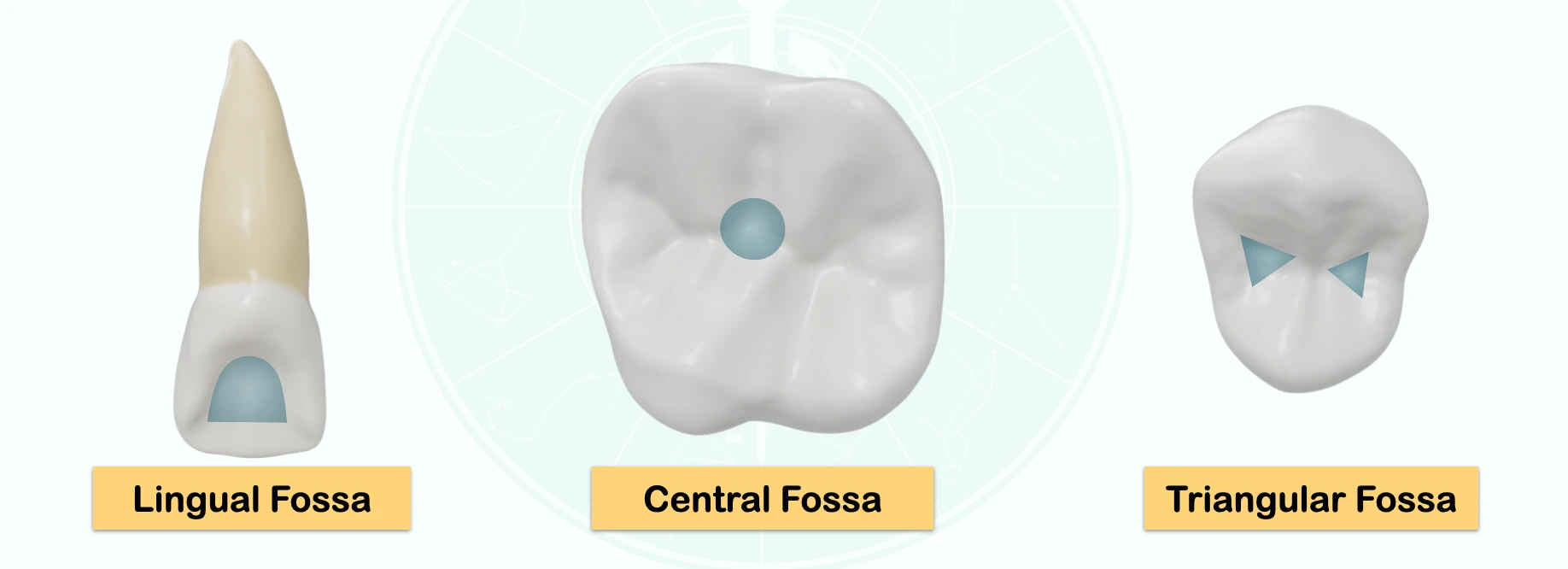
A fossa is an irregular depression or concavity on the tooth surface. It includes
1) Lingual fossa
- Found on the lingual surface of anterior teeth.
- Presents as large depression incisal to the cingulum.
2) Central fossa
- Found on the occlusal surface of molars.
- Formed by the convergence of ridges terminating at a central point in the bottom of the depression where there is a junction of grooves.
3) Triangular fossa
- Present on the occlusal surfaces of premolars and molars, mesial or distal to the marginal ridges.
- Sometimes, found on the lingual surfaces of maxillary incisors at the edge of the lingual fossa where the marginal ridges and cingulum meet.
Sulcus & Grooves
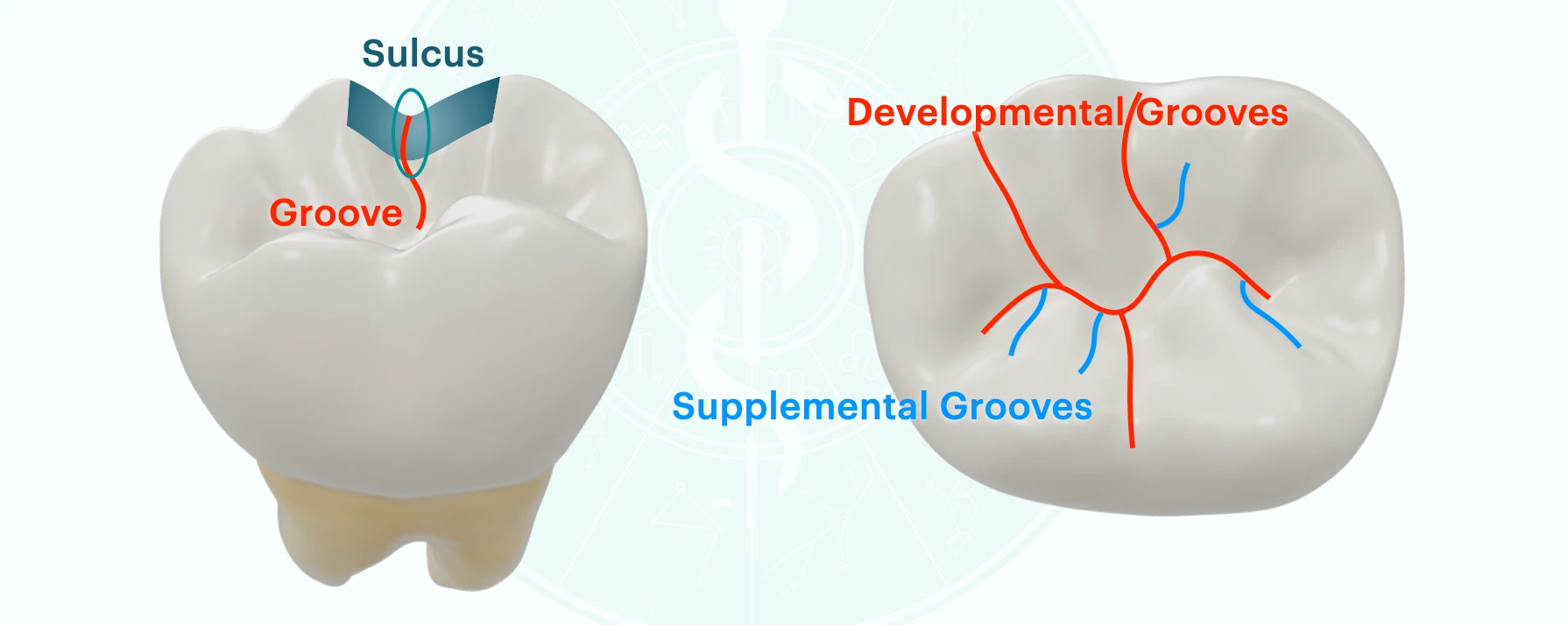
It is a long depression or valley on the surface of a tooth, that is formed by the inclines of ridges and cusps.
- These inclines meet at an angle and forms a developmental groove i.e, sulcus has a developmental groove at the junction of its inclines.
- Sulcus vs Grooves: Sulcus is a valley-like long depression, whereas grooves are shallow linear depressions.
Developmental Grooves
-
These are shallow groove or line present between the primary parts of the crown or root.
-
Buccal and Lingual grooves: Developmental grooves found on the buccal and lingual surfaces of posterior teeth.
-
For example, mandibular first molar have four developmental grooves:
- Buccal/Mesiobuccal DG between MB and DB cusp.
- Distobuccal DG between DB and distal cusp.
- Lingual DG between ML and DL cusp.
- Central DG at the center.
Supplemental Grooves
- These are shallow, less distinct linear depression on the tooth surface, that are short and appear as tributaries of the developmental grooves.
- These are supplemental to a developmental groove, and do not mark the junction of primary parts of crown or root.
Pits
- These are small pinpoint depressions located at the junction of developmental grooves or at the terminals of those grooves.
- For example, central pit is a landmark in the central fossa of molars where developmental grooves join.
Fissures
Fissures are deep invaginations (linear, narrow clefts or deep grooves) on the occlusal surfaces of posterior teeth (premolars and molars) formed due to the incomplete coalescence of enamel lobes during development.
These can be extremely diverse in shape and have been described as broad or narrow funnels, constricted hourglasses, and multiple invaginations with inverted Y-shaped divisions and irregularly shaped.
Fissure types include:
- V type: Wide at the top and gradually narrowing towards the bottom; shallow and wide; tends to be self-cleaning.
- U-type: Shallow and wide; tends to be self-cleaning.
- I-type: Extremely narrow slit; deep, narrow, and constricted, resembling a bottleneck; more caries susceptible.
- IK- type: A narrow slit associated with a larger shape at the bottom; may require invasive technique and are very susceptible to caries.
Types of pits and fissures (Symons 1996)
- Shallow: Cuspal inclines meet at a wide angle. The base of the fissure is visible. No visible clefting between the cuspal inclines.
- Intermediate: Cuspal inclines meet at an angle narrower than the designated shallow fissures. The base of the fissure is usually visible. Clefts are visible at a uniform width of the fissure.
- Deep: Cuspal inclines meet at a narrow angle. The base of the fissure is not visible. Slit-like clefting is visible between the cuspal inclines.
References
- Wheeler's Dental Anatomy, Physiology and Occlusion(2019), Stanley J. Nelson DDS MS, Elsevier.
- The image used is licensed under the Creative Commons Attribution-Share Alike 4.0 International license (Author: Bizhan Khodabandeh, Source: Wikimedia Commons).
*This article is excerpt from the above mentioned book and Medical Sutras does not make any ownership and affiliation claims.