
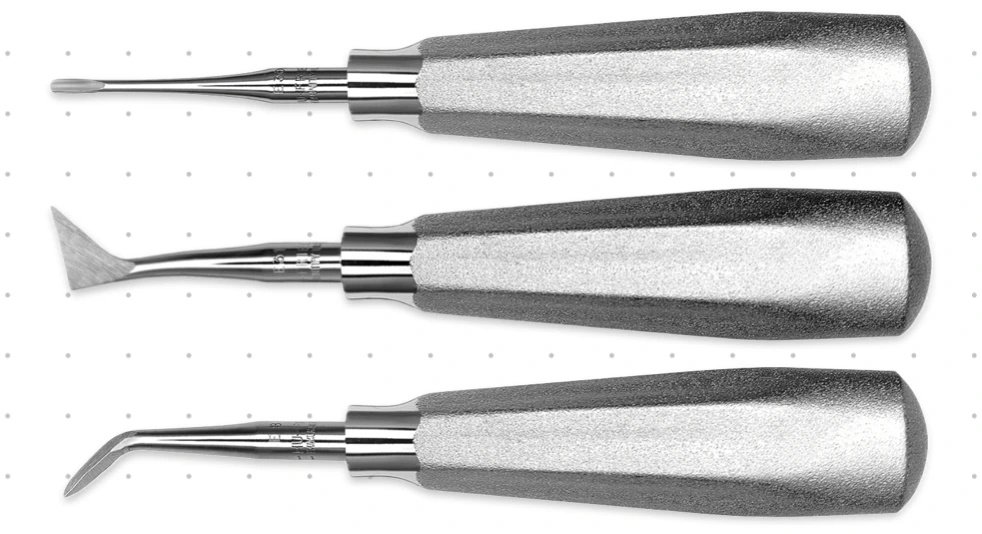
Dental elevators are used for luxation (loosening) of teeth from surrounding bone before the application of dental forceps.
Significance
- Makes extraction easier.
- Minimises the incidence of broken crowns, roots, and bone.
- Facilitates removal of broken root (as prior elevator use loosens the root in the dental socket).
They are also used to:
- Expand the alveolar bone (buccocervical plate), thereby, facilitating removal of tooth that has a limited and obstructed path of removal.
- Remove broken or surgically sectioned roots from their sockets.
Principles of Use
- Wedge.
- Wheel and Axle.
- Lever.
Parts of Dental Elevator
An elevator consists of three major components i.e., handle, shank and blade.
Handle
- To apply substantial, but controlled, force.
- Must be of generous size, so that it can be held comfortably.
- Must be used with caution, as excessive amount of force can prove detrimental.
Shank
- Connects the handle to the working end or blade.
- Should be strong enough to transmit force from the handle to the blade.
Blade/Working end
- Used to transmit the force to the tooth, bone, or both.
Types of Dental Elevators
Straight Elevator
- Most commonly used elevator to luxate teeth.
- Its blade has a concave surface on one side that is placed toward the tooth to be elevated.
- Small straight elevator, No. 301, is commonly used to luxate teeth before application of the forceps.
- Larger straight elevators are used to displace roots from their sockets and luxate teeth that are more widely spaced or once a smaller-size elevator becomes less effective.
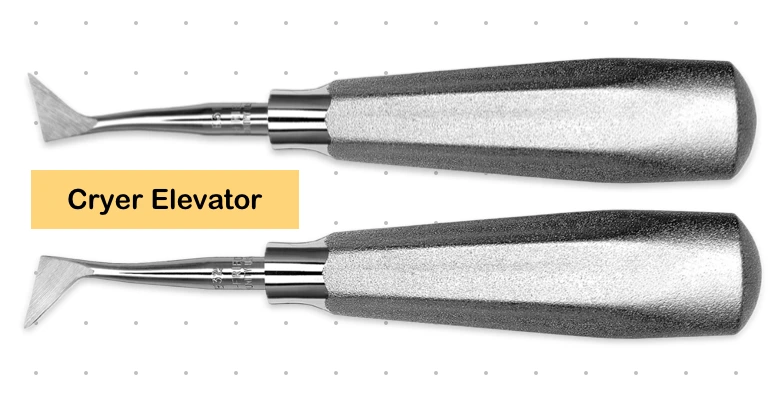
Triangular Elevator
- These elevators come in pairs: one left and one right.
- Most useful when a broken root remains in the tooth socket and the adjacent socket is empty.
- Works on the wheel-and-axle principle, where the sharp tip of the elevator engages the root (cementum) of the remaining tooth portion, and as the elevator is turned, the root is delivered.
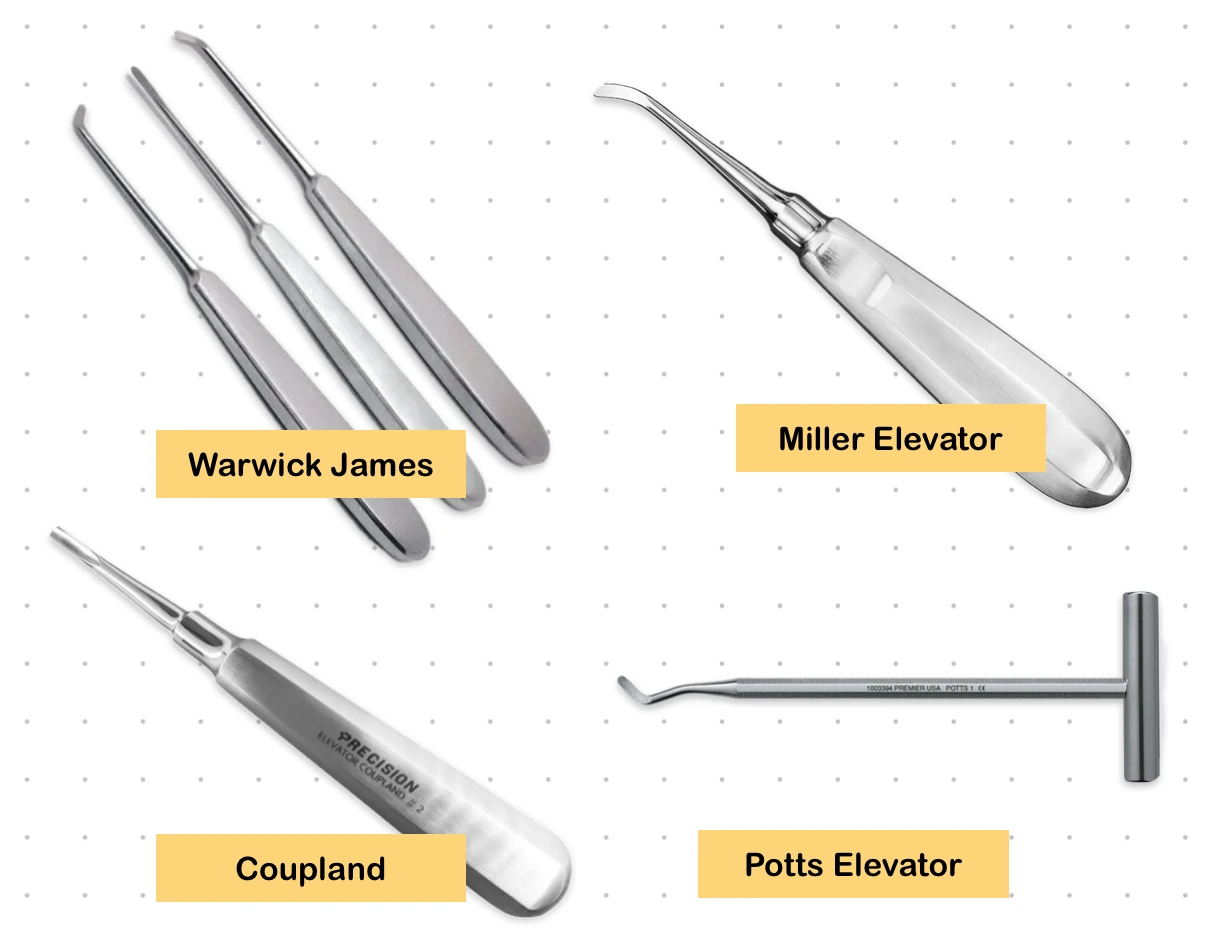
Pick-type Elevator
- Used to remove roots.
- Used as a lever to elevate a broken root from the tooth socket.
- Usually it is necessary to drill a hole with a bur (purchase point) approximately 3mm deep into the root just at the bony crest, and the tip of the pick is inserted into the hole, and with the buccal plate of the bone as fulcrum, the root is elevated from the tooth socket.
- Heavy version of the pick is the Crane pick.
- Root-tip pick/Apex elevator: Delicate instrument that is used to tease small root tips from their sockets, by inserting the tip into the periodontal ligament space between the root tip and socket wall. Thin instrument, should not be used as a wheel-and-axle or lever type of elevator such as the Cryer elevator or Crane pick.

References
- Contemporary Oral and Maxillofacial Surgery (6th edition), Jame R Hupp, Edward Ellis, Myron R Tucker, Mosby Elsevier.
*This article is excerpt from the above mentioned book and Medical Sutras does not make any ownership and affiliation claims.