
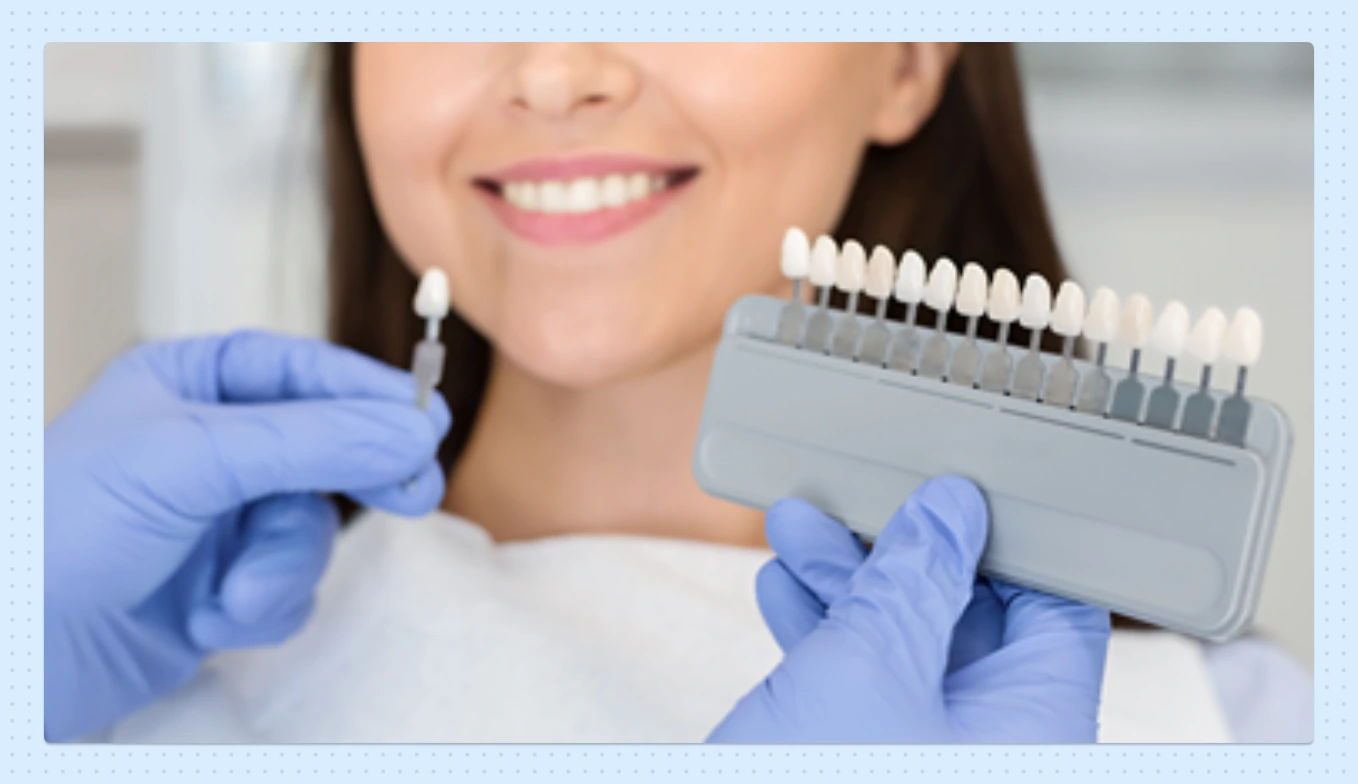
Teeth shade has always been a challenging task and a point of debate between the doctor, dental technician and the patient. Many restorations fail due to inadequate shade matching.
Basic Terminologies
-
Three Dimensions of Color: Verbal descriptions of color are not precise enough to describe the appearance of teeth and definition of a particular color is different according to different authors. To overcome this problem, color perception is described by three objective variables : hue, value and chroma. These three parameters constitute the three dimensions of color space.
-
Hue: The dominant color of an object, for example, red green or blue. This refers to the dominant wavelengths present in the spectral distribution. The continuum of these hues creates the 3D color solid.
-
Value: Also known as the gray scale, it is expressed by the lightness factor with varying levels of gray between the extremes of white and black. Teeth and other objects can be separated into lighter shades (higher value) and darker shades (lower value).
-
Chroma: Refers to the degree of saturation of a particular hue. For example, red can vary from scarlet (high saturation) to light pink (low saturation), and, the yellow color of a lemon is more saturated (vivid) than that of a banana (less saturated, dull yellow).
-
Primary Colors: These occur naturally by themselves and cannot be formed by mixing multiple colors, eg. red, yellow, blue, etc.
-
Secondary Colors: These are formed by combining two primary colors. eg. orange (red and yellow), green (yellow and blue), purple (blue and red).
-
Tertiary Colors: Made up of one primary and one secondary color, eg. amber, vermillion, magenta, violet, teal, etc.
-
Complementary Colors:
- These are two colors that are on the opposite sides of the color wheel and helps create the highest contrast.
- When combined in equal proportions, the complementary colors form a dull gray color.
- Clinical Significance : If the value of a restoration is to be lowered, the complementary color can be added to make the shade more gray and hence lower in value.
-
Metamerism: It is the phenomenon where two objects appear to match in color under one condition but shows apparent differences under another.
Guidelines for Clinical Shade Matching
- Commonly found light in dental offices: Natural, Incandescent, Fluorescent.
- It is best to perform shade matching in natural light source, at 10 am or 2 pm on a clear, bright day, when the ideal color temperature of 5,500 K is present.
- Color-corrected lighting tubes that burn at about 5,500K (D50 illuminants) should be installed, when there is no access to natural light source.
- An illuminance of 1,00 lux is considered optimal for visual color assessments.
- Color rendering index of 90 or greater.
- At least, two different sources of light should be used to minimize metamerism.
- Gray or pastel colored walls and cabinets.
- Brightly colored clothing should be draped and lipstick should be removed.
- Teeth to be matched should be clean and stains, if any, be removed.
- Cheek retractors to be used.
- Operator should stand between the patient and light source.
- Patient should be viewed at the eye level, at a working distance of 25 cm (10 inches).
- Shade guide should match the porcelain.
- Shade should be matched quickly (less than 5 seconds).
- Give rest to the eyes in between, by focussing on a neutral gray surface.
- To select appropriate hue - Canine tooth.
- To select the appropriate value - Squinting.
- If the exact match is not found, then, the shade tab with lower chroma and highest value should be selected.
- The polychromatic nature of the tooth being matched should be mapped eg. cracks, hypocalcification and translucency of the incisal enamel.
Methods of Shade Selection
- Visual Methods: Vita Classical, Vita 3D Master, Portrait IPN shade guide, Vintage shade guide, IPS e-max shade determination
- Instrumental Methods: Spectrophotometer(Spectroshade, Vita Easyshade), Digital Camera with colorimeter (ShadeScan, ShadeVision).
Visual Methods
Variables of the Visual Shade Guide Method
- Subjective Variables: The clinician 's variability of experience, age, eye fatigue, judgement mood, emotional shifts, illusions and color vision.
- Physical Variables: Lighting conditions, type and intensity of light source, angle of incidence, tooth texture (contour), color of the wall and clothes worn by the patient and staff.
VITA Classical
- Hue is selected first, then, selecting appropriate match of chroma and value is the recommended technique.
- In VITA classical shade guide, all grades of A (A1, A2, A3, A4) are similar in hue, as all grades of B, C, D are.
- A1, A2, A3, A4 grading is based on the chroma.
- Once hue is selected, the best match for color variety is determined.
- Finally, the value is determined with a second commercial shade guide.
VITA Toothguide 3D Master
- Most commonly used, gives superior and standardized color difference.
- Significantly increases repeatability of color matching.
- The shade samples are grouped into six lightness levels i.e, value, each of which has chroma and hue variation in evenly spaced steps.
- The shade guide unit is spaced in steps of four CIELAB units in lightness dimension and two CIELAB units for hue and chroma selection.
- CIELAB system is like the MUNSELL system. It is also known as CIE L*a*b* (L is for lightness, value in MUNSELL system), a is for green to red, b is for blue to yellow.
Instrumental Methods
Spectroshade
- It is a calibrated device that records two images which overlap each other for better comparison.
- If the color difference between the two images is less than 1.00, then the image will be saved, else if greater than 1.00, the image will be deleted.
Vita Easyshade
- The probe of the device is held at 90 degress at the middle one-third of the selected teeth.
- It records the consecutive readings generated by the device.
ShadeVision
- Measures the target shade with a light glare at the junction of the gingival and middle third.
- The shades are selected from a database of CIE L*a*b* values.
ShadeScan
- It records the light glare directed at the mesiobuccal and disto-buccal line angle in the middle third of the tooth.
References
- Fundamentals of Color : Shade Matching and Communication in Esthetic Dentistry, 2nd Edition. https://amzn.to/3SMYUsV
- Phillips' Science of Dental Materials, By Kenneth J. Anusavice. https://amzn.to/3OyhZN9
*This article is an excerpt from the above mentioned books and Medical Sutras does not make any ownership or affiliation claims.