
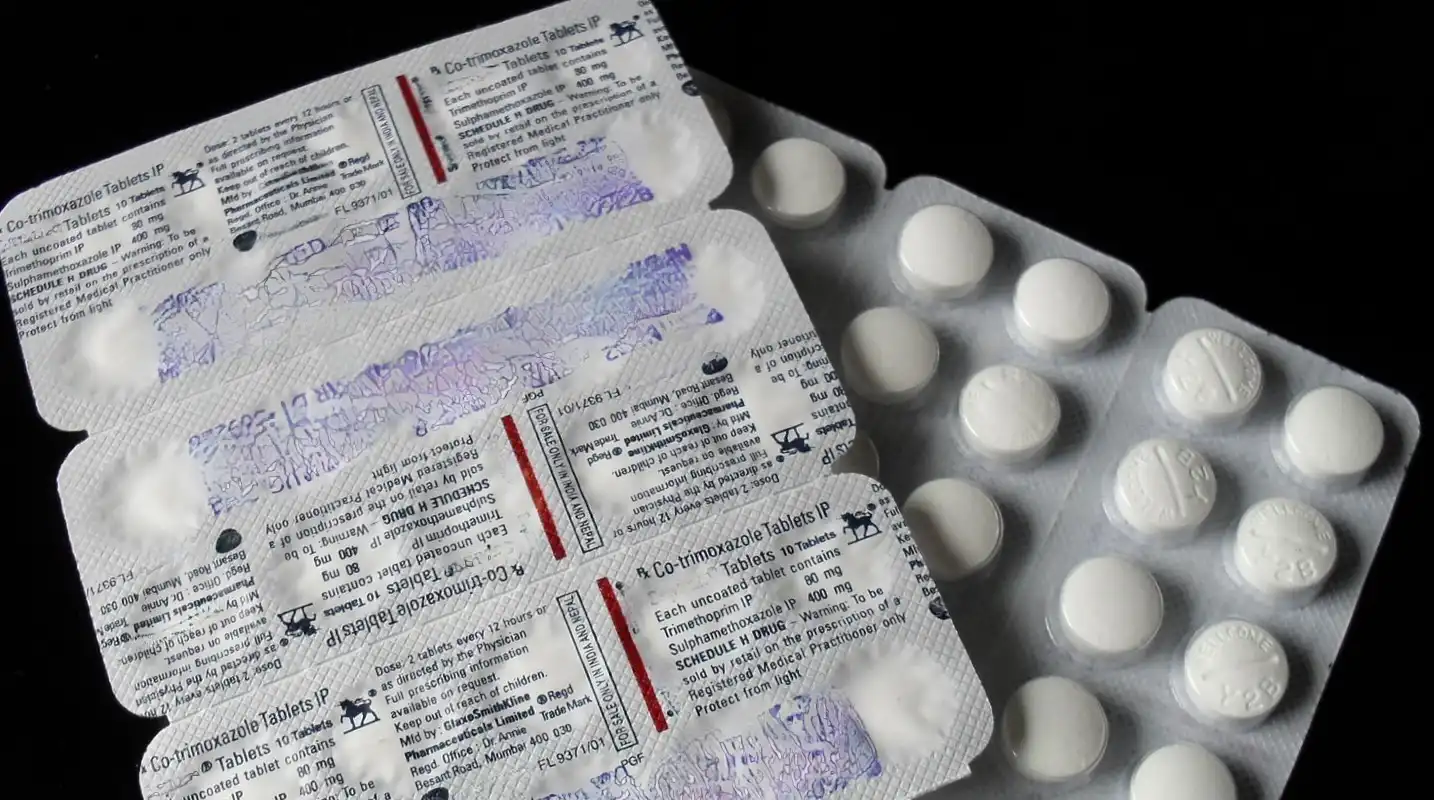
Introduced in 1969, Cotrimoxazole is the fixed dose combination of trimethoprim and sulfamethoxazole.
Trimethoprim is a diaminopyrimidine related to the antimalarial drug pyrimethamine, while, Sulfamethoxazole belongs to the sulfonamide group of antibiotics.
Reasons for the combination:
- Both have nearly the same half-life (~10 hr).
- Individually, both sulfonamide and trimethoprim are bacteriostatic, but the combination becomes cidal against many organisms.
- Maximum synergism is seen when the organism is sensitive to both the components, but even when it is moderately resistant to one component, the action of the other may be enhanced.
- Optimal synergy in case of most organisms is exhibited at a concentration ratio of 20 parts sulfamethoxazole : 1 part trimethoprim , the MIC of each component may be reduced by 3-6 times. This ratio is obtained in the plasma when the two are given in a dose ratio of 5:1, because trimethoprim is more lipid soluble, enters many tissues, has a larger volume of distribution and attains lower plasma concentration than sulfamethoxazole.
Spectrum of Action
The antibacterial action of trimethoprim and sulfamethoxazole resembles and overlap considerably. Most gram-negative and gram-positive microorganisms are sensitive to trimethoprim. Additional organisms covered by the combination are :
- Salmonella typhi, Serratia, Klebsiella, Enterobacter, Yersinia enterocolitica, Pneumocystis jiroveci and
- many sulfonamide-resistant strains of Staph aureus, Strep. pyogenes, Shigella, enteropathogenic E coli, H influenzae, gonococci and meningococci.
Mechanism of Action
The antibacterial action of cotrimoxazole results from sequential block of folate metabolism i.e., its action on two steps of the biosynthetic pathway of tetrahydrofolic acid.
- Trimethoprim selectively inhibits dihydrofolate reductase (DHFRase) enzyme and prevents the reduction of dihydrofolic acid to tetrahydrofolic acid.
- Sulfamethoxazole competitively inhibits dihydropteroate synthase, the bacterial enzyme responsible for incorporation of para-aminobenzoic acid (PABA) into dihydropteroic acid, the immediate precursor of folic acid.
*Trimethoprim : Have more than 5,000 times greater activity against bacterial DHFRase than against the mammalian enzyme and ~100,000 times more drug is required to inhibit human reductase than the bacterial enzyme. Thus, human folate metabolism is not interfered at antibacterial concentrations of trimethoprim.
*Sulfonamides : Sensitive microbes must synthesise their own folic acid. Hence, mammalian cells and bacteria that use preformed folic acid are not affected by sulfonamides.
Resistance
Resistance to trimethoprim mostly occurs through plasmid mediated acquisition of a DHFRase that have lower affinity for the drug.
- Resistance to the combination has been slow to develop compared to either drug alone, but widespread use of the combination over a long period has resulted in reduced responsiveness of over 30% originally sensitive strains.
- Emergence of resistant Staph. aureus and Enterobacteriaceae is a special problem in AIDS patients receiving the drug for prophylaxis of Pneumocystis jiroveci pneumonia.
Pharmacokinetics
Absorption
- Trimethoprim is more rapidly absorbed than sulfamethoxazole - concentration ratios may vary with time.
Distribution
- Trimethoprim is distributed and concentrated rapidly in tissues. Volume of distribution of trimethoprim is almost nine times that of sulfamethoxazole.
- Trimethoprim adequately crosses blood-brain barrier and placenta, while sulfamethoxazole has a poorer entry.
- Trimethoprim is 40% plasma protein bound, while sulfamethoxazole is 65% bound.
- Each drug is found in high concentration in bile.
- Trimethoprim is partly metabolised in liver and excreted in urine.
Metabolism
- Half-life of trimethoprim is ~11 hours, while that of sulfamethoxazole is ~10 hours.
Excretion
- Around 60% of administered trimethoprim and 35-50% sulfamethoxazole are excreted in the urine in 24 hours, of which 2/3rd of sulfamethoxazole is unconjugated.
- Metabolites of trimethoprim are also excreted,
- The rate of excretion and the concentrations of both drugs in the urine are reduced significantly in patients with uremia.
Adverse Effects
Dermatologic reactions : About 75% of adverse effects involve the skin (rashes) and cotrimoxazole is reported to cause up to three times as many skin reactions as sulfamethoxazole given alone.
GI reactions : Nausea, vomiting, glossitis and stomatitis are common, while diarrhea is rare. Transient jaundice with histological features of allergic cholestatic hepatitis has been noted.
CNS reactions : Consists of headache, depression and hallucinations.
Hematological reactions : Include anemias (incl. aplastic, hemolytic and macrocytic), coagulation disorders, granulocytopenia, agranulocytosis, purpura, and sulfhemoglobinemia. Folate deficiency (megaloblastic anaemia) is infrequent, occurs only in patients with marginal folate levels.
Renal effects : A reversible decrease in creatinine clearance has been noted. Patients with renal disease may develop permanent impairment of renal function and uremia. Dose should be reduced in moderately severe renal impairment.
Pregnancy : Cotrimoxazole should not be given during pregnancy. Trimethoprim being an antifolate, there is theoretical teratogenic risk. Neonatal haemolysis and methemoglobinemia can occur it it is given near term.
Elderly patients : Are at risk of bone marrow toxicity.
AIDS patients : Frequently have hypersensitivity reactions including rash, neutropenia, Stevens-Johnson syndrome, Sweet's syndrome and pulmonary infiltrates. In such patients, the therapy can be continued following rapid desensitisation.
Preparations & Dosage
- Trimethoprim (80mg) + Sulfamethoxazole (400mg) : BD for 2 days then 1 BD.
- Trimethoprim (160mg) + Sulfamethoxazole (800mg) (DS) : 1 BD.
- Trimethoprim (20mg) + Sulfamethoxazole (100mg) : Pediatric tablet.
- Trimethoprim (40mg) + Sulfamethoxazole (200mg) per 5 ml susp : BD Infants 2.5 ml, 1-5 yr : 5ml, 6-12 yr : 10 ml. (*Not to be used in infants.)
Indications
Urinary tract infections (uncomplicated lower urinary tract infections)
- Acute cystitis : Single dose therapy with 4 tablets.
- Lower & Upper urinary tract infections : 3-10 days course.
- Chronic or recurrent infections of the urinary tract.
- Bacterial prostatitis (Trimethoprim is concentrated in prostate due to relatively acidic pH of prostatic fluid).
Bacterial respiratory tract infections
- Acute exacerbations of chronic bronchitis.
- Facio-maxillary infections : Acute otitis media in children and acute maxillary sinusitis in adults caused by susceptible H. influenzae, Strep. pneumoniae and Moraxella catarrhalis.
- Should not be used to treat streptococcal pharyngitis as it does not eradicate the microorganism.
Bacterial diarrhoea and dysentery
- May be used for severe and invasive infections by E. coli, Shigella, nontyphoid Salmonella and Y. enterocolitica.
- Fluoroquinolones are more commonly used, as the response rate is lower than previously and resistance is increasingly common. However, it is still a valuable alternative for empirical therapy of infective diarrhoea.
Pneumocystis jiroveci infection
- Severe pneumonia in AIDS patients : Has both prophylactic as well as therapeutic value, but high doses are needed. Adjunctive glucocorticoids should be given in patients with p02 of < 70 mmHg or an alveolar-arterial gradient of > 35 mmHg.
- Prophylaxis in neutropenic patients : Low dose therapy is effective in prevention of infection by P. jiroveci. Significant protection against sepsis caused by gram-negative bacteria was also noted.
References
- Laurence L. Brunton - Goodman & Gilman's Manual of Pharmacology and Therapeutics-McGraw-Hill Medical (2008).
- Essentials of Medical Pharmacology (8th Edition), K.D. Tripathi -Jaypee Brothers Medical Publishers (P) Ltd.
- Basic and Clinical Pharmacology (15th Edition), Bertram G. Katzung, Todd W. Vanderah, McGraw Hill Lange.
*This article is an excerpt from the above mentioned books and Medical Sutras does not make any ownership or affiliation claims.